A Decapitation Strike and Its Cascading Consequences
On February 28, 2026, the United States and Israel launched a coordinated air and missile campaign against Iran, killing Supreme Leader Ali Khamenei and striking nuclear, military, and command infrastructure across the country. Economist and commentator J. Bradford DeLong, writing from well outside his usual terrain of economic history, produces something rare for the moment: a sober, wide-angle assessment of what the strike means not just for Iran, but for the entire architecture of global security.
DeLong opens with the question that matters most and admits he cannot answer it:
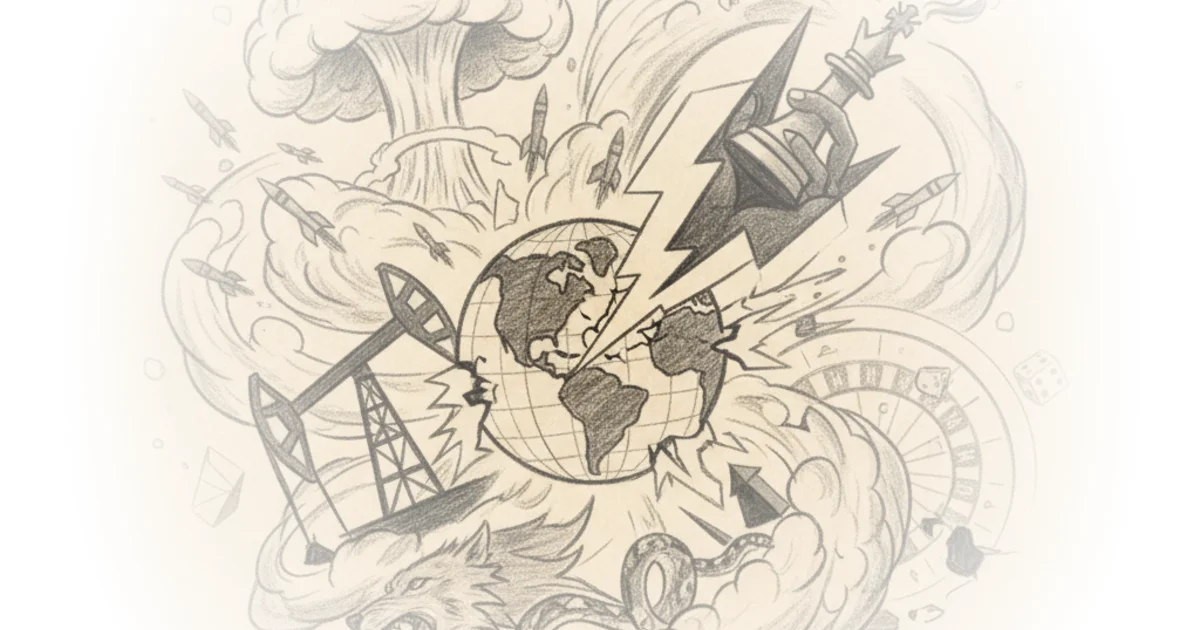
The chances that in fifty years Tel Aviv, Damascus, and more are seas of radioactive glass. Have those fallen or risen as a result of the unconstitutional war against the government of the Islamic Republic of Iran launched this weekend?
That framing alone sets the piece apart from the triumphalist commentary flooding cable news. He is not asking whether the strike succeeded tactically. He is asking whether it moved the probability distribution of civilizational catastrophe in the wrong direction.
The Credibility Collapse
DeLong zeroes in on a devastating contradiction at the heart of the administration's messaging. Even as the bombing campaign was underway, the White House continued to insist that Iran's nuclear program had already been destroyed months earlier. He quotes the administration's own statements from June 2025, when Secretary Marco Rubio declared Iran's nuclear sites "destroyed" and the press secretary announced a "TOTAL and COMPLETE obliteration" of Iran's nuclear facilities.
If that were true, the February 2026 strikes targeting nuclear infrastructure would be unnecessary. DeLong does not belabor the point. He simply lays the contradiction bare and moves on, letting readers draw the obvious conclusion about the reliability of official statements.
Of course, Donald Trump is not a reliable narrator. No one in the Trump administration is a reliable narrator. Plus the U.S. these days cannot be understood, even as shorthand, to be a unitary actor with coherent objectives. It is chaos monkeys all the way down.
The phrase "chaos monkeys all the way down" is memorable, but it also carries analytical weight. DeLong is arguing that the traditional framework of international relations, where states are treated as rational actors with coherent preferences, simply does not apply to the current American government.
The Regime Will Not Simply Collapse
Where hawkish commentators might celebrate the killing of Khamenei as a decisive blow, DeLong pushes back hard. He outlines three possible outcomes of the decapitation: a military junta he calls "IRGCistan," a protracted internal power struggle, or the rapid democratic transition that American hawks implicitly hope for.
The structural odds do not favor (3).
That single sentence carries the weight of decades of failed regime-change experiments, from Iraq to Libya. DeLong notes that Iran's institutions were specifically designed with redundancy to survive exactly this kind of strike. The Islamic Republic is not a personality cult. It is a system with overlapping networks in the military, clergy, and bureaucracy.
His analysis of the Iranian institutional response is sharp. He observes that the regime shifted to "continuity mode" remarkably quickly, with maximalist rhetoric from President Pezeshkian masking a fundamentally conservative institutional move: preserve the system first, sort out succession later.
The Hormuz Problem
DeLong draws an instructive parallel between the Strait of Hormuz and the Bab el-Mandeb, where Houthi forces demonstrated for nearly two years that asymmetric actors can effectively close a maritime chokepoint. The economics are brutal in their simplicity:
They exploited the asymmetry between how much it cost them to keep shooting, how much it cost the U.S. Navy to suppress their capabilities, and how much it costs everyone else to keep sailing.
Twenty million barrels of oil per day transit the Strait of Hormuz, with almost no pipeline alternatives. Even a substantially degraded Iranian military could add enough "stochastic risk" to effectively close the strait. The global economic implications of that scenario dwarf anything seen since the 1973 oil embargo.
It is worth noting that DeLong's analysis here could benefit from more attention to what Gulf states themselves can do defensively. The UAE, Saudi Arabia, and others have invested heavily in missile defense and naval capabilities since the Houthi campaign. The picture may not be quite as bleak as DeLong's framing suggests, though the fundamental asymmetry he identifies is real.
The Proliferation Lesson
The arms-control dimension is where DeLong's argument is most forceful and most alarming. He argues the strike teaches every medium power on earth a single, devastating lesson:
If you are going to rely on nuclear capability as a deterrent, build more, spread it out, harden it, and never trust U.S. claims about what they have taken out.
The logic is difficult to refute. Iran engaged in extended nuclear negotiations, signed the JCPOA in 2015, and was attacked anyway. Whatever the merits of the strike on narrow tactical grounds, the signal it sends to Pyongyang, Islamabad, and any future aspirant state is unambiguous: diplomacy does not protect you. Only an operational nuclear deterrent does.
DeLong extends this argument into even darker territory, suggesting the killing of Khamenei may transform what deterrence itself looks like for the rest of the century. He reaches back to Thomas More's Utopia, quoting at length from a passage about targeting enemy leaders and their families as an alternative to mass warfare. The implication is unsettling: if heads of state can be killed by precision strikes, deterrence logic may evolve toward personal threats against leaders and their families, delivered by bomb, missile, drone, or assassin.
The Strain on American Power
One of DeLong's sharpest observations concerns military bandwidth. Every carrier group, Patriot battery, and sortie committed to the Iran campaign is a resource unavailable for deterring Russia in Eastern Europe or China in the Western Pacific.
Trump has offered no endgame: there are no articulated conditions for success beyond the fall of the regime, no explanation of what follows if Iran fragments or descends into civil war, and no domestic debate rallying support comparable to 2002-03.
The comparison to 2002-03 is pointed. Whatever one thinks of the Iraq War debate, there was at least a debate. Congressional votes were held. Intelligence was presented, however flawed. DeLong notes that this campaign launched without anything comparable, raising constitutional questions he flags but does not explore in depth.
A fair counterpoint: DeLong somewhat understates the degree to which the October 7 attacks and subsequent regional escalation shifted the political landscape. Public opinion polling on Iran has hardened considerably since 2023, and the absence of formal debate may reflect a different political reality rather than pure executive overreach.
Fat Tails
DeLong closes with a concept borrowed from his native discipline of economics, applying it to geopolitics:
Wars are stochastic processes with fat tails. The first 24 hours of this one have not closed off the worst tails; they have thickened them.
A stochastic process with fat tails is one where extreme outcomes are more likely than a normal distribution would predict. DeLong is saying that this war has not reduced the probability of catastrophe. It has increased it. The tail risks, including regional nuclear exchange, energy market collapse, and the unraveling of non-proliferation norms, are all fatter now than they were before the first missile launched.
Bottom Line
DeLong, writing explicitly outside his area of expertise, produces a piece that is more useful than most specialist commentary precisely because he treats the situation as what it is: an enormous, poorly specified gamble with civilizational stakes. He does not pretend to know how it will end. He does not offer policy prescriptions. He simply maps the second-order and third-order consequences that the celebratory coverage ignores: proliferation incentives, energy chokepoints, military overstretch, the death of arms-control credibility, and the normalization of leader assassination as statecraft.
The piece is at its strongest when connecting disparate threads, from Houthi naval strategy to Thomas More's Utopia, into a coherent picture of escalating risk. It is at its weakest when it waves at constitutional questions without engaging them, and when it treats Iranian regime resilience as nearly certain without acknowledging the genuine fragility that years of protests and economic mismanagement have created. But as a first-day assessment written while bombs were still falling, it holds up remarkably well as a guide to what actually matters.