Egor Kotkin delivers a jarring, high-stakes thesis: the current administration's aggressive global posture is not merely policy failure, but a farcical echo of 1930s fascism that, paradoxically, may save the world from a total war. While many analysts fear a repeat of the tragedy of the 1930s, Kotkin argues we are witnessing a grotesque comedy where incompetence acts as a brake on catastrophe. This is not a comforting read, but it offers a distinct framework for understanding why the administration's self-sabotage might be the only thing preventing a global conflagration.
The Farce of Fascism
Kotkin opens by acknowledging the immediate, crushing human cost of the administration's actions, specifically citing the slashing of global health programs. He writes, "the 'doged' by Musk $4 billion per year on programs to combat malaria, HIV, tuberculosis, hunger, illiteracy, etc. in the poorest countries of the world... without which tens of thousands will die." The author is clear that no historical analysis can absolve the administration of this suffering. However, he pivots quickly to a macro-historical view, suggesting that while the intent mirrors the rise of fascism, the execution lacks the terrifying efficiency of the past.
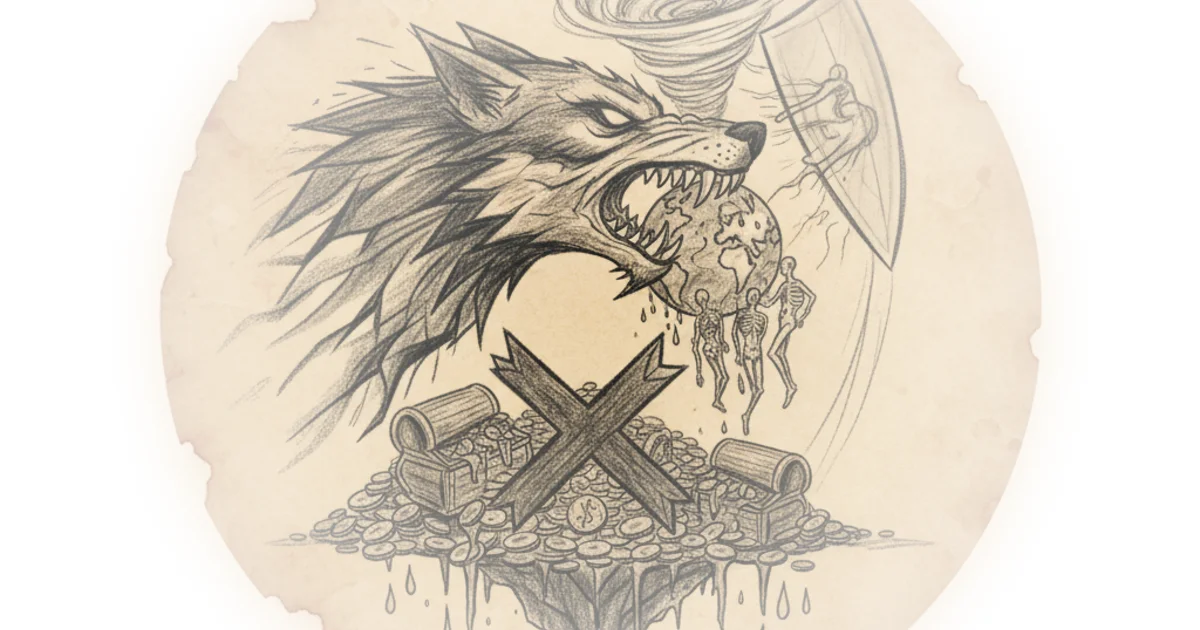
The core of Kotkin's argument rests on a comparison to the Weimar Republic, but with a crucial twist. He posits that "neoliberal America plays the role of Weimar Germany, and 2) there's no USSR." Without a counter-force, the conditions for fascism seemed ripe. Yet, the author observes a dissonance in the current leadership. "From day one of Trump's return, the process of turning Trump's power into a Trump regime caused mixed feelings: on one hand, all elements of classical fascism are in place... On the other, even its execution feels like some kind of clown show." This duality is the piece's most provocative claim: that the very nature of the current leadership prevents the consolidation of power required for a true totalitarian state.
"We (all of humanity) got lucky—the 1930s are indeed repeating, but this time—as a farce."
Kotkin leans heavily on a paraphrase of Karl Marx to drive this point home, mapping current figures onto historical archetypes: "Caussidière instead of Danton, Louis Blanc instead of Robespierre, Donald Trump instead of Adolf Hitler." He argues that the administration's psychological need for domination is real, but the capacity to organize the state for total war is absent. "Trump's character, ideally suited to take the place of the Fuhrer, that he plays on television, is also hinders for the development of fascism in its most dangerous phase, where it requires to perform the functions of the Fuhrer in reality." The author suggests that the administration is too busy cashing in on political capital to build the machinery of a true dictatorship.
The Dialectics of Self-Destruction
The commentary then shifts to the mechanics of fascist power, which Kotkin defines as an attempt to stop capitalist disintegration through centralized force. He argues that this system is inherently unstable because "fascism cannot exist without enemies to dominate." When real enemies are scarce, the administration must create them, leading to a scenario where "everyone else is the enemy and it fights against the whole world."
This logic drives the administration toward a trade war, which Kotkin identifies as the catalyst for its own undoing. He writes, "Trump shows how attempts to pin down the failures of capitalism on an arbitrary group of people... inevitably results in pain for everyone." The author outlines a grim trajectory where the administration, facing the failure of economic coercion, will inevitably seek a "small victorious war" to rally support. However, he argues that the incompetence of the current leadership makes a sustained, large-scale conflict unlikely to succeed.
Critics might note that this analysis underestimates the resilience of authoritarian regimes to absorb economic pain or the willingness of the military to intervene in domestic politics to preserve order. Kotkin acknowledges the risk of a military crackdown but suggests the administration's "competency tax" is too high to sustain a full-blown dictatorship. He notes that "Trump's expansionist plans regarding Canada, Greenland, the Panama Canal, and intentions to deal with Iran" are clear, but the execution is flawed. "Attacking Iran, Trump steps on the escalation ladder to hell... the most he can achieve from the air is to make Iran respond with blowing up Saudis oil facilities and blocking the gulf of Persia."
The author's most counter-intuitive point is that the trade war itself is a form of defense. "The trade world war that shocked so many is the best news that could happen when the fascists are already in power." By engaging the entire world in a trade war, the administration is exhausting its political and institutional resources, leaving it unable to pursue the more dangerous path of a conventional military war or a domestic coup. "Engaging Trump in the stupidest possible war on the biggest possible scale is actually postpones real wars and limits his ability to wage them in the future."
The Cost of the Farce
Kotkin does not sugarcoat the human toll of this dynamic. He warns that "the pain they will cause will also be limited" only in comparison to the alternative, but the suffering is still immense. The author concludes with a Russian proverb: "Thank you, God, that you took it in money," suggesting that the economic pain of the trade war is a payment to avert a much worse fate. "Economic pain of Trump's trade war is paying a waiver of the pain of real war."
The piece ends with a call for global resistance, not to stop the trade war, but to accelerate it. "Essentially, Trump has offered the world a noose against America... which the world instead of shying away, must accept and strangle Trump's America with it as hard as possible." The logic is that a coordinated global pushback will force the administration to collapse under the weight of its own contradictions before it can launch a global war. "It won't kill America or the world, it will only break the neck of American fascism."
"The intent might be the same, the potential to do harm might be even greater, but as long as current generation of fascists is that much more inept... the pain they will cause will also be limited."
Bottom Line
Kotkin's argument is a bold, if unsettling, reframe of current events: the administration's incompetence is the primary barrier to a second world war. Its strongest asset is the historical parallel it draws between the structural conditions of the 1930s and today, while its greatest vulnerability is the assumption that the military and institutional guardrails will hold against an administration actively dismantling them. Readers should watch for whether the administration's "small victorious war" impulses can be contained by economic pressure, or if the farce turns into a tragedy after all.