Noah Smith cuts through the noise of impending mass unemployment with a counterintuitive thesis: AI isn't killing jobs today; it is simply rewriting the job descriptions. While headlines scream about displacement, Smith points to near-all-time high employment rates and a surprising resilience in sectors like radiology, arguing that the real shift is a structural reorganization of labor rather than a reduction in headcount.
The Illusion of Displacement
Smith begins by dismantling the most common fear: that artificial intelligence will immediately render human workers obsolete. He notes that "employment rates for prime-age workers in the U.S. are hovering near all-time highs," a fact that contradicts the doom-laden predictions of many tech pundits. Even in fields where AI was expected to dominate, the reality is more nuanced. "Geoffrey Hinton, one of the pioneers of modern AI, famously predicted the imminent displacement of all radiologists by AI algorithms; in fact, radiologists are in greater demand than ever." This observation is crucial because it highlights the "jagged" nature of AI capabilities; the technology excels at specific tasks but fails to replicate the full bundle of responsibilities required in many professions.
The author leans on recent research to support this, citing Humlum and Vestergaard (2026), who found that while AI adoption boosts productivity, it has resulted in "precise null effects on earnings and recorded hours." The core of the argument is that employers are absorbing AI through task reorganization rather than layoffs. Smith writes, "In other words, so far, AI is replacing tasks, not jobs." This distinction is vital for policymakers and workers alike, as it suggests that the immediate challenge is adaptation, not survival. However, this stability is fragile. Critics might note that the "null effects" observed in Denmark over two years may not hold if AI capabilities accelerate exponentially, potentially hitting a tipping point where task replacement becomes job replacement much faster than historical precedents suggest.
"AI is replacing tasks, not jobs."
The Three Pillars of Future Work
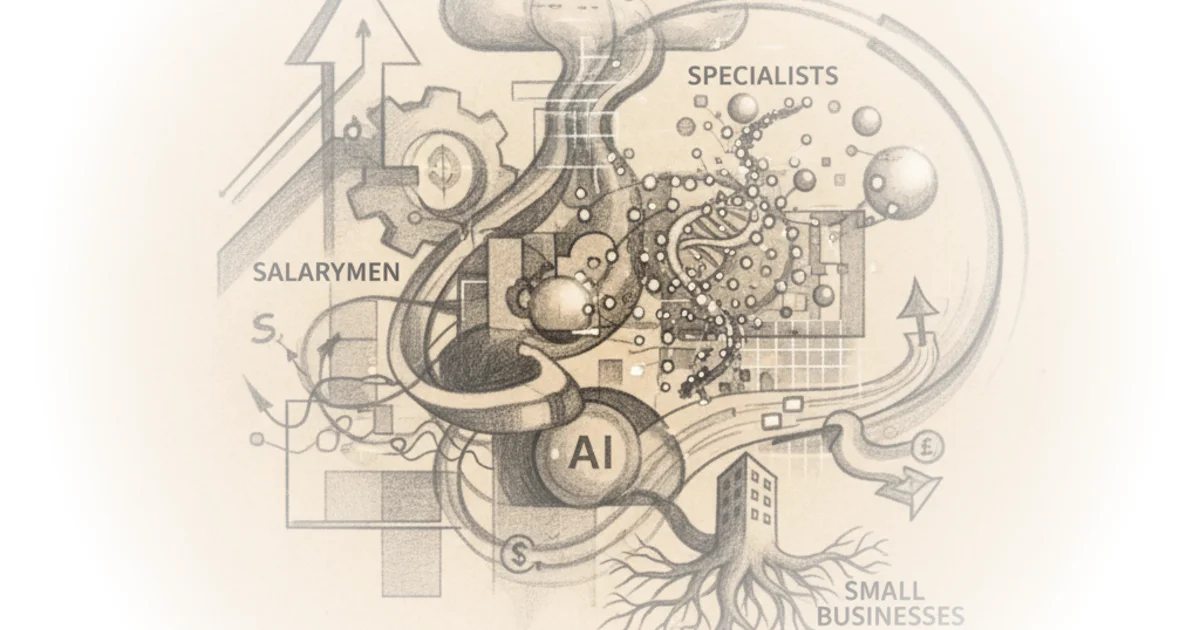
If the current model is task-shifting, what does the future hold? Smith proposes a tripartite division of the labor market: specialists, generalists (or "salarymen"), and small business owners. He draws on a theory by Garicano, Li, and Wu regarding "strongly bundled" versus "weakly bundled" tasks. In strongly bundled jobs, the tasks are so interconnected that one person must do them all; these are the roles most resistant to automation. "The paper's basic conclusion is that AI tends to replace weakly bundled jobs a lot more quickly than it replaces strongly bundled ones." This explains why a radiologist remains indispensable despite AI's ability to read scans; the human element involves diagnosis, patient communication, and liability, which are tightly woven into the role.
"Writing communicates a unique human perspective; simply pressing a button to generate text doesn't say what you want to say."
For those in weakly bundled roles, the path forward is less clear. Smith argues that companies will increasingly need generalists who can navigate the unpredictable strengths and weaknesses of AI. He cites Cedric Savarese to illustrate this new dynamic: "You learn to recognize the confidently incorrect, you learn to push back and cross-check, you learn to trust and verify." The role of the worker shifts from being a producer of code or content to being an "AI wrangler" who manages the gaps in the machine's logic. This is a profound shift in human capital. Instead of deep, narrow expertise, value lies in mental flexibility and the ability to learn rapidly.
The Return of the Salaryman
Perhaps the most provocative element of Smith's commentary is his comparison of the emerging American labor market to the Japanese "salaryman" model of the mid-20th century. Historically, this system involved rotating employees through various divisions, creating workers who were interchangeable but deeply embedded in their specific company's culture. Smith suggests this inefficiency is now a strategic advantage. "When human expertise is replaced by AI expertise, humans' role may be to flit from task to task, doing whatever the AI is bad at, and supervising AI at whatever it's good at."
This model naturally fosters long-term employment. If a worker's value comes from understanding a specific company's idiosyncrasies and networks rather than portable technical skills, they are less likely to leave. Smith observes, "We're in a 'no-hire, no fire' economy — workers are hunkering down in their jobs and refusing to switch." This aligns with the concept of firm-specific human capital, where the "salaryman" becomes the ideal employee for an AI-driven era. A counterargument worth considering is that this model could stifle innovation and wage growth, as workers become trapped in firms where their specific skills are devalued by the very technology they are managing. Yet, in a landscape of rapid technological churn, the stability of the salaryman model offers a compelling, if unglamorous, refuge.
The Rise of the Solopreneur
The third pillar of Smith's vision is the explosion of small businesses and self-employment. AI provides immense leverage, allowing a single individual to perform the work of a small team. "AI creates leverage; it allows you to do more with a smaller team." Smith predicts that the optimal size for many businesses will shrink to one or two people, mirroring Japan's high prevalence of small and medium-sized enterprises. This suggests a future where the "small businessperson" manages a fleet of AI agents to deliver goods or services directly to consumers.
This shift challenges the traditional corporate ladder. For those who are not "specialists" with irreplaceable skills, the choice becomes binary: become a generalist inside a large corporation or strike out as an independent operator. Smith admits this is "not the most optimistic or enticing view of the future of work," particularly for those who built their identities on specific technical skills. Yet, it offers a pragmatic path forward that avoids the dystopian scenario of total human obsolescence.
"Instead of people who do 'payroll' or 'back-end engineering' or 'accounting', companies will need to hire people who can do a little bit of everything, if and when the AI messes something up."
Bottom Line
Smith's strongest contribution is reframing the AI narrative from one of mass unemployment to one of structural reorganization, grounded in the distinction between task replacement and job elimination. However, his reliance on the "salaryman" model as a solution overlooks the potential for this system to create a stagnant, low-mobility workforce where human agency is reduced to mere error-correction. Readers should watch for whether the "no-hire, no-fire" trend solidifies into a permanent feature of the economy or if a new wave of automation finally breaks the "strongly bundled" defense of specialized roles.