Most calls for a general strike are performative, but Eric Blanc argues that the recent surge in Minneapolis proves a different path is possible—one that relies on raw, spontaneous momentum rather than top-down union scheduling. This piece cuts through the noise of viral social media campaigns to offer a sobering, data-driven assessment of what it actually takes to paralyze an economy in the face of authoritarian overreach.
Defining the Stakes
Blanc begins by dismantling the semantic confusion that has plagued recent labor discussions. He insists that a true general strike must "paralyze multiple major industries," distinguishing it from the modest walkouts and small business closures that characterized the January 30 national call to action. While the recent online mobilization was well-intentioned, Blanc notes that "economic disruption was minimal," with only a handful of sectors, like the Grey's Anatomy production, actually halting operations.
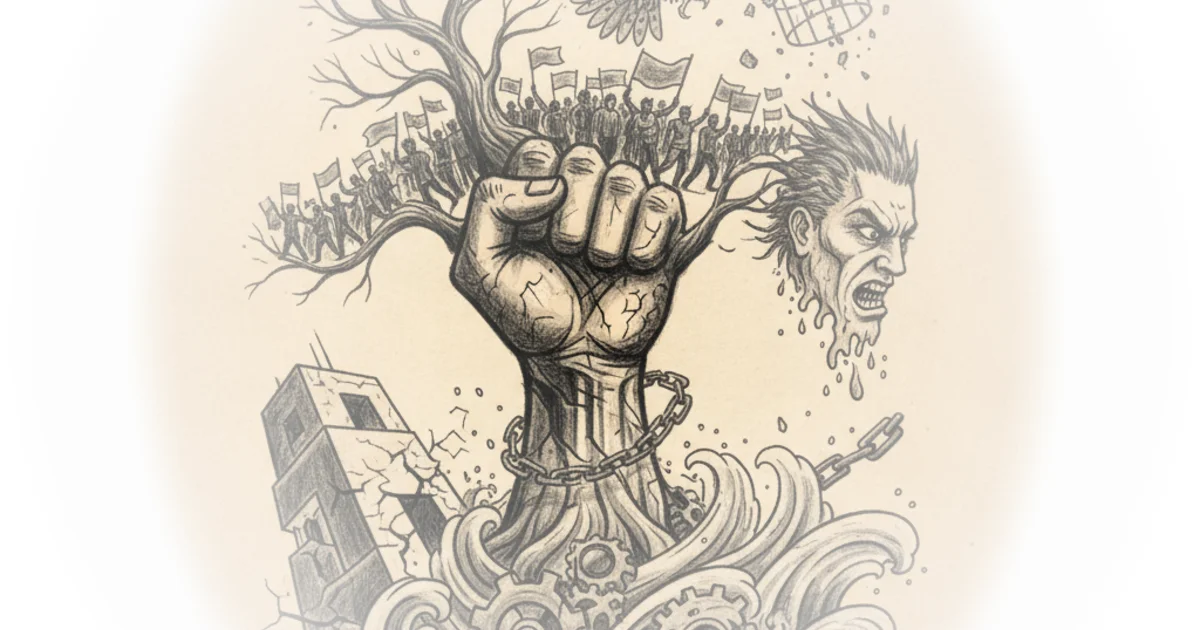
The author contrasts this with the January 23 "Day of Truth and Freedom" in Minneapolis, where over 75,000 people flooded downtown despite freezing temperatures. This event, Blanc argues, offered a glimpse of genuine power. He quotes SEIU Local 26 president Greg Nammacher, who told the Dig podcast, "We achieved things [on January 23] that were not imaginable two weeks before. … It really did feel like history to our members." This distinction is crucial: it moves the conversation from abstract solidarity to tangible, disruptive capacity. However, Blanc is quick to temper this triumph, noting that even this massive turnout "did not seriously disrupt the major corporations that prop up ICE and the [current] administration."
It takes much more than a viral social media post to shut down the economy.
The Engine of Momentum
The core of Blanc's argument rests on a historical materialist view of labor power: strikes are not planned in a vacuum; they are sparked by crisis. He traces the lineage of successful general strikes back to moments of intense emotional and political rupture, citing the 1934 San Francisco general strike which erupted after the police murder of striking workers on "Bloody Thursday." Blanc writes, "Almost every general strike in US history has been sparked by a much smaller labor struggle whose dynamism, popularity, and confrontations with authorities generate enough momentum for large numbers of other workers to suddenly jump in to show solidarity."
This framing challenges the traditional union strategy of long-term, incremental preparation. Blanc suggests that relying solely on "one-on-one conversations with all your co-workers" is insufficient when the political atmosphere is not yet "hot enough." He points to the Minneapolis surge, which was catalyzed not by a union calendar but by the brutal actions of Immigration and Customs Enforcement and the murders of citizens, as proof that "mass consciousness advanced quicker in a few weeks than over two decades of ambitious, deep organizing for change."
Critics might argue that this reliance on external tragedy as a catalyst is a dangerous strategy, effectively waiting for violence to galvanize the public. Blanc acknowledges this grim reality, noting that while the deaths of white citizens sparked outrage, the killings of immigrants like Silverio Villegas González did not generate similar momentum. He warns, "We can't rely on the regime to provide organizing energy for us."
The Trap of Fixed Dates
Blanc offers a sharp critique of the labor movement's fixation on future dates, specifically the projected May Day 2028 general strike. He argues that while setting a target date can inspire, it risks becoming a distraction if it ignores the immediate need to seize "whirlwind moments." He contrasts the 1886 May Day strikes, which were built on years of escalating economic demands for the eight-hour day, with today's political landscape. "As important as economic strikes are for empowering workers and raising wages today, they won't generate momentum directly against ICE or [the current] administration," Blanc asserts.
The author suggests that the focus should shift to "winning fight-backs against ICE" that can serve as onramps for broader disruption. He highlights the successful campaign to force Avelo Airlines to break ties with ICE as a model for this approach. This pragmatic pivot is the piece's most actionable insight, moving away from the abstract goal of a future shutdown toward immediate, winnable battles that build the necessary muscle for larger actions.
We need an orientation to seizing whirlwind moments and launching escalating fights for winnable demands.
Bottom Line
Eric Blanc's most compelling contribution is his rejection of the idea that a general strike can be engineered through social media hype or rigid union timelines; instead, he posits that it must be forged in the fires of immediate, high-stakes conflict. The argument's greatest vulnerability lies in its reliance on the unpredictable nature of mass outrage, yet it offers a necessary corrective to the labor movement's tendency to over-plan and under-act. Readers should watch for how organizers translate the spontaneous energy of Minneapolis into sustained, structural power before the next moment of crisis passes.