In a landscape often dominated by abstract policy debates, Dr. John Campbell delivers a visceral, ground-level report from eastern Uganda that reframes global health not as a matter of expensive pharmaceuticals, but of simple engineering. He argues that the most profound medical intervention available to developing nations is not a new drug, but a seventy-meter-deep borehole that bypasses surface contamination entirely. This is not a story of aid dependency; it is a case study in how clean water acts as the foundational nutrient for both human survival and economic viability.
The Engineering of Survival
Campbell's coverage begins by dismantling the assumption that water access is merely a logistical hurdle. He highlights the specific technical design of the Buanga Way to Health Project, noting that the pipe extends "more than 70 m deep" with "full casing" to ensure structural integrity. This detail is crucial because, as Campbell explains, the casing prevents surface pollutants from seeping into the aquifer. He contrasts this with traditional shallow wells, which are prone to fecal contamination and often require exhausting manual labor to access.
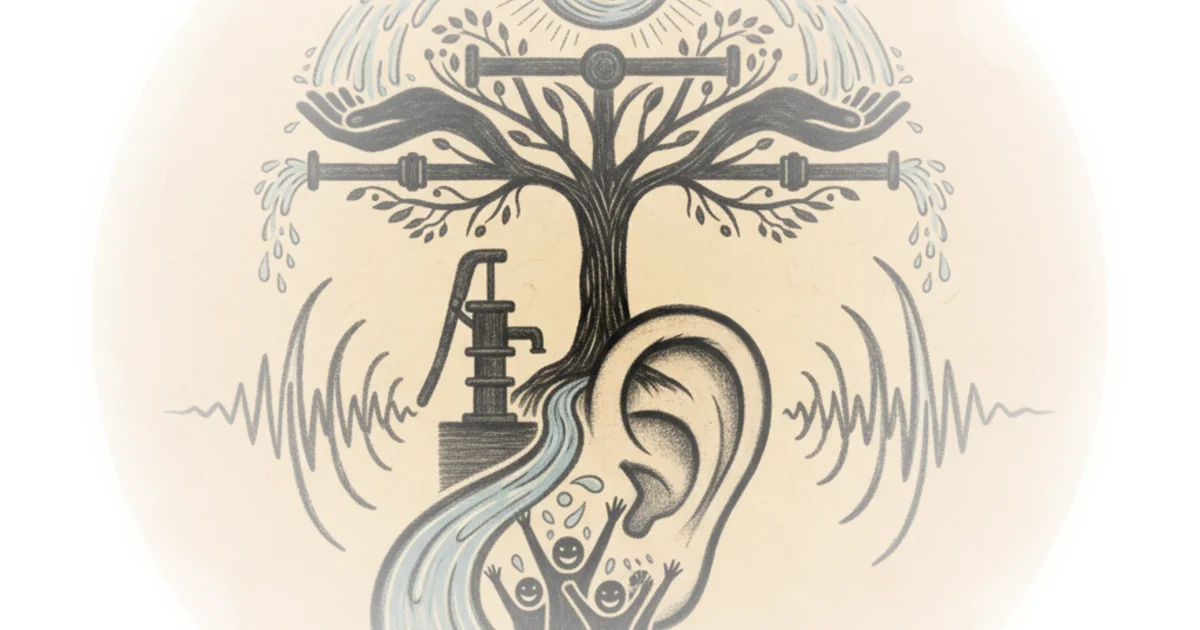
The author's most compelling argument rests on the physiological stakes of this engineering. He points out that for a six-month-old infant, the total blood volume is only about 500 milliliters. "Children can become dehydrated really quickly," Campbell warns, noting that gastrointestinal illness can be fatal in a matter of hours because the body lacks the fluid reserve to compensate for rapid loss. By shifting the water source from a contaminated surface well to a deep, gravity-fed system, the project effectively removes the primary vector for cholera and dysentery. This evidence holds up well; the correlation between deep aquifer access and reduced waterborne disease is well-documented in public health literature, yet Campbell's on-the-ground verification adds a layer of immediacy often missing from clinical studies.
"It's such a simple intervention and yet tragically in so many places people don't have access to that and are still suffering from all these waterborn diseases the fecal oral diseases."
Critics might argue that focusing on a single borehole overlooks the broader systemic issues of sanitation infrastructure, such as sewage treatment and waste management, which are equally vital. However, Campbell anticipates this by framing the water project as a necessary first step: without safe hydration, no other health measure can succeed.
From Health to Economic Empowerment
The narrative shifts from pure survival to economic regeneration, a transition that distinguishes this piece from standard humanitarian reporting. Campbell details how the reliable water supply has unlocked agricultural potential, specifically for coffee seedlings that would otherwise perish during the dry season. He notes that the project has increased agricultural production by an estimated 50%, allowing families to move from subsistence farming to small-scale commerce. "This money is able to help families," he observes, describing how residents sell bananas and coffee to generate income.
This economic angle is the piece's strongest differentiator. Campbell posits that health and wealth are not separate goals but are inextricably linked through the mechanism of water. He describes a model where profits from the coffee nursery are reinvested into medical camps and community health initiatives, creating a self-sustaining loop. "I see this as just a short-term measure. It's not about aid, it's about empowerment," he asserts, emphasizing that the goal is to enable the community to dig their own fields and sustain their own economy.
"Someone can't work if they're sick. But if we can make them healthier and they can come out and dig the fields and sort the water out and plant the coffee, you know, this is all very positive."
While the optimism is warranted, a counterargument worth considering is the vulnerability of such localized models to climate volatility. If the region faces prolonged droughts beyond the current capacity of the pumps, the entire economic model could falter. Campbell acknowledges the heat and the need for irrigation, but the long-term resilience of the water table itself remains a variable not fully explored.
A Legacy Beyond the Present
The emotional core of Campbell's report is the memorial aspect of the project, sponsored by Julie in honor of her late husband, David. This personalizes the infrastructure, transforming a borehole into a living tribute. Campbell reflects on the longevity of the project, stating, "This is going to go on for for generations. We hope." He frames the initiative as a blueprint for the rest of Africa, suggesting that the combination of deep-water access and agricultural support could be replicated elsewhere.
The author's tone here is reflective yet urgent. He recognizes that while the immediate health crisis is being addressed, the true victory is the creation of a system that outlives the initial donors and organizers. The integration of the coffee nursery, with plans to distribute 100,000 seedlings, serves as a tangible metric of this future growth. It is a reminder that public health is not just about preventing death, but about enabling life.
"And then this will outlive you and me. This is going to go on for for generations. We hope."
Bottom Line
Dr. John Campbell's coverage succeeds by grounding complex public health theory in the tangible reality of a single community's transformation, proving that the most effective medicine is often clean water. The argument's greatest strength is its holistic view of health as a prerequisite for economic independence, though it leaves the long-term climate resilience of the water source as an open question. Readers should watch for how this model scales, as the transition from a single successful borehole to a regional network will determine its true global impact.