Most people remember penicillin as a lucky accident—a moldy petri dish and a brilliant lone scientist. This piece argues that such a narrative is not just incomplete, but dangerous, because it obscures the industrial and political coordination that actually saved millions of lives. Hiya Jain, a recent Columbia University graduate, reframes the history of the drug not as a story of serendipity, but as a blueprint for how the United States can solve modern scientific bottlenecks. The urgency here is palpable: if we romanticize the "lone genius," we risk underfunding the messy, collaborative machinery required to turn a lab discovery into a life-saving reality.
The Myth of the Lone Genius
Jain begins by dismantling the popular folklore surrounding Alexander Fleming. While the discovery in 1928 was indeed a moment of "fate," Jain points out that attributing the drug's success solely to this moment ignores a decade of stagnation. "For over ten years, the antibiotic, one of our first effective defenses against the largest cause of human mortality, languished in the lab," she writes. This is a crucial distinction. The discovery was the spark, but without a massive, coordinated effort to scale production, that spark would have died out before it could warm the world.
The author effectively contrasts the romanticized narrative with the grim reality of the 1930s, where doctors could only offer "good nursing care and general supportive treatment" against killers like staphylococci and pneumococci. By highlighting the limitations of the era's only other option, sulfa drugs, Jain sets the stage for why the subsequent industrial push was not just helpful, but existential. The argument lands because it shifts the focus from the origin of the idea to the implementation of the solution. A counterargument worth considering is that without Fleming's initial foresight, no amount of coordination would have mattered; however, Jain's point is that foresight is useless without the capacity to execute.
The Industrial Gamble
The most compelling section of the piece details the massive risk taken by the private sector. When the technology moved to the United States, it wasn't a smooth transition. The mold was "as temperamental as an opera singer," and the yields were notoriously low. Yet, amidst the chaos of World War II, companies like Pfizer decided to gamble their resources on a fragile biological process. "On March 1, 1944 Pfizer's penicillin plant opened... soon the company was producing five times more penicillin than originally estimated," Jain notes. This rapid scaling was not accidental; it was the result of a deliberate, high-stakes industrial strategy.
The narrative here is powerful because it humanizes the machinery. It wasn't just about building tanks; it was about convincing skeptical boardrooms that a "fragile mold" could be mass-produced. The text highlights the specific engineering challenges, such as the need for deep-tank fermentation to keep the mold alive in large vats. This section serves as a stark reminder that scientific breakthroughs often hit a wall when they try to move from the bench to the factory. The author's choice to focus on the "dry stable preparation" and the "enormous effort" required to produce mere grams of powder underscores the sheer difficulty of the task.
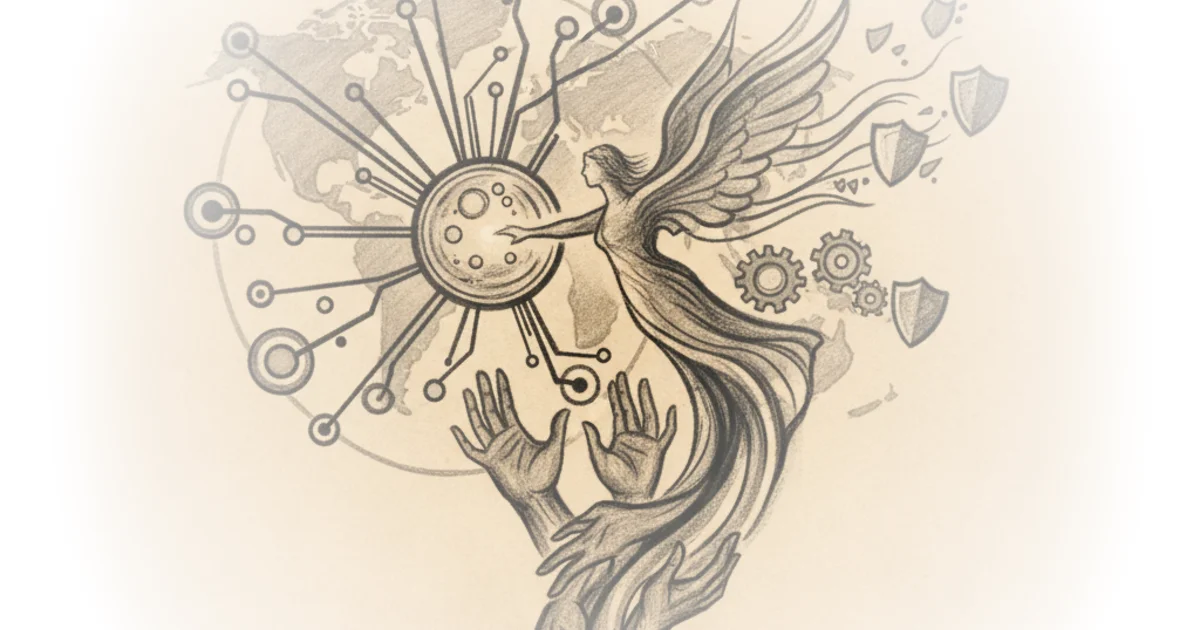
The lesson of penicillin is that scientific miracles may often be accidental in their origins, but the ultimate impact depends on larger systems designed around implementation.
The Power of Coordination
Jain argues that the true miracle of penicillin was the creation of a unique public-private partnership. The Committee for Medical Research (CMR) acted as a clearinghouse, forcing competing pharmaceutical firms to share their data. "Each firm agreed to conduct independent production research and present its findings to the CMR, which served as a clearinghouse for these findings," she explains. This structure broke down the silos that typically plague modern research, where companies guard their trade secrets fiercely. The result was a rapid acceleration in production techniques, including the discovery of a superior mold strain on a rotting cantaloupe in Peoria, Illinois.
The piece suggests that this model of "information-sharing agreement" is the missing link in today's scientific ecosystem. Jain contrasts the wartime urgency with the current state of the National Institutes of Health (NIH), which she argues "often rewards incremental proposals over ambitious ones and buries investigators in administrative overhead." This comparison is the piece's most provocative claim. It suggests that the bottleneck isn't a lack of brilliant ideas, but a lack of the institutional will to coordinate them. Critics might note that the wartime emergency created a level of urgency and resource allocation that is impossible to replicate in peacetime, but the underlying principle of coordination remains valid.
Bottom Line
Jain's strongest contribution is her insistence that the "miracle" of penicillin was a product of systemic design, not just individual brilliance. Her argument is vulnerable to the counterpoint that modern regulatory environments are far more complex than those of the 1940s, making a direct replication of the wartime model difficult. However, the core takeaway is undeniable: if the United States wants to solve its next great scientific challenges, it must stop waiting for luck and start building the infrastructure to make luck count.