Tom van der Linden does something rare in year-end film lists: he admits to breaking his own rules, then uses that breach to reveal why Eternity—a movie with a premise that sounds like a fever dream—deserves to be the crown jewel of 2025. While most critics chase the biggest blockbusters or the most obscure arthouse darlings, van der Linden argues that the year's most profound cinema is found in films that weaponize absurdity to expose the quiet desperation of modern life. He doesn't just rank movies; he curates a conversation about how we choose to live when the machine we serve suddenly stops caring.
The Art of the Broken List
The piece opens with a confession that immediately disarms the reader. van der Linden explains that he had already finalized his top ten list before Eternity forced its way in, creating a logical impossibility that he embraces with humor. "I actually have a few more honorable mentions, but I'm going to pair those with the favorites as I actually found a bunch of thematic connections this year that I think would make for great double features," he notes, setting the stage for a list driven by resonance rather than rigid metrics. This approach signals to the audience that the value lies not in the ranking itself, but in the connections between the films.
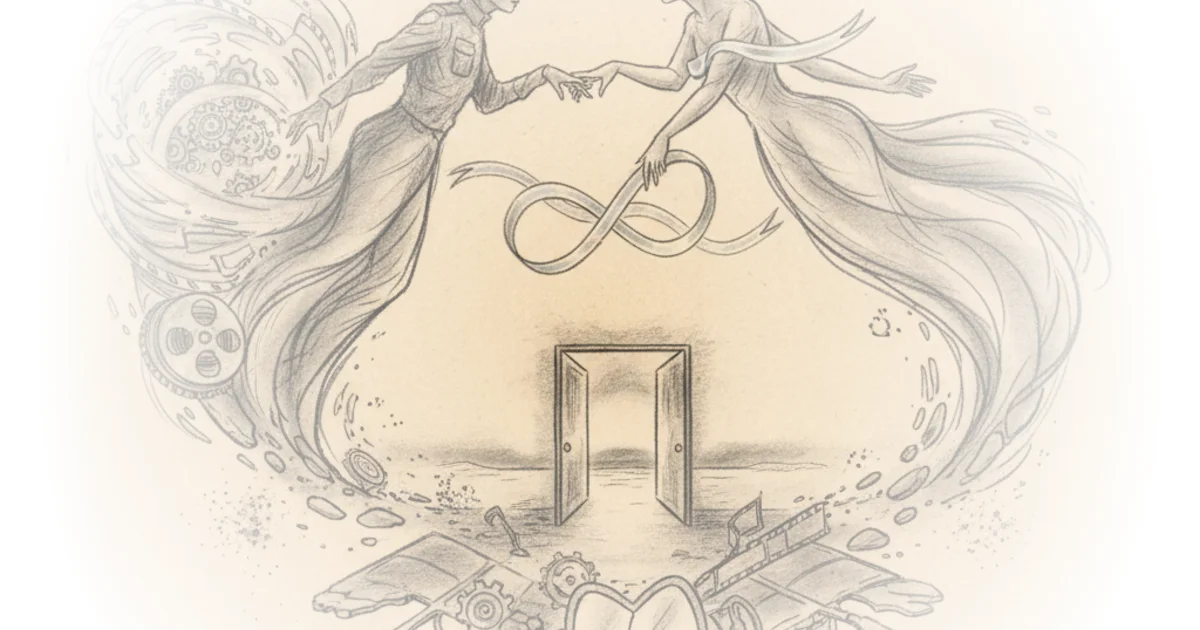
The core of his argument for Eternity is that its sci-fi premise is merely a vehicle for a deeply human truth about choice and limitation. He writes, "It's not just a romantic comedy that argues for real love instead of fiery passion. No, it's also a deeply sincere rumination about what it means to embrace the life that you've been given." This reframing is powerful because it elevates a movie that could easily be dismissed as a "goofy" concept into a philosophical treatise. van der Linden suggests that the film's rigid rules of the afterlife mirror the way our own lives are shaped by the paths we take and the ones we lose forever. As he puts it, "When we have agency to choose, picking certain options permanently locks out others."
"Cinema is always full of surprises."
Critics might argue that forcing a movie into a "top eleven" list undermines the integrity of a curated selection, but van der Linden's transparency about the process actually strengthens his credibility. He isn't pretending to be an algorithm; he's admitting to being moved. He compares the film's impact to It's a Wonderful Life, noting that both films succeed not by revealing new truths, but by "offering a creative perspective, a supernatural spin on this dormant everyday truth in order to emotionally reawaken it."
The Absurdity of the Modern Condition
Moving beyond the personal, van der Linden identifies a distinct trend in 2025 cinema: the use of dark comedy to process the growing absurdity of societal structures. He highlights films like Edington, Weapons, and Bugonia as capturing "various societal changes we've clearly been suffering from." However, he saves his highest praise for Park Chan-wook's No Other Choice, which he argues transcends the typical class-struggle narrative.
The author's analysis of No Other Choice is particularly sharp because it rejects the easy reading of the film as a story about poverty. Instead, he observes that the protagonist's crisis is about the loss of comfort, not survival. "Mansu's struggle mainly reveals his own inflexibility and how the attachment to his lifestyle also keeps him utterly enslaved to the same machine that spit him out so indifferently," van der Linden writes. This is a crucial distinction. It shifts the blame from the system alone to the individual's inability to let go, making the film a more complex critique of capitalism. He describes the film as an "accelerating dark comedy about the growing power of our capitalist overlords, about dehumanization, and about the amount of evil we're actually willing to live with for the illusion of security."
The comparison to David Fincher is apt, but van der Linden goes further, crediting Park Chan-wook with a "creative genius" that surpasses mere slickness. He argues that the film's true horror isn't the violence, but the lengths the protagonist will go to reclaim a status that no longer exists. This perspective invites the reader to look at their own anxieties about status and security with a new, more critical eye.
The Weight of Responsibility
The list then pivots to the theme of motherhood, a topic van der Linden treats with a blend of empathy and unflinching realism. He pairs Thy Will Be Done with If I Had Legs I'd Kick You, describing the latter as "the ultimate encapsulation of a mother who has to juggle 100 balls at once and who constantly feels like she's 2 seconds away from dropping them all." The description of the film's atmosphere is visceral; he notes that the director "always keeps the camera close on the skin of our exhausted main character, which viscerally emphasizes her inner state where everything around her feels like this giant nebulous weight that is constantly pressing down on her."
This section of the commentary is effective because it validates a feeling that is often privatized and stigmatized: the sense of being overwhelmed to the point of collapse. van der Linden argues that the film's power lies in its ability to offer "solidarity and understanding" to those who feel they are on the verge of breaking. He writes, "It just captures so well not just the stress of her specific situation, but also the more general idea of feeling so overwhelmed by responsibilities and by things going wrong beyond your control that you can no longer distinguish noise from signal."
A counterargument worth considering is whether this focus on individual psychological collapse risks ignoring the systemic failures that create such pressure in the first place. While van der Linden acknowledges the "perpetual emergency" of the character's life, the film's internal focus might leave some readers wanting a broader political critique. However, the author's point is that the personal is political, and the sheer intensity of the character's experience is a critique in itself.
The Witness and the Archive
Finally, van der Linden turns to Train Dreams, a film that offers a stark contrast to the high-stress modernity of the other entries. He describes it as a story that "maintains a certain distance," looking back at a life that is already gone. This perspective, he argues, is where the film's unique power lies. "It reminded me of a quote from Cormac McCarthy's The Crossing which said that the lesson of a life can never be its own. Only the witness has power to take its measure," he writes.
This is a profound observation about the nature of historical storytelling. van der Linden suggests that while we often seek to identify with characters, there is a different, perhaps more mature, emotional power in simply witnessing a life unfold and fade. He notes that the film is "not always very subtle about its philosophizing," but argues that this didacticism is necessary to give the audience the "greater vantage point" needed to see the "greater ramifications of time and history that so indifferently and so inexplicably moved past the life of this poor man."
"The lesson of a life can never be its own. Only the witness has power to take its measure."
The author's ability to connect a specific film technique (the distant perspective) to a universal philosophical question (the meaning of a life) is the strongest element of his coverage. It transforms a movie review into a meditation on mortality and memory. He concludes that the film allows the audience to find meaning in a life that the protagonist himself could never fully grasp, a poignant reminder of our own place in the flow of history.
Bottom Line
Tom van der Linden's 2025 list succeeds because it prioritizes emotional resonance over genre conventions, using the unexpected inclusion of Eternity to frame a year of cinema defined by the struggle to find meaning in a chaotic world. His strongest argument is that these films, from the absurd to the agonizing, are not just entertainment but necessary tools for processing the modern human condition. The only vulnerability is the sheer density of his thematic connections, which might overwhelm a casual viewer, but for the engaged reader, it offers a roadmap to the year's most essential storytelling.