In an era where the news cycle feels like a relentless avalanche of crises, Mona Mona offers a startlingly different lens: what if our feeling of being overwhelmed isn't a failure of attention, but a misreading of history itself? By resurrecting Walter Benjamin's 1940 "Angel of History," Mona Mona argues that the chaotic wreckage we witness daily isn't a series of isolated failures, but a single, continuous catastrophe propelled by the very concept of progress we rely on to save us.
The Storm from Paradise
Mona Mona anchors the piece in a vivid description of Paul Klee's painting, Angelus Novus, which the German philosopher kept in his workspace while fleeing Nazi-occupied Europe. "His face is turned toward the past," Mona Mona writes, "Where we perceive a chain of events, he sees one single catastrophe which keeps piling wreckage upon wreckage and hurls it in front of his feet." This reframing is crucial; it suggests that the modern obsession with the "next big thing" blinds us to the accumulating debris of previous decisions.
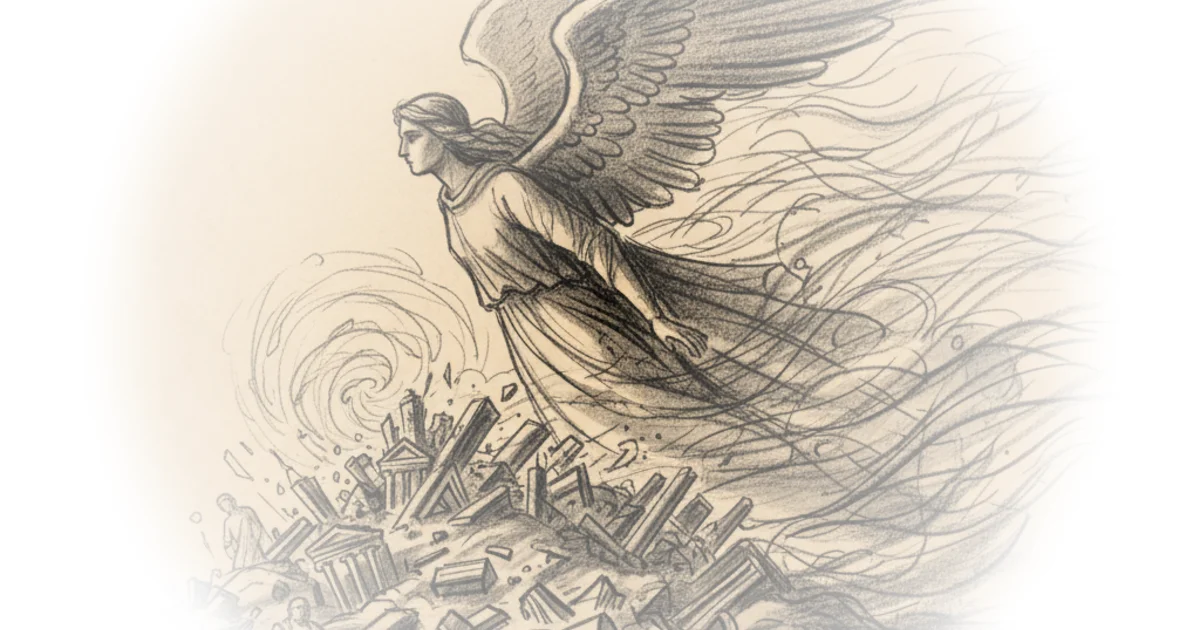
The author's choice to focus on the angel's inability to act is particularly poignant. Mona Mona notes that "The angel would like to stay, awaken the dead, and make whole what has been smashed." Yet, the angel is powerless. Why? Because "a storm is blowing from Paradise; it has got caught in his wings with such violence that the angel can no longer close them." This metaphor strips away the comforting narrative that history is a march toward improvement. Instead, it posits that the force we call "progress" is actually a violent gale that prevents us from stopping to repair the damage.
This storm irresistibly propels him into the future to which his back is turned, while the pile of debris before him grows skyward. This storm is what we call progress.
The power of Mona Mona's argument lies in how it validates the exhaustion many feel today. We are not failing to keep up; we are being blown backward by a system that demands constant forward motion regardless of the cost. However, critics might note that this deterministic view risks paralyzing the reader. If the storm is irresistible, what agency remains for the individual or the community to effect change? Mona Mona hints at this tension but focuses more on diagnosis than prescription in this first installment.
The Weight of the Wreckage
Mona Mona writes from a place of urgency, reminding readers that Benjamin was composing these thoughts while facing imminent death. "In his 'Theses on the Philosophy of History' (1940), written in Paris shortly before his attempt to flee Nazi-occupied France, Walter Benjamin describes Paul Klee's painting Angelus Novus hanging in his workspace." This context is not merely biographical; it grounds the abstract philosophy in the brutal reality of human suffering. The "wreckage" isn't a metaphor for bad economic data; it is the literal destruction of lives and cultures.
By linking the painting to the specific historical moment of 1940, Mona Mona forces us to confront the idea that the "storm" of progress has always been present, even during the darkest chapters of the twentieth century. The author argues that we often mistake the speed of events for their significance. "This is Benjamins' famous image of the Angel of History," Mona Mona concludes, but the weight of the image is that it serves as a warning against the seduction of speed.
The piece effectively challenges the reader to stop looking at the horizon for salvation and to start looking at the pile of debris at their feet. It asks us to consider that the "future" we are rushing toward might just be more of the same catastrophe, merely rearranged. This is a heavy, perhaps uncomfortable, perspective for busy readers who prefer actionable solutions over existential dread.
Bottom Line
Mona Mona's invocation of Benjamin provides a necessary corrective to the shallow optimism of modern discourse, successfully framing current global instability not as an anomaly but as the logical outcome of unchecked progress. The argument's greatest strength is its emotional resonance, yet its biggest vulnerability is the lack of a clear path forward, leaving the reader with a profound sense of helplessness rather than a strategy for resistance.