Most headlines about the beef crisis blame drought, disease, or simple supply and demand. More Perfect Union flips the script entirely, arguing that the disconnect between soaring consumer prices and collapsing rancher profits isn't a market failure—it's a rigged game. The evidence they bring to the table is not just economic data, but the visceral, human cost of a financial system designed to extract wealth from the very people who feed the nation.
The Great Disconnect
The core of the argument rests on a counterintuitive fact that defies standard economic logic: high prices for consumers do not necessarily mean high profits for producers. More Perfect Union writes, "Beef and cattle are not the same thing. The cost of beef and the cost of cattle are completely disconnected." This distinction is crucial because it exposes a broken transmission belt in the food supply chain. While shoppers see record-high prices at the grocery store, the people raising the animals are seeing their margins evaporate.
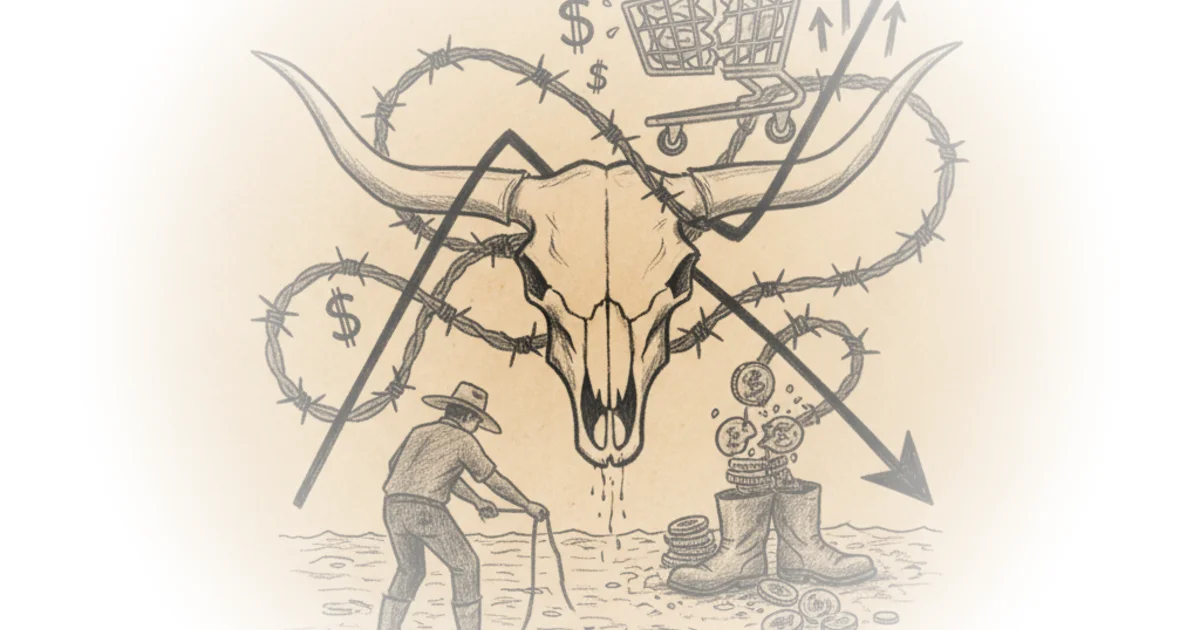
The author illustrates this with the story of John Oday, a sixth-generation Nebraska farmer, who explains that historically, "seven out of ten years a cow calf operation breaks even or loses money." This framing is effective because it humanizes the abstract concept of "market volatility." It shifts the narrative from a statistical anomaly to a systemic trap where independent producers are constantly on the brink of ruin, hoping to make enough in the rare profitable years to pay down debt accumulated during the lean ones.
Critics might argue that global supply chain disruptions and feed costs are the primary drivers of this squeeze, rather than market manipulation. However, the piece suggests these factors are secondary to a more deliberate structural imbalance.
The Speculator's Playground
The investigation takes a darker turn when it examines the role of Wall Street in the cattle futures market. More Perfect Union describes this arena as a place where "massive corporations and Wall Street speculators trade in predictions and profit off of price changes" without ever owning a single cow. The author highlights the devastating impact of this detachment, noting that during the pandemic, "farmers were getting screwed" even as store shelves emptied.
The emotional weight of this argument lands hardest through the story of Koi Young, a former rancher forced to sell his herd after a sudden market crash. More Perfect Union quotes his harrowing experience: "That Friday the 13th March of 2020, the board tanked... I was expected to get 125 to 128,000 from the sale. And I came home with a $36,000 check. I cried all the way home from the sale." This anecdote serves as a powerful indictment of a system where paper trades can destroy real livelihoods overnight. The argument here is that the futures market has been transformed from a tool for risk management into a playground for speculation that creates artificial volatility.
"The feeder futures market is just there to create chaos and volatility for farmers, but it's just pure paper trade. And those guys don't own any cattle."
The Consolidation Trap
Beyond the financial markets, the piece identifies a physical bottleneck in the industry: extreme consolidation. The author explains that while 90% of cattle are raised by small to medium-sized independent producers, the meatpacking sector is dominated by just four major companies: JBS, National Beef, Cargill, and Tyson. This concentration of power allows packers to suppress the prices they pay to ranchers while keeping retail prices high.
More Perfect Union points out a stark reversal in the distribution of the consumer dollar: "In 1980, the cattle producers receive 63 cents of every consumer beef dollar... Jump to 2021. That allocation... has been completely flipped on its head." This data point is the piece's strongest evidence of market failure. It suggests that the current pricing structure isn't an accident of economics but the result of a deliberate strategy to shift value from the producer to the processor and retailer. The author notes that a class-action lawsuit alleges these packers were "managing the marketplace to ensure there was never more demand than there was an available supply of cattle."
The Human Cost and the Path Forward
The final section of the coverage connects these economic mechanics to the existential threat facing American agriculture. The author warns that the loss of independent ranchers is accelerating, with nearly 20,000 farms going out of business annually. More Perfect Union writes, "What happens in 20 years when we're all gone?" This question reframes the beef crisis not as a temporary price spike, but as a potential extinction event for a specific way of life and a critical component of national food security.
The proposed solution is equally stark: the need for aggressive antitrust enforcement. The author argues that "sustained long-term profits are the only thing that's going to solve the beef cost issue," and that this can only happen by "getting corporate influences out of the market." While this is a bold political stance, it aligns with the evidence presented regarding the widening spread between producer and consumer prices. A counterargument worth considering is whether breaking up packers alone would lower consumer prices quickly, or if it would simply lead to higher operational costs passed on to shoppers. Yet, the piece maintains that without restoring profitability to the rancher, the supply chain itself will collapse.
Bottom Line
More Perfect Union's strongest asset is its ability to weave complex market mechanics into a compelling narrative of betrayal and survival, proving that the beef crisis is a story of power, not just price. Its biggest vulnerability lies in the political feasibility of its solution, as dismantling entrenched corporate giants faces immense legislative headwinds. Readers should watch for the outcome of the ongoing antitrust litigation, as it may be the only mechanism capable of resetting the broken scales of the meat industry.