Joeri Schasfoort doesn't just ask if the rules-based international order is dead; he forces us to confront the terrifying possibility that the replacement isn't a new era of great power rivalry, but a regression to something far more archaic and personal. While most analysts are busy debating whether Trump's threats to annex Greenland are strategic bluffs or genuine policy, Schasfoort introduces a radical third option: that we are witnessing the rise of "neo-royalist" dynasties where global stability is secondary to the personal wealth and status of a billionaire court. This is not your standard geopolitical forecast; it is a historical lens shift that reframes the chaos of the last decade not as a failure of institutions, but as a return to the pre-Westphalian game of thrones.
The Death of the Rules
Schasfoort begins by dismantling the comforting narrative that the post-WWII order was a moral triumph. He reminds us that the "rules-based international order" was always a fiction for the powerful. "We knew the story of the international rulesbased order was partially false, that the strongest would exempt themselves when convenient," he notes, pointing out how the International Criminal Court issues warrants for leaders of weak nations like Sudan while ignoring those of superpowers. The author effectively argues that the system's collapse wasn't a sudden shock but a slow erosion accelerated by the very powers that built it. Russia's annexation of Crimea, China's alternative lending institutions, and the US's own torture programs under the Bush administration all chipped away at the foundation long before Trump took office.
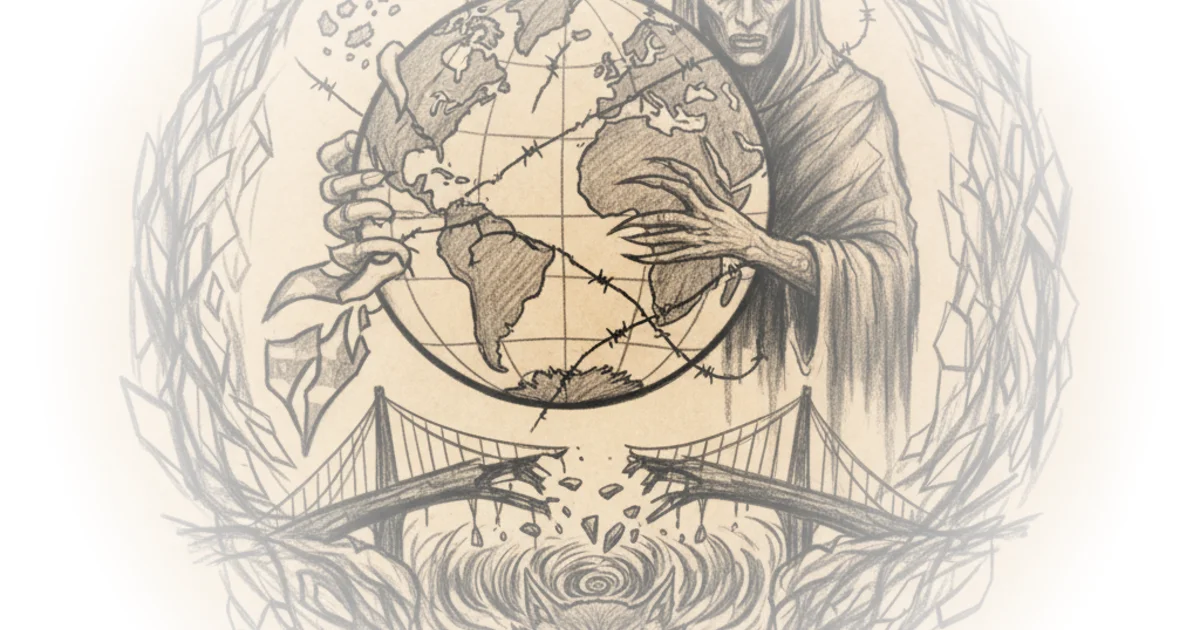
Yet, the speed of the current unraveling is what makes this moment distinct. Schasfoort highlights Canadian Prime Minister Mark Carney's assessment that "we are in the midst of a rupture, not a transition." This distinction is crucial. A transition implies a managed shift; a rupture suggests a violent break where the old guard rules no longer apply. The author suggests that while the order looked like a success in terms of preventing world wars and reducing poverty, it failed the bottom 50% of Americans, creating the perfect breeding ground for a leader who openly promised to blow it up.
The liberal rules-based international order is dead.
Critics might argue that declaring the order "dead" is hyperbolic, as institutions like the UN and NATO still function, albeit imperfectly. However, Schasfoort's point is that their normative power—the ability to shame or constrain great powers—has evaporated, rendering them largely ceremonial.
The Great Power Illusion
The article then pivots to the most common explanation for this chaos: a return to "great power competition." This is the view held by both the Trump administration and many traditional realists like John Mearsheimer. The logic is straightforward: in a world without rules, states must maximize power to survive. Schasfoort writes, "The US is acting like a great power that is consolidating its power in its own hemisphere to recover its strength first."
Under this theory, the US is simply reasserting the Monroe Doctrine, using military force to secure its hemisphere against rivals like China and Russia. Steven Miller, a key architect of Trump's foreign policy, is quoted as saying, "We live in a world in the real world... that is governed by strength, that is governed by force, that is governed by power." Schasfoort presents this as a coherent, if brutal, strategy of consolidation. The US wants to dominate the Western Hemisphere so no other great power can threaten it, treating allies like Canada and Denmark as mere obstacles to be moved.
However, Schasfoort quickly introduces a fatal flaw in this "great power" narrative. He cites research from professors Stacy Goddard and Abraham Newman, who argue that the strategic logic doesn't hold up. "Upon closer inspection, Russia's and China's activities in Venezuela and around Greenland are extremely limited," he explains. Furthermore, the resources in these territories are often too expensive to extract profitably. If the goal were purely strategic consolidation against China, the math simply doesn't work. This is where the author's coverage becomes most distinctive, challenging the standard geopolitical playbook.
The Return of the Court
If the "great power" explanation is flawed, what is the alternative? Schasfoort proposes a return to the era of "competing royal houses," where international relations are driven not by national interest, but by the personal status and wealth of a small group of elites. He leans heavily on the "Game of Thrones" analogy provided by Goddard and Newman: "It's like every almost everybody on Earth relates to this show about a small group of elites who really don't care about their societies in general. They just care about redistributing resources amongst these houses."
This framework reinterprets Trump's chaotic actions not as a grand strategy, but as the behavior of a "neo-royalist." In this view, Trump is not a statesman securing the nation, but a king protecting his court of billionaire backers. The high tariffs against India, the threats against Canada, and the interest in Greenland are not about national security; they are about personal leverage and resource redistribution among the elite. Schasfoort writes, "To truly understand Trump's attacks on neighbors and allies, we need to view the new international order through the lens of what came before the era of great power competition."
This is a provocative claim. It suggests that the "flexible realism" of the Trump administration—summarized by the belief that "Denmark is a tiny country with a tiny economy and a tiny military. They cannot defend Greenland"—is less about statecraft and more about the raw assertion of personal power. The author argues that this explains why the US would attack loyal allies: in a royalist system, loyalty is transactional, and borders are fluid if you have the strength to take them.
It's like every almost everybody on Earth relates to this show about a small group of elites who really don't care about their societies in general. They just care about redistributing resources amongst these houses.
A counterargument worth considering is that this "royalist" lens might be too cynical, ignoring the genuine ideological shifts in the American electorate that drove Trump to power. Not every policy decision can be reduced to the whims of a billionaire court; domestic political pressures and genuine security concerns still play a role. Nevertheless, Schasfoort's framing offers a compelling explanation for the apparent irrationality of current US foreign policy.
Bottom Line
Schasfoort's strongest contribution is his refusal to accept the "great power competition" narrative as the default explanation for global chaos, instead offering a historically grounded, if unsettling, alternative: the rise of neo-royalism. The piece's biggest vulnerability lies in its reliance on a binary choice between two complex theories, potentially oversimplifying the messy reality of modern statecraft. Readers should watch for whether the US administration's actions continue to align with strategic national interests or if they increasingly resemble the personal whims of a court, as the author predicts. The era of rules is over; the question is whether we are entering an era of realism or an era of kings.