Paul Cooper doesn't just recount the discovery of a lost city; he reconstructs the terrifying logic of an empire that turned a geological nightmare into a civilization's heartbeat. In this episode of Fall of Civilizations, Cooper argues that the Inca didn't merely survive the Andes—they engineered a society where the very hostility of the environment became the glue of their state, a feat that makes their eventual collapse not just a tragedy, but a geological inevitability.
The Architecture of Survival
Cooper opens by grounding the listener in the visceral reality of Hiram Bingham's 1911 expedition, stripping away the romantic myth of the "lost city" to reveal a desperate scramble for survival. He writes, "Presently we found ourselves in the midst of a tropical forest beneath the shade of whose trees we could make out a maze of ancient walls... some of which were beautifully fitted together in the most refined style of inca architecture." This description isn't just atmospheric; it sets the stage for Cooper's central thesis: the Inca were master engineers of a landscape that actively tried to kill them.
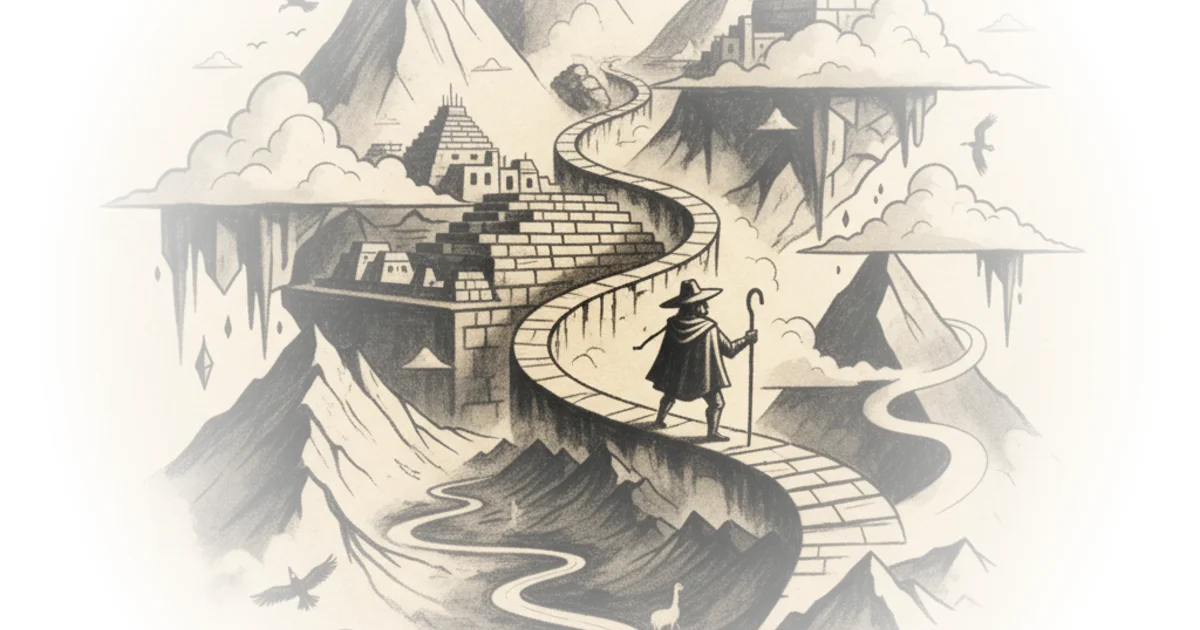
The author meticulously details the vertical stratification of the Andes, explaining how the Inca divided the mountains into distinct ecological zones—the quechua for maize, the sunni for potatoes, and the puna for grazing. "Less than two percent of its total area is at all suitable for growing food," Cooper notes, highlighting the sheer statistical improbability of their success. This framing is crucial because it shifts the narrative from one of cultural superiority to one of extreme environmental adaptation. The Inca didn't have horses or oxen; they had to turn fields by human hands. Cooper argues that this lack of draft animals forced a "reciprocal economy" where collective labor was not a choice but a biological imperative for survival.
"A group of farmers worked much faster than one on his own and the dry cold valleys needed irrigation canals dug through and rock enormous labors that required large work gangs and so to survive in this tough environment people needed to pull together."
This is the piece's most compelling insight: the centralized, authoritarian nature of the Inca state was a direct response to the fragility of their ecosystem. Critics might argue that Cooper leans too heavily on environmental determinism, potentially downplaying the role of ideological or religious coercion in maintaining such a vast empire. However, the evidence of the mit'a labor system and the intricate road networks suggests that without this rigid social contract, the civilization would have starved within a generation.
The Fragile Web of the Ring of Fire
Cooper expands the scope to the geological stage, reminding us that the Andes are part of the "Pacific Ring of Fire," a zone where 90 percent of the world's earthquakes occur. He describes the Atacama Desert on the western flank as "the driest place on earth," a place so arid that scientists once used it to simulate Mars. Yet, he points out the paradox: "More than 90 of the water that falls in these mountains will drain into the atlantic ocean," feeding the Amazon while leaving the coast bone-dry.
This geological context is essential for understanding the Inca's trade networks. Cooper explains how caravans of llamas, capable of carrying 40 kilograms across terrain that would break a horse, created a "fragile web" connecting the coast, the highlands, and the jungle. "Seashells decorating the clothes of people who lived a thousand miles from the sea and bright tropical feathers decorating the hair of people who had never laid eyes on the jungle," he writes, illustrating the incredible reach of this system. The author's choice to emphasize the llama as a self-sufficient pack animal is a brilliant touch; it explains how the Inca could sustain a massive empire without the logistical burden of feeding their transport animals.
The narrative then pivots to the precursors of the Inca, the Moche and Nazca, who also mastered this harsh terrain. Cooper notes that the Nazca lines, vast geometric patterns visible only from the mountains, were likely "ostentatious expressions of wealth and power" or religious markers. "We don't know the full significance of these lines," he admits, but the sheer scale implies a level of social centralization that foreshadowed the Inca. This historical depth prevents the story from feeling like a sudden miracle; it was the culmination of thousands of years of trial and error in the world's most difficult landscape.
"The Andes mountains are the largest continental mountain range in the world... this is one of the most seismically active areas in the world with around 90 percent of the world's earthquakes and about 75 percent of its volcanoes occurring along this enormous ring."
By anchoring the civilization in this volatile geology, Cooper prepares the listener for the inevitable collapse. If the foundation is built on the edge of a volcano, the fall is not a matter of if, but when. The author's pacing here is masterful, moving from the triumph of the puna grasslands to the looming threat of the tectonic plates, creating a sense of dramatic irony that permeates the entire episode.
Bottom Line
Cooper's greatest strength is his refusal to treat the Inca as a static museum exhibit; instead, he presents them as dynamic engineers who turned a geological death trap into a thriving empire through sheer social cohesion. The argument's vulnerability lies in its heavy reliance on environmental determinism, which risks oversimplifying the complex political and spiritual drivers of Inca expansion. Ultimately, this is a masterclass in understanding how human societies adapt to the limits of their planet, making the eventual cataclysm feel both tragic and geologically inevitable.