Most histories of the Eastern Roman Empire treat its final centuries as a slow, inevitable fade into darkness. Kings and Generals, however, argues that the collapse was not merely a matter of shrinking borders, but a fundamental structural failure of how the state mobilized its own people. This analysis is notable because it moves beyond the romanticized image of the Byzantine warrior to expose a military machine that was increasingly ill-equipped to handle the technological and demographic realities of the 14th and 15th centuries.
The Shift from Provincial to Central
The core of the argument rests on the transition from the middle Byzantine "theme" system to the late "pronia" system. Kings and Generals explains that the catastrophic Battle of Manzikert shattered the old provincial model, forcing a reorganization under Alexios I. "The pronia were grants of the revenue of the land and the labor services the inhabitants of the district owed to the state," they write. This distinction is crucial: unlike the earlier system where soldiers were tied to local administration, the new holders of fiscal rights were often absentee landlords serving a central government.
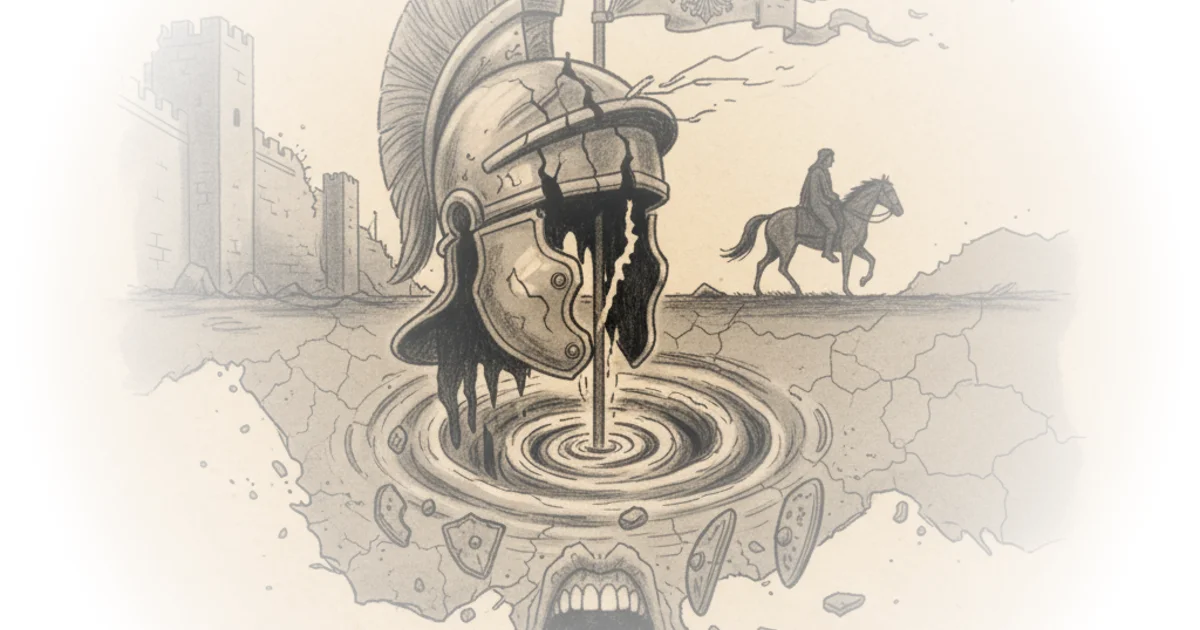
This shift created a military that was theoretically more centralized but practically more fragile. The commentary notes that while these soldiers were reservists called upon when needed, the wealthiest were accompanied by small retinues, "the largest not exceeding 80 men while the norm was probably a mere handful." The author effectively highlights the disparity between the ideal of a grand imperial army and the reality of a patchwork of private retinues. Critics might note that the comparison to Western feudalism is imperfect, as the state retained ultimate ownership of the land, but the practical outcome—a reliance on individuals rather than a standing provincial force—was similar.
Unlike the thematic soldiers of the middle Byzantine era, the pronia holders were not provincial soldiers but one of the central army, and consequently quite often an absentee landlord.
The organizational structure became equally fragmented. The text details how units were commanded by an allagator, with theoretical sizes ranging from 300 to 500 men. However, as the empire shrank, these formal structures dissolved into ad hoc arrangements. Kings and Generals points out that by the late 13th century, the organization of forces was "entirely ad hoc," a stark contrast to the rigid discipline of previous centuries. This fragmentation meant that as the Ottomans and Serbs conquered provinces, the very tax base that funded the allagia evaporated, leaving the central government with a hollowed-out military apparatus.
The Equipment Gap and the Infantry Crisis
Perhaps the most damning section of the coverage focuses on the material reality of the late Byzantine soldier. While the cavalry remained relatively well-equipped, the infantry branch is described as "the achilles heel of the late Byzantine armies." The author details how the typical cavalryman might wear a porpoise (padded surcoat) and a chapel de fer (iron hat), but the infantry was a different story entirely. "The infantry branch constituted the achilles heel of the late Byzantine armies," Kings and Generals states, noting that archers were increasingly unarmored peasants rather than professional soldiers.
The analysis of weaponry reveals a desperate reliance on foreign technology. The text notes that by the 14th century, many archers abandoned the traditional composite bow for the Western crossbow, yet even this was a stopgap. The most striking evidence of decline is the empire's inability to participate in the gunpowder revolution. "The virtually non-existent economic sources of the empire meant that it was impossible for them to participate in this late medieval arms race," the authors argue. This economic constraint is the silent killer of the empire, more so than any single battle.
The narrative of the Hungarian engineer Orban serves as the tragic climax of this technological failure. The text recounts how the Byzantine emperor could not afford Orban's salary or supply materials, forcing the engineer to sell his services to the Ottoman Sultan Mehmed II. "Ironically, the Hungarian engineer would die during the siege by one of his own creations," Kings and Generals writes, a detail that underscores the bitter irony of the empire's fall. The lack of domestic manufacturing capability meant that when the walls of Constantinople were finally breached, it was by a weapon the defenders could neither build nor afford to maintain.
The virtually non-existent economic sources of the empire meant that it was impossible for them to participate in this late medieval arms race.
The coverage also touches on the internal friction caused by this lack of resources. During the 1453 siege, disputes arose over the use of the few cannons the city possessed. One account describes a gunner being accused of bribery simply because his cannon exploded—a common occurrence at the time, but one that the desperate defenders could not afford to interpret as mere bad luck. This highlights a breakdown in command and trust that plagued the final defense.
Bottom Line
Kings and Generals succeeds in reframing the fall of Constantinople not as a sudden military defeat, but as the inevitable result of a century-long economic and structural erosion. The strongest part of this argument is the detailed breakdown of the pronia system, which effectively illustrates how the empire traded long-term stability for short-term fiscal survival. The biggest vulnerability of the piece is its heavy reliance on the 1453 siege as the definitive endpoint, potentially underplaying the resilience the empire showed in holding onto small territories for decades after the main army had ceased to exist as a coherent force. For the modern reader, the lesson is clear: a military's strength is only as durable as the economic engine that feeds it.