Jeffrey Kaplan opens with a claim that feels less like a philosophical exercise and more like a moral indictment of modern comfort: that the average person living in a wealthy society is, by default, complicit in the suffering of others. He argues that Peter Singer's 1972 essay, "Famine, Affluence, and Morality," remains the most unsettling and logically airtight challenge to our daily habits, suggesting that buying a new car or a cup of coffee is not a neutral act, but a moral failure. This is not a plea for charity; it is a demand for a complete restructuring of how we define obligation.
The Supererogatory Trap
Kaplan begins by dismantling the comfortable distinction most people make between what we "have to do" and what is "nice to do." He introduces the technical terms "obligatory" and "supererogatory" to show how society has built a firewall around our spending. "You didn't have to do it, but it was a really nice thing to do. It was an extra thing that you did and it was a good thing to do. It was not obligatory," Kaplan explains, using the example of bringing coffee to a meeting. He contrasts this with a promise made, which creates a binding duty. The problem, he notes, is that we treat famine relief exactly like that extra coffee—praiseworthy if given, but entirely optional if withheld.
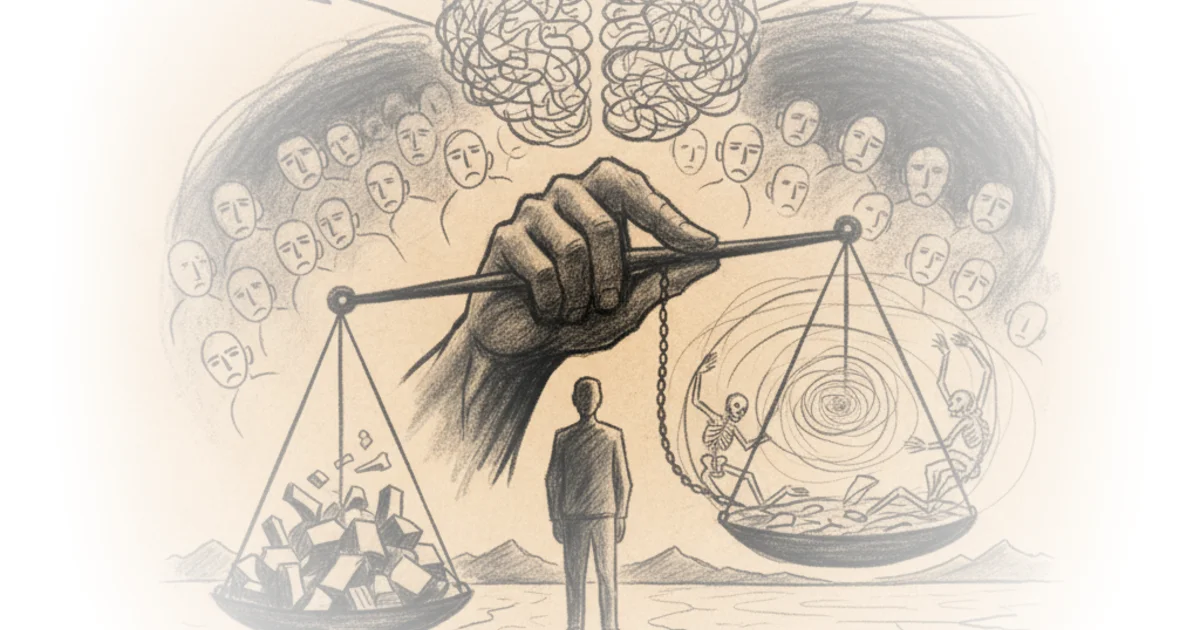
This framing is effective because it exposes the cognitive dissonance in our lives. We accept that we have a duty not to murder or to catch a falling child, yet we feel no guilt about spending money on luxuries while others starve. Kaplan points out that Singer's argument is radical precisely because it applies universally: "I can say all of these things that the thesis of the paper is that you need to completely rework your life without knowing anything about you." The argument does not depend on your specific income or history, only on the fact that you live in an affluent society where your surplus can save a life.
"The only thing according to Singer that can be justified... is the way of thinking where you think that giving to famine relief instead of buying new clothes or a new car or whatever, giving to famine relief is obligatory."
Kaplan highlights how Singer flips the script on our intuition. In our current moral framework, the person who buys a new car is not condemned, while the person who donates is praised. Singer argues this is backwards. "This way of looking at the matter cannot be justified," Kaplan writes, quoting Singer directly. The implication is stark: if you are not donating your surplus to prevent death, you are not merely being frugal; you are actively choosing to let people die.
The Logic of Prevention
To support this radical conclusion, Kaplan breaks down Singer's argument into four logical steps, noting that the first premise is the only point of contention, yet it is the most difficult to refute. The core logic rests on the idea that if you can prevent something terrible without sacrificing anything of moral significance, you must do it. Kaplan summarizes the premises: hunger and disease are undeniably bad; our luxuries (new clothes, cars, restaurant meals) are not of moral significance; and donating to agencies like Oxfam or UNICEF effectively prevents that suffering.
The strength of Kaplan's commentary lies in his insistence that the empirical claims are solid. "By donating money to relief agencies like Oxfam, we could prevent hunger, disease, and other sources of suffering, disability, and death," he notes, confirming that the mechanism for saving lives exists and works. The only barrier is our willingness to reclassify our spending. Kaplan argues that the conclusion is inescapable: "We must morally donate the money that we spend on luxuries to relief agencies. And we don't get to spend them on luxuries."
Critics might note that this rigid framework ignores the psychological necessity of small comforts for mental health, or that it assumes a level of global efficiency in aid distribution that may not always exist. However, Kaplan suggests that Singer anticipates these objections and finds them insufficient to override the moral imperative. The argument forces a choice: either the first premise is false, or our entire lifestyle is immoral. As Kaplan puts it, "Every time you buy new clothes that you don't absolutely need... you're doing something wrong. You're doing something bad."
The Uncomfortable Verdict
The piece concludes by emphasizing the sheer isolation of this moral stance. Despite the paper's fame in academic circles, it has failed to permeate the broader culture. "No one in our society, not in 1972. And even though this is a super famous paper... People don't think that buying new clothes or buying a cup of coffee from a coffee shop is a bad thing to do," Kaplan observes. He notes that Singer himself is still alive and active, yet the radical conclusion that "ordinary people are evil" for living normal lives remains a fringe view.
Kaplan's delivery of this argument is compelling because he refuses to soften the blow. He presents the logic as a clean, unbroken chain where the only way to break it is to deny that preventing death is more important than buying a new car. "If you don't give to famine relief, Singer thinks you've done something wrong," Kaplan writes, driving home the point that the status quo is not a neutral baseline, but an active moral failing.
"Every time you do any of those things, you're doing something wrong. You're doing something bad."
Bottom Line
Jeffrey Kaplan's commentary effectively strips away the polite fictions of modern charity, revealing Singer's argument as a direct challenge to the very definition of a "good life" in a wealthy nation. The strongest part of this analysis is its logical clarity, which leaves the reader with no easy escape from the conclusion that surplus wealth is a moral liability. Its biggest vulnerability, however, is its reliance on a utilitarian calculus that may feel emotionally unsustainable for the average person to maintain daily, leaving the reader to wonder if the argument is logically sound but practically impossible to live by.