Tim Mak delivers a sobering reality check on the growing pressure to hold Ukrainian elections while the country remains under active bombardment. Rather than treating this as a standard political timeline, the piece reframes the debate as a potential existential crisis for Ukrainian democracy, exposing the dangerous gap between diplomatic demands and the brutal logistics of war.
The Taboo of Voting
Mak introduces us to Oleksii Kovzhun, a veteran political consultant who has spent decades navigating Ukraine's turbulent political landscape, from the anti-Soviet underground to the chaotic elections of the 2000s. Yet, Kovzhun now refuses to speak the word itself. "I try not to say the word [elections] at all. It's evil," Kovzhun tells Mak, a statement that immediately sets the tone for an article that treats the topic not as a procedural necessity but as a moral hazard.
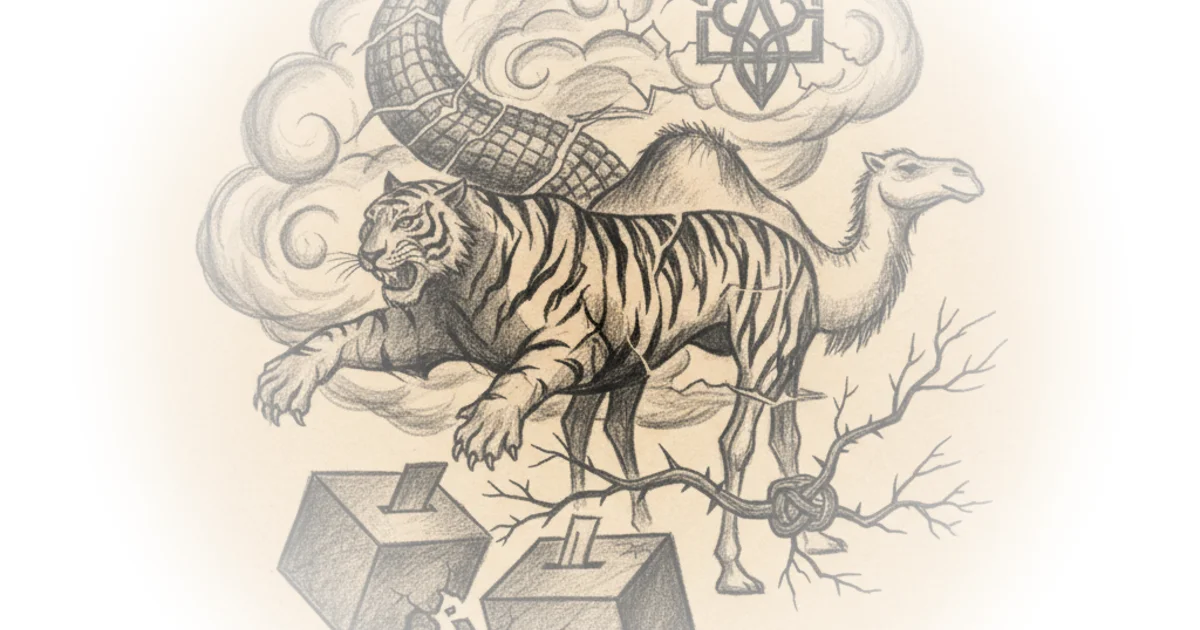
The author highlights a critical shift: after the administration declared it was "time" for Kyiv to select a new president, President Volodymyr Zelenskyy unexpectedly signaled a willingness to hold elections under martial law. Mak argues that this pivot is less about democratic renewal and more about external pressure. "If elections are indeed held under martial law, the vote would demonstrate Washington's desire to replace the president and pressure Kyiv rather than encouraging Ukrainians to exercise democratic choice," Mak writes. This is a provocative claim that cuts through the usual diplomatic platitudes, suggesting that the push for elections could be a mechanism for regime change rather than a celebration of sovereignty.
If elections are indeed held under martial law, the vote would demonstrate Washington's desire to replace the president and pressure Kyiv rather than encouraging Ukrainians to exercise democratic choice.
The piece grounds this high-stakes political maneuvering in the gritty history of Ukrainian elections. Mak reminds readers that the 2004 Orange Revolution, which saw Viktor Yushchenko survive a poisoning attempt to win the presidency, was born out of a fight against Kremlin interference. Kovzhun recalls the terror of that era: "It was both fun and terrifying... terrifying, because he understood that the Russians could come for him at any moment." By weaving in these memories, Mak illustrates that the threat of Russian interference is not theoretical; it is a historical constant that has evolved from poisoning candidates to dropping ballistic missiles.
The Logistics of Disenfranchisement
The core of Mak's argument rests on the sheer impossibility of a fair vote under current conditions. The author meticulously details the human cost of the logistical nightmare: nearly six million Ukrainians are abroad, four million are internally displaced, and another four million live under occupation. "Almost one million Ukrainians are also currently serving in the Armed Forces, making it physically impossible for them to campaign, run for office, or cast their vote," Mak notes. This isn't just a bureaucratic hurdle; it is a fundamental disenfranchisement of the very people defending the nation.
Mak captures the frustration of those on the front lines through Kovzhun's observation: "Ukraine is now forced to play a game, not to say 'no' to America… They tell us about elections. We say: 'Okay, but for that we need…' And then we set conditions that they cannot meet." This framing suggests that the demand for elections is a diplomatic trap, setting Ukraine up for failure by demanding the impossible.
Critics might argue that delaying elections indefinitely undermines democratic legitimacy, regardless of the war. However, Mak counters this by pointing to the precedent of 2014, when elections in Donetsk were effectively sabotaged by Russian forces. He recounts the story of election observers in Donetsk who had to use the code phrase "Let's buy roses!" to escape armed Russian officers searching for them. "Many members of the committee tried to go to the [Donetsk] airport to collect the ballots that had been delivered by plane, but some got captured right in the airport," recalls observer Serhii Tkachenko. This historical parallel serves as a stark warning: attempting to hold elections now could simply repeat the chaos of 2014 on a national scale, with even deadlier consequences.
The Human Cost of Political Games
Mak does not shy away from the human element, focusing on the soldiers and civilians who are being asked to vote while their homes are being destroyed. The author emphasizes that the current war is unlike any other in recent decades, where "a ballistic missile can reach a crowded area within minutes, in any area of the country." This reality makes the concept of a secure polling station almost absurd.
The piece concludes with a reflection on the uncertainty of the future, echoing Kovzhun's sentiment that the outcome of this political struggle is unknowable. "A new world will come. What kind? Who knows," Kovzhun says. "It's like a supernova explosion. And what happens after that, we don't know. It's beyond the sequence of events." Mak uses this metaphor to underscore the gravity of the situation: Ukraine is not just navigating a political cycle; it is surviving an existential event that will reshape its destiny.
It's like a supernova explosion. And what happens after that, we don't know. It's beyond the sequence of events.
Bottom Line
Tim Mak's most compelling contribution is his refusal to treat the election debate as a mere procedural issue, instead exposing it as a high-stakes gamble with the future of Ukrainian democracy. While the argument that external pressure is driving this push is strong, the piece could have explored more deeply how Ukrainian civil society is organizing to resist or adapt to these demands. The strongest takeaway is clear: holding an election under these conditions risks turning a democratic process into a tool of coercion, with the human cost falling hardest on those already fighting for their lives.