This piece cuts through the noise of geopolitical posturing to reveal a terrifying reality: a currency collapse so severe that global trading platforms briefly registered the Iranian rial as worthless. John P Ruehl does not merely report on the stock market; he documents a "battle for survival" where the death toll may reach 30,000, framing the unrest not as a political uprising but as a desperate reaction to economic strangulation. For the busy listener, the stakes are immediate and human: this is a story about how financial engineering and sanctions can dismantle a society from the inside out.
The Anatomy of a Collapse
Ruehl anchors his analysis in the visceral reality of the bazaar, noting that "Exchange shops offered the record-low rial-to-dollar rate in Tehran." He argues that the crisis was not a sudden panic but a slow-motion credit failure where the government's managed currency system finally snapped under the weight of scarcity. The author highlights the sheer speed of the depreciation, writing that "In early January, several currency trackers briefly displayed the Iranian rial's value as '$0.00,' unable to process the speed and scale of the depreciation." This detail is crucial; it suggests a breakdown so profound that the digital infrastructure of global finance could not even register the currency's existence.
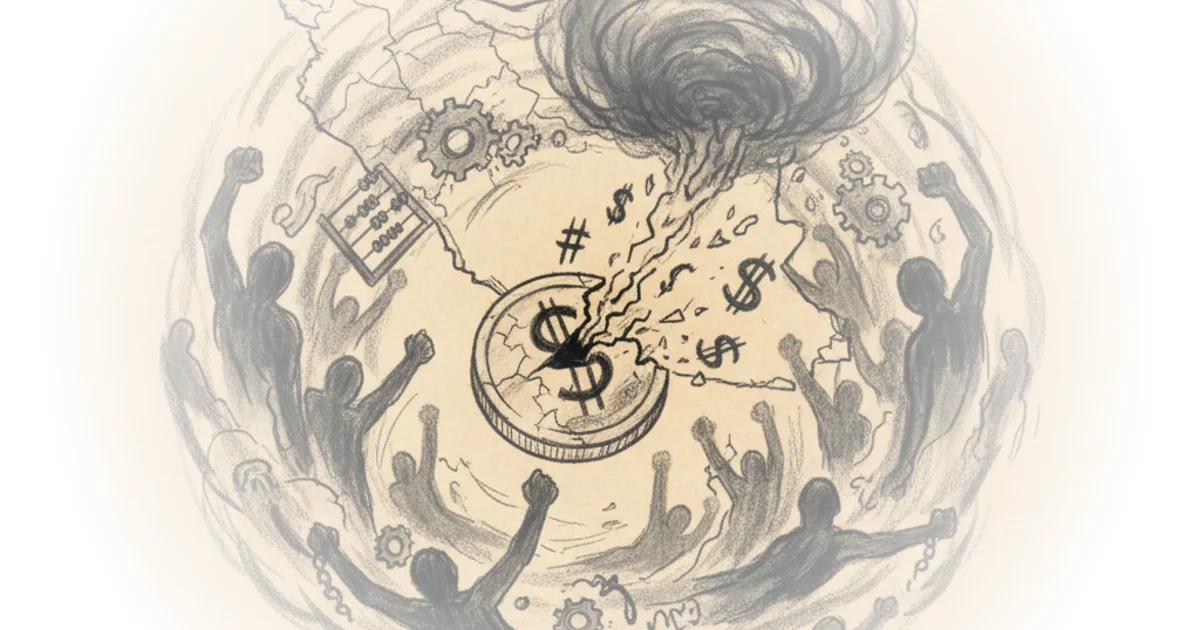
The commentary effectively traces the lineage of this disaster, connecting the current chaos to the restoration of UN sanctions after Western powers activated the "trigger mechanism" under the Joint Comprehensive Plan of Action in September. Ruehl draws a stark parallel to Venezuela, noting that "The crisis mirrors patterns seen in other countries under prolonged financial pressure; the Venezuelan bolivar's collapse in the 2010s, for example, was a result of bad economic policies and years of U.S. sanctions." This comparison is not just historical context; it serves as a warning of what happens when a state loses the ability to import essentials while its currency evaporates.
"Their dissent over the worsening economic conditions drew in other groups around the country, producing widespread instability despite little coordination."
The author makes a compelling case that the government's attempt to fix the deficit by "printing money" only accelerated the rot. As Ruehl explains, the government's reliance on a "three-tier gasoline pricing system" caused "food inflation soaring past 70 percent," a policy that inevitably turned the commercial class against the state. This is a vital distinction: unlike previous protests driven by ideology, this movement was sparked by merchants who could no longer price their goods. The argument holds weight because it identifies the erosion of the regime's traditional base—the bazaar—as the critical turning point.
A Fractured Opposition
The piece shifts to the complex dynamics of the protests, arguing that the lack of a single leader is both a vulnerability and a shield. Ruehl observes that "During the 2009 Green Movement, protestors rallied around prominent political figures, which made the movement easier to crush," contrasting that with the current "decentralized networks" of neighborhood groups and student circles. This structural analysis is sharp; it explains why the regime finds it difficult to decapitate the movement even as it claims to be hunting "organized networks."
However, the author also grapples with the murky role of foreign actors. While Iranian officials blame "foreign-backed saboteurs," Ruehl acknowledges that "it would be naive to assume that Iran's adversaries are not seeking to exploit the unrest without openly directing it." He details the involvement of the Mujahedin-e-Khalq (MEK), a group with a controversial history, noting that "The MEK was removed from the U.S. terrorism watch list in 2012, having been on it since 1997." The text suggests that while the West may not be orchestrating the riots, the presence of groups like the MEK and the flow of technology like Starlink terminals create a "sustained attritional pressure" that weakens the state.
Critics might argue that Ruehl underplays the agency of the Iranian people by focusing so heavily on external manipulation. If the protests are truly a "battle for survival," the internal drive for change should be the primary lens, not the shadow of foreign intelligence operations. Yet, the author balances this by emphasizing the human cost, stating that "Even conservative Iranian government estimates acknowledge more than 3,000 deaths, with other sources placing the toll as high as 30,000." This statistic forces the reader to confront the brutality of the crackdown, regardless of who lit the match.
The Geopolitical Gamble
The final section of the coverage examines the dangerous calculus of the international community. Ruehl points out that while the administration has threatened military action, "visible interference... risks validating Tehran's claims of outside influence, intensifying repression and provoking wider regional instability." The author cites the chilling rhetoric from the White House, quoting the demand for a deal: "Hopefully Iran will quickly 'Come to the Table' and negotiate a fair and equitable deal—NO NUCLEAR WEAPONS—one that is good for all parties."
This framing exposes the tension between diplomatic pressure and the reality on the ground. The administration's threats of force, coupled with the activation of sanctions on Iran's "ghost fleet," have created a pressure cooker. Ruehl notes that "The U.S. also announced new sanctions in response to the violent measures and has threatened a military attack, which has led to 'worry' in the region." The piece suggests that while the goal is to curb nuclear ambitions, the method risks triggering a wider war that could destabilize the entire Middle East.
"Time is running out, it is truly of the essence!"
The author's inclusion of this urgent warning underscores the precariousness of the situation. The commentary does not shy away from the fact that the "12-day war in June 2025" and subsequent Israeli targeting of energy infrastructure have left Iran in a state of "water bankruptcy" and energy shortage. These are not abstract policy points; they are conditions that make life unsustainable for millions. The piece effectively argues that the administration's strategy of maximum pressure has reached a tipping point where the economic pain has translated into existential threat for the population.
Bottom Line
John P Ruehl delivers a sobering analysis that prioritizes the human cost of economic warfare over the political theater of sanctions and threats. The piece's greatest strength is its unflinching documentation of the merchant-led uprising, which reveals a regime losing its grip on the very class that sustained it for decades. However, the argument leaves the reader with a haunting question: as the administration pushes for a nuclear deal amidst a humanitarian catastrophe, is the world prepared for the fallout of a state that has run out of options? The most critical takeaway is that the "battle for survival" in Tehran is no longer just an Iranian crisis; it is a test of whether the international community can manage a collapse without igniting a regional war.