The Neocon Comeback Nobody Voted For
When Donald Trump first stormed the Republican establishment, his appeal rested on a simple proposition: forget the endless wars, forget the nation-building fantasies, and focus on the Americans left behind by globalization. That message carried him to the presidency twice. But a recent interview featuring Senator Ted Cruz on the Trigonometry YouTube channel suggests that the old Republican instincts -- regime change abroad, neglect at home -- have reasserted themselves with a vengeance. The Novara Media hosts Aaron Bastani and Kieran Allen dissect this transformation with a mix of exasperation and grim analytical clarity.
The Cruz interview is revealing precisely because Cruz does not seem to realize how revealing it is. He rattles off a wish list of regime changes -- Iran, Venezuela, Cuba -- with the enthusiasm of a man describing a three-for-one sale rather than military interventions affecting hundreds of millions of people.
Because there is a very real possibility in the next 6 months we could see new governments in Iran, Venezuela, and Cuba. And if we end up with governments in those three countries that want to be friends with America rather than our enemies with America, that would be the biggest geopolitical shift since the fall of the Berlin Wall.
The hosts are not buying it. Bastani's counterpoint lands with surgical precision: the Iranian regime was actually weaker before the bombing campaign began. By killing civilians -- including, as Bastani notes, over 165 children in a single double-tap strike -- the Trump administration did what decades of theocratic rule could not: it unified the Iranian public behind its government. The war conferred democratic legitimacy on the Islamic Republic, turning what had been an unpopular regime into a rallying point for national survival.
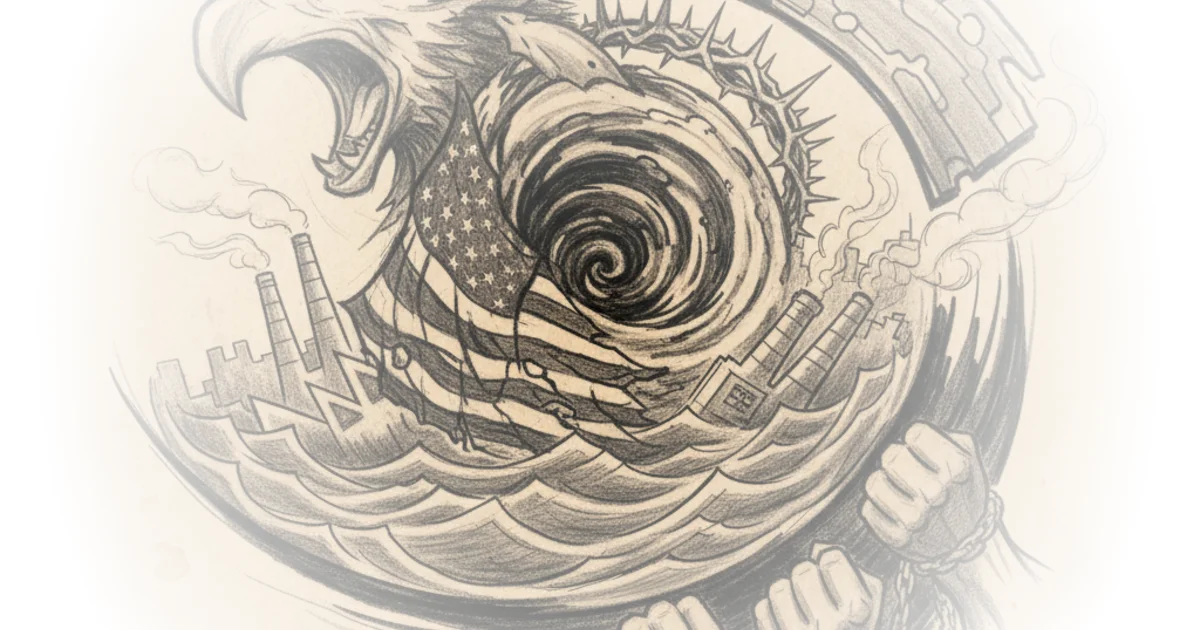
The Domestic Abandonment
The more damning thread in this discussion concerns what Cruz and his colleagues are not talking about. Bastani frames it bluntly: American politicians have given up on actually trying to improve America.
American politicians for a long time have given up on actually trying to improve America. It's too hard. There's too many special interests. It doesn't make you rich. Doesn't win you friends in powerful and influential places.
The statistics the hosts marshal are difficult to argue with. Forty million Americans needed food stamps before Trump's reforms. Chinese adolescent girls are now taller than their American counterparts -- a proxy measure for nutritional access that should alarm anyone paying attention. Maternal mortality in the United States is higher than in Bosnia. Worker engagement has dropped to its lowest level in a decade, and for the first time in Gallup's tracking history, more American workers report struggling in their lives (49 percent) than thriving (46 percent).
These are not cherry-picked outliers. They represent a consistent pattern of domestic decline that makes Cruz's giddy excitement about toppling foreign governments look, at best, like a distraction and, at worst, like a deliberate refusal to engage with problems that might upset donors.
The Fiscal Doom Loop
Perhaps the most striking section of the discussion concerns the debt trajectory. Trump and Elon Musk promised to shrink the deficit through the Department of Government Efficiency. The Brookings Institution's projections tell a different story. Debt stands at 99 percent of GDP today. Under current Congressional Budget Office projections, it will reach 120 percent by 2036 and 175 percent by 2060. If Trump's "temporary" tax provisions become permanent -- as temporary tax provisions almost invariably do -- debt could reach 211 percent of GDP.
Between 2020 and 2024, the US economy grew by $6 trillion. Sounds like a lot until you realize the debt increased by 12 trillion. In other words, for every dollar added with regards to debt, you're creating 50 cents of GDP.
That fiscal multiplier of 0.5 is a damning number. In the immediate postwar period, each dollar of government spending generated roughly ten dollars of value. The diminishing returns have not just diminished -- they have inverted. The United States is now borrowing more than it produces, and the gap between interest rates on government debt and economic growth is widening, setting up what economists call explosive debt dynamics.
It is worth noting, however, that deficit hawks have been predicting imminent fiscal catastrophe for decades, and the United States has consistently defied those predictions. The dollar's reserve currency status and the depth of Treasury markets provide buffers that other nations do not enjoy. The question is not whether those buffers exist but whether the current trajectory will eventually exhaust them -- and what happens in the meantime to ordinary Americans whose wages, housing costs, and healthcare access deteriorate while their government spends trillions on interest payments and foreign military adventures.
Empire in Decline, or Business as Usual?
The hosts situate Trump's foreign policy within a longer imperial history, tracing American expansionism from the Monroe Doctrine of 1824 through the Spanish-American War, manifest destiny, and the postwar Pax Americana. Allen makes a structurally interesting argument: because the United States lacks a formal territorial empire -- unlike the British in India or the French in Algeria -- it can afford to be less pragmatic about the consequences of its interventions. The refugees flee to Europe. The energy price shocks hit European consumers. The deindustrialization hits Asia. America, protected by two oceans, absorbs relatively little blowback.
The Europeans will get the energy inflation. The Asians will get the de-industrialization, and the Russians and Europeans will get the displaced people and the refugees, and America gets none of it. So they can keep on making these crazy, outlandish, destructive choices and actually the disincentives to stop doing that are quite low.
This is a compelling structural argument, though it perhaps understates the domestic costs. The Strait of Hormuz disruption that Cruz so blithely discusses would drive global energy prices higher, and the United States, despite its shale revolution, is not immune to those price movements. The 92,000 jobs lost in February 2026 suggest that the tariff-driven reindustrialization narrative has not materialized either.
The Disappearing Ink President
The hosts juxtapose Cruz's warmongering with Trump's own 2025 speech in Saudi Arabia, in which he praised sovereign development, mocked nation-builders and neocons, and celebrated the Gulf states for charting their own destinies. It was, as Bastani acknowledges, arguably the best speech on the Middle East by a sitting U.S. president in living memory. A year later, Trump is bombing Iran.
Allen offers the most memorable characterization of this incoherence: everything Trump says is written in disappearing ink. The incentive structure shifted. New special interests captured the administration. And whatever rhetorical commitments Trump made to sovereignty and non-intervention evaporated as soon as they became inconvenient.
Critics might counter that Trump's Saudi speech was always more transactional than principled -- a pitch to Gulf investors wrapped in anti-interventionist language. The consistency was never in the ideology but in the deal-making. What changed was not Trump's beliefs but the deals on offer.
Bottom Line
The Novara Media discussion exposes a fundamental tension at the heart of the second Trump presidency: the populist economic nationalism that won elections has been abandoned in favor of the same neoconservative foreign policy agenda that Trump originally ran against. Ted Cruz's gleeful regime-change fantasies, set against cratering domestic indicators -- record debt projections, job losses, collapsing worker wellbeing -- illustrate a political class that has found it easier, more profitable, and more personally rewarding to bomb foreign countries than to fix American ones. Whether this represents imperial decline, elite capture, or simply the eternal pull of the military-industrial complex, the result is the same: the voters who chose "America First" are getting America last.