In a landscape often dominated by theological gatekeeping, this piece from Wayfare offers a startlingly intimate counter-narrative: that the most profound moments of faith occur not in the safety of the familiar, but in the disorienting friction of the other. The editors argue that encountering unfamiliar rituals—from the shock of wine replacing water to the raw energy of a progressive congregation's prayer—does not dilute one's own tradition but rather sharpens its contours and deepens its mystery. For the busy reader seeking substance over soundbites, this is a rare meditation on how religious boundaries can become bridges rather than walls.
The Shock of the Sacred
The piece opens with a visceral childhood memory that grounds high theology in human confusion. Wayfare reports, "None, however, was more shocking than the moment when the familiar sacramental water turned to wine in this new church—the symbolic drink looked unsettlingly like spilt blood." This anecdote is not merely nostalgic; it establishes the central thesis that distance from one's own tradition forces a reckoning with the nature of belief itself. The author describes standing bewildered in a rural Idaho church, looking to a grandmother for guidance that never came, leaving the child to grapple with the "mysterious fruit of the vine."
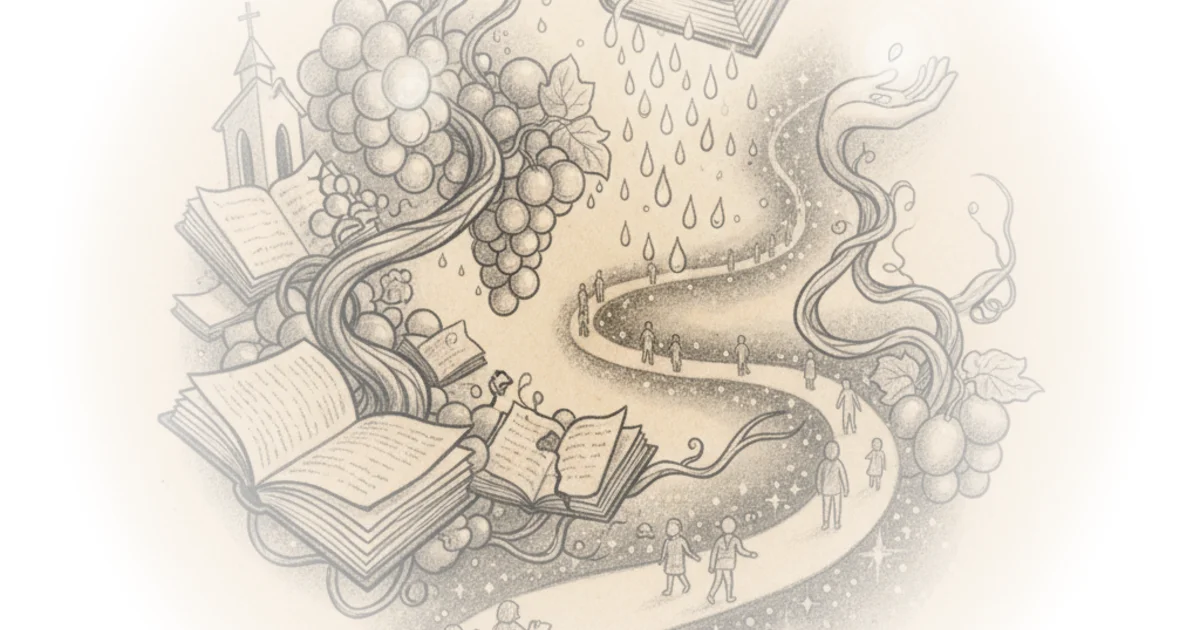
The argument here is that this discomfort is generative. The piece suggests that when the "staid, familiar hymns" are replaced by the unknown, the observer is forced to ask, "Is this okay?" and in doing so, begins a journey of genuine inquiry. This lands effectively because it bypasses intellectual abstraction and taps into the universal feeling of being an outsider. Critics might argue that this romanticizes the friction of interfaith encounters, ignoring the very real historical tensions that often make such interactions fraught with danger or hostility rather than wonder. Yet, the editors maintain that the "open-ended invitation" to explore how others experience God is where true discipleship begins.
"I knew this was church, but it wasn't mine. Over time, Grandma's worship service created an open-ended invitation to me to explore how others experienced God."
The Architecture of Welcome
The narrative shifts from the quiet confusion of childhood to the deliberate, expansive hospitality of the Metropolitan Community Church (MCC) in Los Angeles. Wayfare notes the stark contrast between the generic "visitors welcome" signs common in many chapels and the MCC's explicit declaration: "Founders MCC... is a prophetic, liberating, and progressive Christian community of faith that honors, values, and welcomes all people." The editors highlight the specificity of this welcome, which roots itself in the LGBTQ+ community while explicitly inviting heterosexuals as well.
This section draws a powerful parallel to the historical mission of the MCC, founded in 1968 specifically to minister to the LGBTQ+ community when most denominations offered exclusion. The piece argues that the MCC's ability to "cast the net so wide" exposed the author's own hesitancy. The ritual of choosing between wine and grape juice, and the act of placing a flower for a father on Father's Day, served as a "bridge to the unfamiliar congregation." The editors suggest that these small, tangible acts of inclusion are more transformative than any theological treatise. "They extended the invitation to us in large part, I like to think, because we had sincerely worshipped alongside them just minutes earlier," the piece argues, noting that the community's focus on shared worship transcended institutional differences.
Prayer as a Mirror
Perhaps the most incisive observation in the article concerns the mechanics of prayer itself. Wayfare reports that when the author heard a prayer offered in "friendly and more energetic tones," it felt "strange, distant, and unworthy of God's attention" compared to the familiar, formal "Thee and Thou" of their own tradition. This moment of dissonance reveals a deeper truth: our comfort with religious language often masks a lack of spiritual engagement. The piece notes, "The humility of prayer is often sharpened when I hear a prayer that follows unfamiliar patterns, employs language that seems overly informal, or is highly liturgical."
The argument here is that the "tone" of prayer can reveal a proximity to the divine that rigid formalism sometimes obscures. The author's wife observes that the prayer felt "so real," a sentiment that challenges the reader to consider whether their own rituals have become rote. A counterargument worth considering is that the shift toward informal language can sometimes sacrifice theological depth for emotional immediacy, potentially flattening the mystery of the divine into mere sentiment. However, the editors insist that the "energy" of the prayer was not a replacement for doctrine but a different mode of accessing it.
The Weight of Memory
The final movement of the piece takes the reader into a synagogue, where the author confronts the Kaddish, the mourner's prayer. Wayfare describes how the congregation called out the names of the deceased, an act that "helped shrink the distance of time and generations." This experience forced a theological crisis regarding the author's own tradition's practice of posthumous baptism. The editors write, "Did they really need my meager efforts to do what they could not, would not do?" This question reframes the entire concept of salvation, moving it from a transactional obligation to a relational mystery.
The piece connects this to the broader Jewish concept of Am Yisrael (the people of Israel), suggesting that communal memory is a form of salvation in itself. The author realizes that their own desire to "extend salvation" might be an imposition rather than a gift. "Approaching the divine economy now meant that I might have to allow God to sort out the pathways of salvation that were more encompassing and mysterious than I had thought," the editors conclude. This is a profound admission of humility, suggesting that the "mysterious, unsearchable ways of God" are best approached with awe rather than a desire to categorize or control.
"Learning about someone else's faith, religious practice, and worldview, always opens up questions for me that call me back into my own religious life."
Bottom Line
The strongest element of this commentary is its refusal to treat interfaith engagement as a mere exchange of ideas; instead, it frames it as a visceral, often uncomfortable, but ultimately necessary confrontation with the self. The piece's greatest vulnerability lies in its reliance on the author's personal safety and privilege to navigate these spaces, a context that may not be universally available. Ultimately, the editors succeed in arguing that the "mysterious fruit of the vine" is not a symbol of division, but a catalyst for a deeper, more resilient faith that thrives on the very differences it once feared.