In an era obsessed with data-driven self-optimization, Maria Popova presents a startling counter-narrative: the only way to truly know if you love someone is to stop thinking and start suffering. Drawing on the work of philosopher Martha Nussbaum, this piece argues that our intellect is not the tool for discovering love's truth, but rather the primary obstacle to it, a thesis that challenges the very foundation of how modern society approaches emotional clarity.
The Intellect as a Shield
Popova frames the central conflict not as a battle between heart and mind, but as a struggle between the raw reality of vulnerability and the comforting lies of rationalization. She introduces Nussbaum's "incompleteness theorem of the heart's truth," noting that "We deceive ourselves about love — about who; and how; and when; and whether." This framing is crucial because it shifts the blame for confusion away from a lack of information and toward a biological imperative for self-protection. The author suggests that our brains are wired to construct narratives that minimize pain, even if those narratives are factually false.
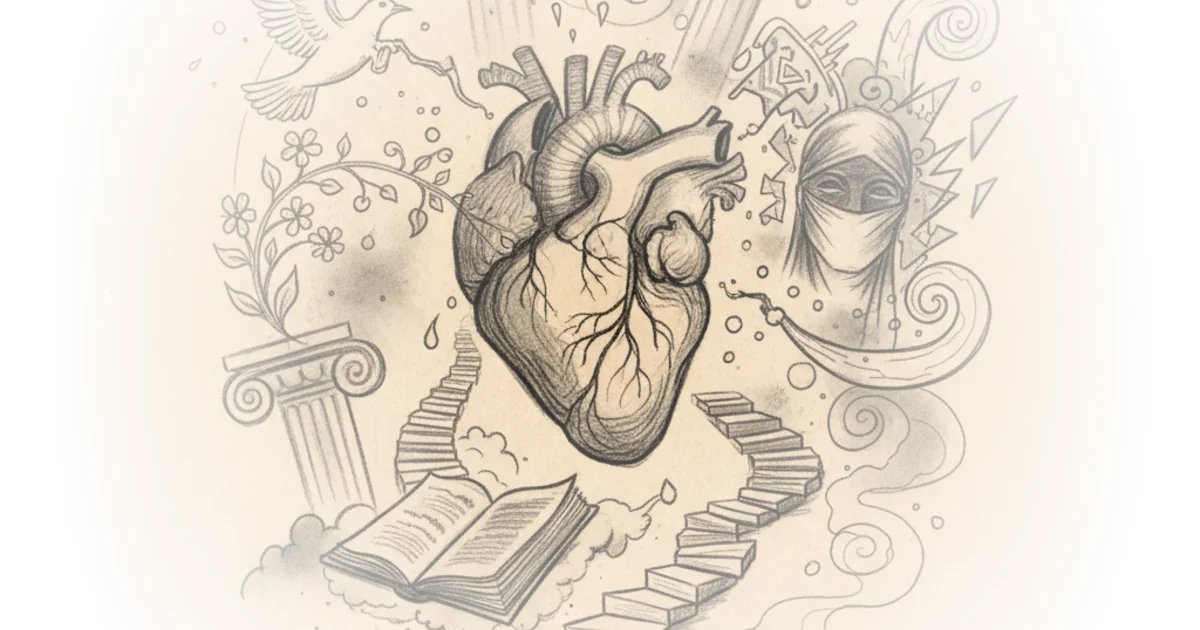
The piece leans heavily on Marcel Proust's In Search of Lost Time to illustrate this mechanism. Popova writes, "The shock of loss and the attendant welling up of pain show him that his theories were forms of self-deceptive rationalization — not only false about his condition but also manifestations and accomplices of a reflex to deny and close off one's vulnerabilities." This is a powerful observation: we often convince ourselves we are indifferent to someone to avoid the terror of needing them. The argument lands effectively because it reframes emotional numbness not as a sign of moving on, but as a sophisticated defense mechanism.
Critics might argue that this view romanticizes suffering too heavily, suggesting that pain is the only valid metric for truth. However, Popova and Nussbaum are careful to distinguish between suffering as a tool for clarity and suffering as a goal in itself.
"The alternations between love and its denial, suffering and denial of suffering … constitute the most essential and ubiquitous structural feature of the human heart."
Catalepsis and the Crystallization of Truth
The commentary then pivots to the concept of "catalepsis," a Greek term Popova explains as a condition of certainty that cannot be dislodged. Here, the text moves from psychological analysis to a more metaphysical claim about how truth is apprehended. Popova notes that Nussbaum sees the intellect's "cost-benefit analysis of the heart" as a way of "comforting oneself, of putting oneself in control by pretending that all losses can be made up by sufficient quantities of something else."
This section is particularly striking in its rejection of the scientific method as applied to emotion. Popova writes, "Proust tells us that the sort of knowledge of the heart we need in this case cannot be given us by the sciences of psychology, or, indeed, by any sort of scientific use of intellect." The author argues that the "subtlest, most powerful, most appropriate for grasping the truth" is the instrument of suffering itself. The logic follows that because our default state is to hide from pain, any experience that pierces that shield must be authentic. As Popova puts it, "The suffering itself is a piece of self-knowing."
This perspective offers a profound correction to the modern tendency to treat relationships as projects to be managed or optimized. By invoking W.H. Auden's observation that "When enchanted, we neither believe nor doubt nor deny: we know, even if, as in the case of a false enchantment, our knowledge is self-deception," Popova highlights the danger of confusing certainty with truth. The piece suggests that true knowledge of love is not a static state of certainty, but a dynamic, often painful, engagement with reality.
The Paradox of Self-Projection
The final layer of the argument addresses the solipsistic nature of love. Popova explores how we often love our own projections rather than the actual person. She writes, "I understood that my love was less a love for her than a love in me… It is the misfortune of beings to be for us nothing else but useful showcases for the contents of our own minds." This is a sobering admission that even in our most intimate moments, we are often talking to ourselves.
However, Nussbaum's insight, as presented by Popova, is that denying this porousness is the greater error. By trying to maintain a fortress of self-sufficiency, we block the very connection we seek. Popova concludes that love is not a structure waiting to be discovered, but something "embodied in, made up out of, experiences of suffering." This reframing is bold: it suggests that the pain of loss is not an external event that happens to love, but the very substance that proves love exists.
"To try to grasp love intellectually is a way of not suffering, not loving — a practical rival, a stratagem of flight."
Bottom Line
The strongest part of this commentary is its unflinching rejection of the idea that emotional clarity can be achieved through logic alone; it correctly identifies that our rationalizations are often the very things obscuring our truth. Its biggest vulnerability lies in the potential for readers to misinterpret the glorification of suffering as a prescription to seek out pain rather than to recognize its clarifying power. For the busy professional, the takeaway is not to embrace misery, but to recognize that the discomfort of vulnerability is the only reliable signal that a connection is real.