Rohit Krishnan offers a startlingly specific vision of the future where the bottleneck of creation has vanished, only to be replaced by a crisis of direction and trust. He argues that once artificial intelligence democratized the ability to build, the true scarcity shifted from execution to the judgment of what is worth building, creating a world where speed is cheap but wisdom is the only remaining currency. This is not a generic prediction about automation; it is a granular look at how the very nature of work, capital, and human connection fractures when the cost of production approaches zero.
The Death of the Bottleneck
Krishnan begins by recalling the moment the barrier to entry for massive scale collapsed. He describes the first "one-person billion-dollar company" not as a fluke, but as a signal that changed the game forever. "Once the world knew it was possible it became inevitable," he writes, noting that this shift turned entrepreneurship into a "speed race to the bottom." The author suggests that when the friction of building disappears, the market does not reward the builder, but the one who can navigate the resulting chaos fastest. This mirrors the historical lesson of Goodhart's law, where a measure becomes a target and ceases to be a good measure; here, the ability to ship code became the target, rendering the quality of the code secondary to the speed of deployment.
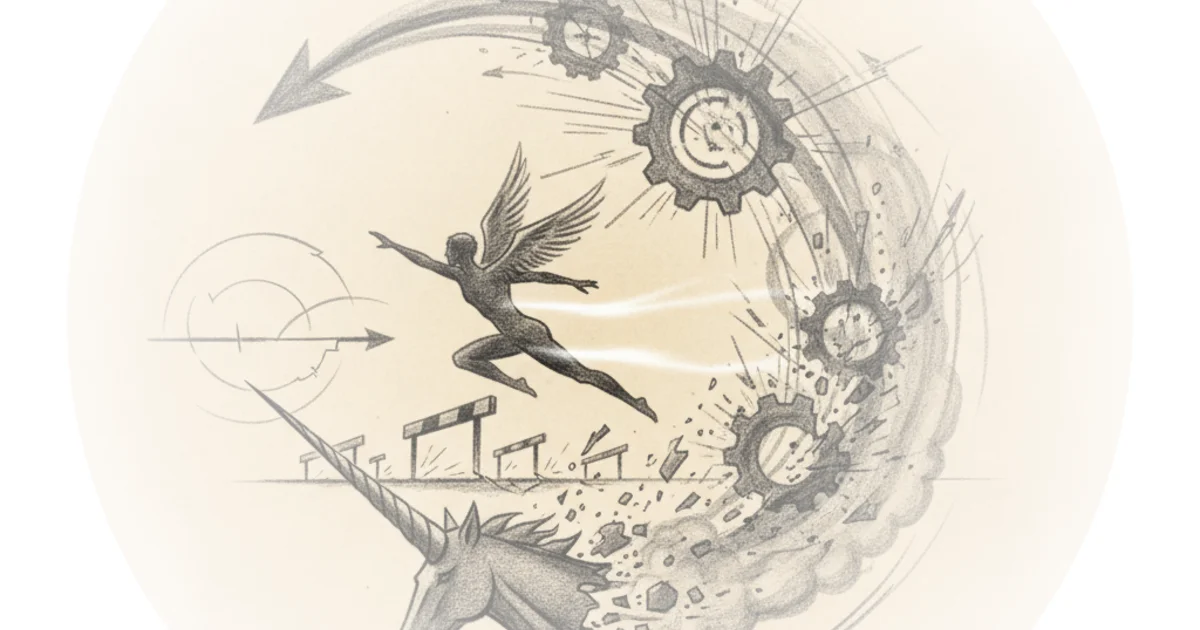
The narrative then moves to the author's own experience as an "analyst" in this new era, a role born not from a lack of data, but from an excess of it. "Someone had to monitor the drones," Krishnan notes, explaining that while analysis became cheap, accuracy did not. He describes a high-stakes environment of adversarial games, where the job was less about creating value and more about confusing the algorithms of competitors. "Ships seemingly going the wrong way, or water displacement made to look fake, all sorts of tricks, some legal and some not," he recounts. This section is particularly compelling because it reframes the AI revolution not as a utopia of leisure, but as a frenetic, stressful arms race where human attention is the only thing that cannot be automated away. Critics might argue that this adversarial framing is too pessimistic, overlooking the collaborative potential of open-source models, yet the author's point stands: in a world where anyone can generate anything, the incentive structure shifts toward deception and differentiation.
"If all people needed to do was be faster than others to ask a question, that's a speed race to the bottom."
The Collapse of the Firm
As Krishnan traces the evolution of the workplace, he identifies a fundamental breakdown in the traditional corporation. He argues that the "Coasean bargain"—the economic logic that justified large firms to minimize transaction costs—has shattered. "The Coasean bargain that made some companies larger broke apart, there ended up being a much larger number of individual contractors and smaller companies than were feasible before," he observes. The result is a landscape of "conglomerates made up of these people who individually wanted to go and help them figure out answers to problems that they could not answer otherwise." This is a profound insight into the future of organizational design: the firm becomes a thin wrapper, a mere aggregator of independent agents rather than a hierarchy of employees.
The author highlights the terrifying efficiency of this new model, where every job is essentially a prototype for its own obsolescence. "Every job was the last job. What is done once got done for all time," Krishnan writes. He describes a scenario where a worker might spend a week solving a complex logistics problem, only for the AI to learn from that interaction and perform it perfectly forever after. "The progress bar would go from 0 to 100 as you did it, and once done it remained done." This creates a paradox where the value of labor spikes momentarily but vanishes instantly, forcing a shift from selling time to selling unique, non-replicable insights. The author notes that this has led to a society where "people today have jobs for 4 months," turning the concept of a career into a series of sporadic, high-premium gigs.
The Return of the Analog
Perhaps the most striking turn in Krishnan's argument is his prediction that the digital saturation of the economy will force a retreat to the physical world. As digital signals become cheap and easily faked, he argues, "the only signalling that was costly was individual presence." This leads to a bizarre inversion where the future is not more virtual, but intensely analog. "When nothing you see or hear could be easily trusted then what remained were small enclaves functioning like private clubs," he explains. Trust, once a byproduct of reputation and history, now requires physical verification. "Hence, physical presence," he concludes, noting that people are moving to cities not for commerce, but to be part of a network where they can verify each other's humanity.
This section connects to the "local knowledge problem" discussed in related deep dives: the idea that certain information is too contextual to be captured by global models. Krishnan suggests that the ultimate bottleneck is no longer data processing, but the ability to distinguish truth from fabrication in a world of infinite synthetic content. "If you couldn't be trusted you couldn't enter," he writes, describing a future where social capital is defined by one's ability to be physically present in the right room. This is a sharp critique of the assumption that technology will inevitably lead to a borderless, frictionless world; instead, it suggests that friction is the only thing that preserves value.
"When nothing you see or hear could be easily trusted then what remained were small enclaves functioning like private clubs."
The Stagnation of Discovery
Despite the chaos of the labor market and the shift in social dynamics, Krishnan offers a sobering observation on scientific progress. He notes that while the cost of goods and services has plummeted, the pace of fundamental discovery has not accelerated proportionally. "The biggest surprise from the heady days when the future was utopia might be that the pace of scientific discoveries changed, but not too much," he writes. He points out that while we have better food and medicine, "string theory remains a theory" and "nobody's riding rockets to the moon." This suggests that the bottleneck to scientific advancement was never a lack of computational power or data analysis, but rather a lack of new conceptual frameworks. "We could run a ton more tests now but there are only so many problems we could brute force our way through," he argues, echoing the sentiment that the low-hanging fruit of the 20th century has been picked, leaving us stuck in a new kind of stagnation.
The author concludes that the ultimate constraint remains human attention and the physical world. "Energy and land remained bottlenecks, because you could always use more and they could always be cheaper, but the world didn't oblige," he writes. Even with abundant capital and advanced robotics, the decisions of what to build remain "market problems as opposed to analysis problems." These are wicked problems that require traversing the "demandscape" and testing ideas against reality, a process that cannot be shortcut by speed or automation. "There are no shortcuts," Krishnan asserts, reminding the reader that the complexity of the physical world imposes limits that no amount of digital efficiency can overcome.
Bottom Line
Krishnan's most powerful contribution is his reframing of the AI revolution not as a story of abundance, but of a new, more intense scarcity: the scarcity of trust and the scarcity of direction. His argument that the future will be defined by a retreat to physical presence and small, high-trust enclaves is a compelling counter-narrative to the prevailing digital utopianism. However, the piece's greatest vulnerability lies in its assumption that the market will naturally correct to value deep thinking; history suggests that in the absence of clear incentives, the rush to commoditize even the highest levels of cognition could persist. Readers should watch for how the tension between algorithmic efficiency and the human need for verified truth plays out in the next decade, as this will likely determine the shape of the next economic era.