Many observers believe we are living through the death of culture. The author argues they are mistaken. We are not witnessing decline—we are standing at the edge of a new renaissance.
The piece examines what the author calls "renaissance moments"—periods in history when a culture is fundamentally renewed by art and literature. These include the European Renaissance, the Romantic Revival, the American Renaissance, and the modernist movement. Each began with strikingly similar patterns. And our current moment shares those same signs.
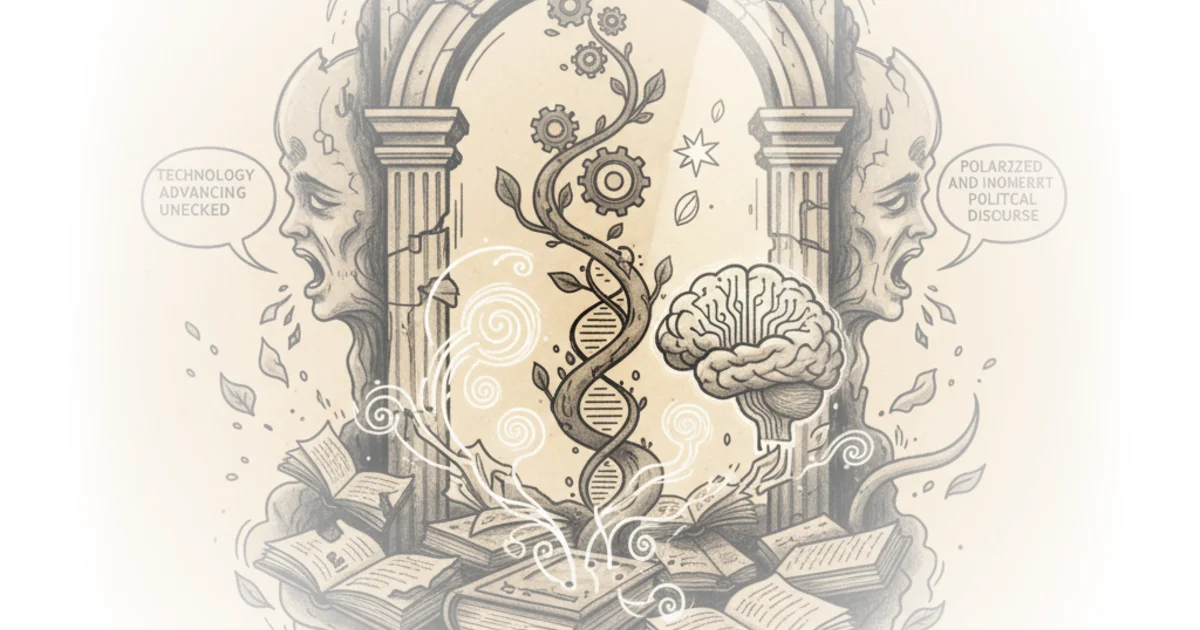
The Pattern of Renewal
The author has studied these historical revivals extensively. What emerges is a recognizable pattern: cultural renewals rarely begin within institutions. The great sparks came from outside the academy—from patrons, readers, and artists.
In Renaissance Florence, Plato's Academy became one of great sparks. It was born among those outside credentialed expertise. The Romantic Revival came largely from poets who were not academic specialists. William Blake was an engraver. Samuel Taylor Coleridge was a restless visionary with no degree from Cambridge. Percy Bysshe Shelley was a political exile. John Keats and Percy Bysshe Shelley were working-class men who changed the course of literature.
In America, Ralph Emerson wrote Nature—an essay that set the American Renaissance ablaze—while being an ex-pastor with no institutional home. Walt Whitman and Emily Dickinson, the two greatest poets of that movement, were amateur writers who composed between jobs and daily chores.
The modernist movement followed the same pattern. T.S. Eliot was a banker. Wallace Stevens was an insurance executive. Langston Hughes was a journalist. None fit the academic mold.
The author argues this proves something: while universities matter, the work of sustaining literary imagination does not belong to them alone. It belongs to communities of readers.
The First Sign: Breaking the Closed Circle
Every renaissance begins with a breaking from what the author calls a "closed circle"—a system that traps consciousness within a narrow circuit of thinking and behavior.
In the European Renaissance, this closed circle was medieval scholasticism promulgated by both church and academy. It was broken open by the introduction of Platonism and later the Reformation—both introducing the radical concept that each person possesses an interiority allowing direct communication with the divine.
The Romantic Revival's closed circle was the tight structure of Enlightenment rationality. It was broken open by the return to nature, prioritizing intuition and the vitality of inner life.
For American artists, the closed circle was the burden of British artistic inheritance. Americans had yet to find their own form of art. This was broken when transcendentalists introduced new spiritual vitality inspiring original American art distinct from inherited tradition.
The modernist tradition's closed circle was Victorian artistic form, broken open by formal rebellion and innovation.
Today, the author argues our closed circle is one of intellectual exhaustion and cultural disassociation. People are beginning to realize they are living in a closed circle. Millions have their attention enslaved by streaming platforms, doped on entertainment and online shopping. What breaks this circle is rest from the machine and recovery of spiritual life exercised not exploited by market interests—nature, literature, community, listening to oneself, developing deep interiority and appreciation of arts.
The Second Sign: Reviving the Imagination
The second sign involves a revival of imagination as something to be activated through reading, writing, and creating new art.
Many people today associate "imagination" with fantasy or mental pictures. But Renaissance thinkers understood it differently. Pico della Gondolano considered imagination harnessed by faith and reason, channeled into artistic creation, perception, and ethical behavior. Ficino saw humanity as a link between higher and lower worlds—and imagination as the faculty enabling spiritual ascent and mediation between realms.
This is a high view of imagination. And what every renaissance has discovered is a revitalization of this principle: readers and artists begin to see themselves participating in a larger imaginative order. They cease regarding imagination as belonging only to dead geniuses. They begin seeing it as a living participatory power authorizing present creation.
The greatest revival of imagination happened with the Romantics. Blake believed all humanity is imagination—one energy shared between humanity and God. Coleridge defined it as "the living power in the prime agent of human perception" and "a repetition in the finite mind of the eternal act of creation in the infinite I am." Emerson described it as an alembic—when nature passes through a human being, it distills into art. Whitman was an alchemist allowing the American spirit to pass through him and channel into poetry.
Today, this sign is appearing in our aversion to AI-generated art and draw toward human-made value. Our faculties of imagination were dulled long before AI arrived. The author argues sufficient wake-up call exists to need real human art—not just more digital entertainment but engagement with the world of imagination itself—a real world from which enduring art and social harmony come.
The Third Sign: Art as Threshold
The third sign involves understanding art as a window and threshold into deeper way of seeing.
Generations raised on smartphones have their sense of beauty trained by passive consumption of digital media. When a painting or work of art is placed before young people today, they expect enjoyment without intellectual or spiritual effort.
But real art is interactive. It requires playing with it, thinking with it, contemplating and meditating upon it. Philosopher C.S. Lewis wrote that in contemplating a painting, there is moment when we lose consciousness that it is not the thing—we contemplate an icon, an image becoming a window into imagination's world.
Books and poems work similarly. People are waking up to this: placing yourself within art's presence for several minutes, entering on its own terms, yields treasures of beauty and wisdom unavailable in entertainment.
All renaissance moments have rediscovered art—but new renaissance begins by resetting conditions of enjoyment established by passive consumption. We must exercise, meditate, dialogue with art, contemplate it. Become pilgrims and creators through this process.
The Fourth Sign: Language's Power
The fourth sign is awareness of language's generative power to shape consciousness and reality.
Renaissance moments bring new attention to language's ability to transform consciousness collectively. Lyric poetry represents enactments of transforming consciousness. Silence at a poem's beginning differs from silence at its end—experience changes consciousness, and experience with art is transformation's highest form.
The Renaissance reintroduced attention to style bringing geniuses like Shakespeare. The Romantics brought poetry nearer to common life charged with spiritual vitality rivaling Hebrew prophets. Emily Dickinson single-handedly invented concise dynamic poetry representing human experience in ways never done before. Virginia Woolf and James Joyce imagined new forms of narration representing human consciousness through stream-of-consciousness.
Today, this sign appears in the return to imagination as power—active power waking us up to need for real human art and engagement with imagination itself.
A Question Worth Asking
Critics might question whether ordinary people can truly bring about a renaissance. The author addresses this directly: history answers emphatically yes. When universities are absorbed in financial interests, when entertainment platforms smother culture with opioid-like stimulation, when political discourse grows incoherent—then no one else remains to help. Fortunately, new signs emerge similarly to past renactions.
The author's hope is that readers discover their own capacity for vision—a place where communities of readers can reset conditions of enjoyment, become pilgrims and creators, recover imagination as active power, and exercise deep interiority in appreciation of arts offering far more than any streaming platform.
"Revivals of learning are rarely begun within institutions."
Bottom Line
The author's strongest argument is that history itself proves revivals begin outside institutions—from readers, artists, and ordinary people living lives similar to today. The pattern is unmistakable across multiple renaissances. His biggest vulnerability: while the historical parallels are compelling, identifying exactly which contemporary developments constitute these "signs" requires more specificity. What exactly constitutes "rest from the machine"? Which art? Which language transformation? The argument remains suggestive rather than definitive—historical precedent suggests possibility, not certainty. The piece's greatest value lies in reframing despair about culture into hope for renewal.