Ray Carpenter doesn't just ask what would happen if the NFL adopted soccer's disciplinary system; he runs a simulation that exposes how fragile the American game's balance of power really is. By applying the concept of red cards—where a player is ejected for repeated fouls—to decades of play-by-play data, Carpenter reveals a startling truth: the NFL is already teetering on the edge of becoming a sport where one mistake can collapse an entire unit.
The Philosophy of the Card
Carpenter begins by contrasting the officiating cultures of the two sports, arguing that soccer's "gray areas" actually invite tactical genius rather than chaos. He writes, "I like to explain soccer to non-soccer fans as a sport that rewards cheating or cutting corners because of its gray areas." This framing is provocative, suggesting that what looks like gamesmanship in soccer is actually a sophisticated layer of strategy absent from the highly regulated NFL.
He notes that while FIFA has tried to clamp down on time-wasting with new rules for the 2026 World Cup, such as a strict ten-second substitution window, the sport still retains a unique "game within the game." Carpenter observes that having only one referee policing a massive field is like "having one lifeguard for the entire Atlantic Ocean," yet this scarcity forces teams to adapt in ways American football never does. He posits that if an NFL team faced a talent gap, they might adopt a defensive posture known as "parking the bus"—a term referencing a strategy where a team defends with nearly all players behind the ball, sacrificing offense entirely to secure a draw.
Critics might argue that the NFL's structure of downs and yards inherently prevents such extreme defensive conservatism, but Carpenter's simulation suggests otherwise. He challenges the reader to consider: "Will a team ever park the bus in an NFL game? It's a fundamentally difficult question to answer..." The implication is that the current rules prevent teams from fully exploiting their weaknesses, whereas soccer allows for a more fluid, albeit chaotic, tactical response.
If your team isn't faster, you have to play more physical. If your team is shorter, you have to play with more speed. It's all about the game within the game.
The Mechanics of Disadvantage
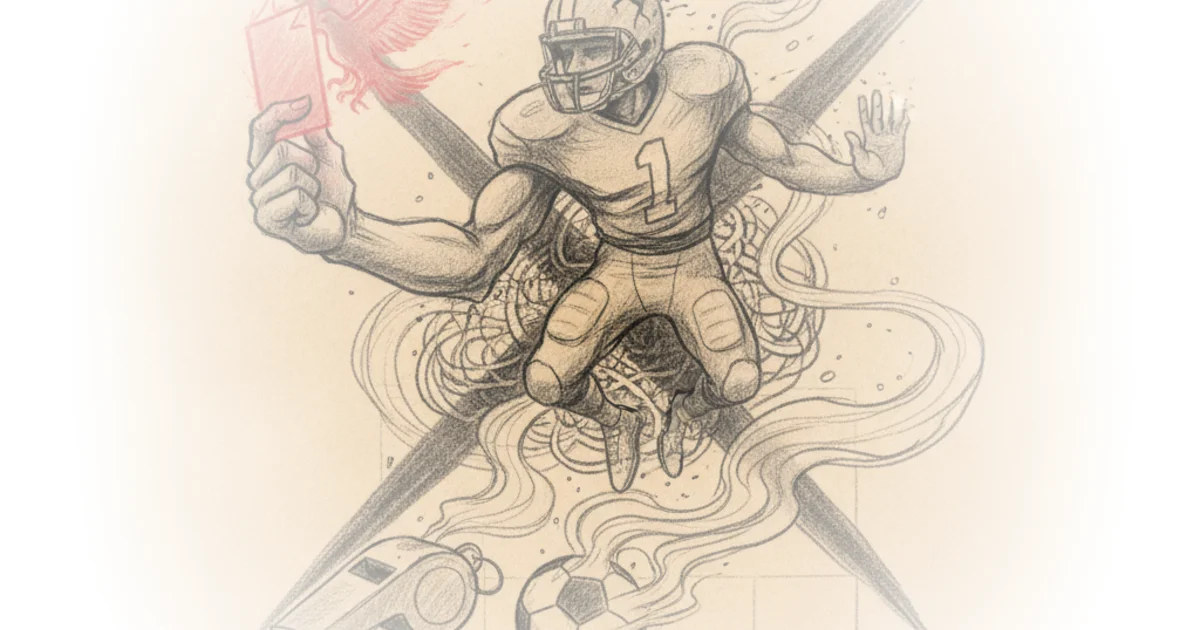
The core of Carpenter's analysis lies in his translation of soccer's yellow and red cards into an NFL context. In soccer, a red card means playing the rest of the match a man down, a penalty that almost guarantees defeat unless the score is zero-zero. Carpenter adapts this by creating a model where committing the same penalty twice results in ejection. He writes, "If you commit the same penalty twice in the same game, you receive a red card and your team's side of the ball must play one player down for the rest of the game."
To quantify the impact, Carpenter utilized historical data from nflfastR to analyze plays where teams were already shorthanded due to penalties or injuries. He found that when the defense fields only ten players, the offense gains a significant advantage. "Using a linear regression... I landed on the number .068 EPA per play for when an NFL player is hypothetically sent off," he explains. This metric—Expected Points Added per play—demonstrates that losing even a single defender fundamentally shifts the probability of scoring.
This evidence holds up well against the backdrop of known anomalies in football, such as the "too many men on the field" penalty. Carpenter notes that these situations happen more often than fans realize, citing a specific play where the Tampa Bay Buccaneers had only nine defenders in the red zone, leading to an easy score for Bijan Robinson. He argues that while these are rare occurrences now, a formal red card system would make them systemic, forcing coaches to manage player discipline with the same intensity as soccer managers.
The Human Cost of Repetition
Perhaps the most striking element of Carpenter's simulation is the identification of players who would have been ejected under this new regime. The data points to figures like Philip Rivers, who allegedly committed two delay-of-game penalties in thirteen different games, and Laremy Tunsil for false starts. "In 13 different games, Rivers got two delay of game penalties," Carpenter notes with a touch of irony. "This is tough to check and cruel... But red cards in soccer are often cruel and tough to check too, so I thought it was fitting."
The simulation also uncovers absurd historical scenarios, such as the Washington Football Team being down to eight men on defense or an offensive line playing without a long snapper. Carpenter highlights a 1999 game where an offensive tackle received two false starts in zero seconds, effectively ending his team's ability to run plays. He writes, "Imagine trying to finish a game without your long snapper."
This section reveals a vulnerability in the NFL's current penalty structure: it treats repeated infractions as isolated incidents rather than cumulative failures of discipline. By drawing on the soccer model, Carpenter forces us to confront how much the game relies on players not making the same mistake twice. The historical context here is fascinating; just as the introduction of the "offside trap" in association football changed defensive tactics in the 1970s, a red card rule would force NFL offenses to become hyper-conservative or risk total collapse.
Imagine trying to finish a game without your long snapper. That's all for today, thanks everyone.
Bottom Line
Ray Carpenter's simulation is a brilliant thought experiment that exposes the fragility of the NFL's 11-on-11 equilibrium. The strongest part of his argument is the data-driven proof that a single missing player drastically alters Expected Points Added, validating the soccer intuition that numerical disadvantage is catastrophic. However, the model's biggest vulnerability lies in its assumption that NFL players and coaches would adapt to such a rule without fundamentally breaking the flow of the game; unlike soccer, where play continues fluidly, an NFL game with a man down might become unplayable rather than just difficult. Readers should watch for how the league handles penalty discipline as the sport evolves, because Carpenter's work suggests that the line between a strategic foul and a career-ending ejection is thinner than we think.