Paul Cooper doesn't just recount the history of a fallen empire; he reconstructs a world that vanished so completely that even its name was forgotten by the very people who walked its streets. While most historical narratives focus on the rise of power, Cooper's "Fall of Civilizations" episode on Vijayanagara is notable for its forensic attention to the silence left behind—the specific, haunting details of how a global metropolis was swallowed by granite and time. This is not a dry recitation of dates, but a sensory excavation that forces the listener to confront the fragility of human achievement against the backdrop of deep geological time.
The Cartographer's Discovery
Cooper anchors the narrative not in the glory of kings, but in the quiet curiosity of a British East India Company officer named Colin Mackenzie, who stumbled upon the ruins in 1800. The author highlights Mackenzie's unique position as a man who "became so fascinated with the place that he would never leave," amassing a collection of 1500 manuscripts and thousands of coins before turning his attention to the overgrown city of Hampi. Cooper writes, "Mackenzie records what it was like to wander through the overgrown ruins of this great city as his guides told him what they could about its history."
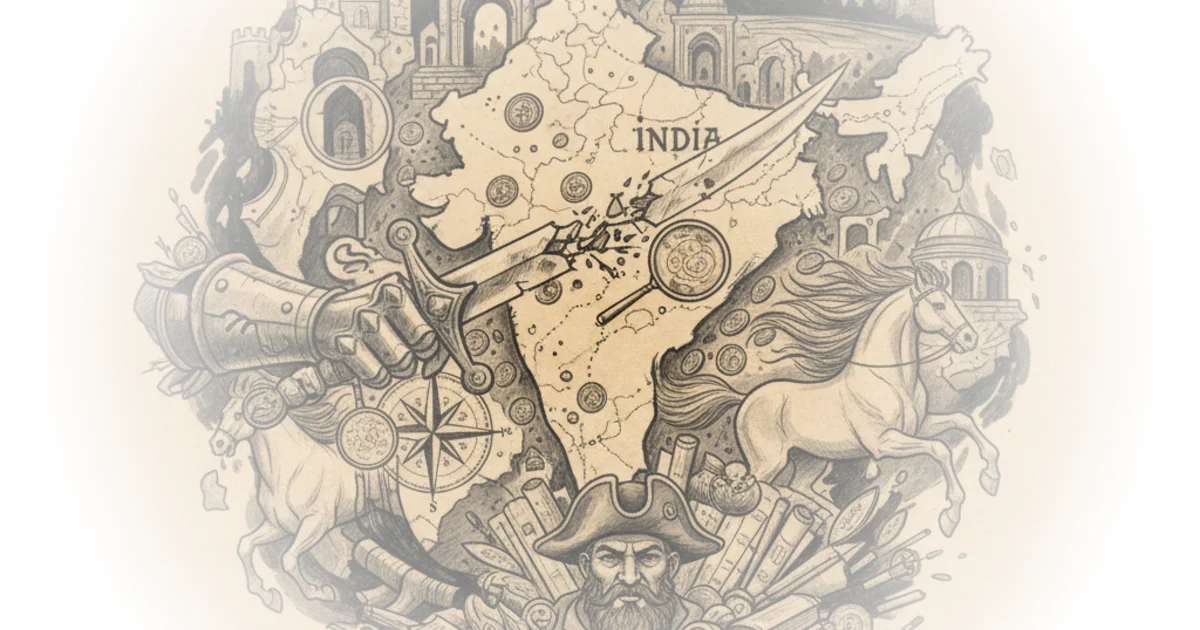
This framing is effective because it humanizes the discovery process, shifting the focus from imperial conquest to the sheer mystery of the past. Cooper notes that Mackenzie was "not a man given over to poetry and he let his maps and sketches do the talking," yet the author still captures the emotional weight of the moment when Mackenzie realized the scale of what lay before him. The description of the ruins as "crumbling and overgrown" near the village of Hampi, known locally as "al-purtun" or the ruined city, sets a tone of melancholic grandeur that permeates the rest of the piece.
"This place is now almost ruined but its remains are still very magnificent and curious... many great houses whose terraces are level with or sunk below the soil."
Cooper's choice to quote Mackenzie's journal directly grounds the listener in the 19th-century perspective, making the loss feel immediate rather than abstract. The author effectively uses Mackenzie's observation of the "interior ramparts" and "waterworks of the most remarkable sort" to illustrate the sophistication of the Vijayanagara engineering, which had been largely erased from the collective memory of the region.
The Stone and the Silence
The piece then pivots to the landscape itself, treating the Deccan plateau not merely as a setting, but as a character that outlasted the civilization. Cooper describes the terrain as a "strangely wild place" where "enormous rounded boulders teeter in strange and unlikely balancing acts." He draws on the vivid description of a later visitor, A.H. Longhurst, to paint a picture of a land where "earthquakes of remote ages have torn from their flanks the enormous boulders and have piled these up round about their sides in the most fantastic confusion."
This geological context is crucial to Cooper's argument. By establishing that the granite sheets are "three and a half billion years old," he creates a stark contrast between the fleeting nature of human empires and the permanence of the earth. The author argues that while the "soft rocks have eroded around them these hard granites have remained," serving as a silent witness to the rise and fall of countless societies. This framing elevates the narrative from a simple history lesson to a meditation on time itself.
Critics might note that focusing so heavily on the geological stability of the region risks downplaying the specific human agency and political failures that led to the empire's collapse. However, Cooper balances this by weaving in the human story of the Indus Valley civilization, noting that "the tragedy is that it has never been decoded and so the names of their cities the names of their kings their deeds and works the lives of everyday people all of it has been lost beneath the sands of Pakistan perhaps forever."
The Echoes of the Indus
Before diving deep into Vijayanagara, Cooper traces the lineage of civilization back to the Indus Valley, using it as a cautionary tale of climate and collapse. He points out that the Indus Valley people "did not use as extensive irrigation techniques and so were more reliant on the annual floods of the river," a vulnerability that proved fatal when the monsoons weakened. Cooper writes, "As the floods failed the capacity of the river to support the population would have collapsed at this time."
This historical parallel serves as a powerful undercurrent for the Vijayanagara story, suggesting that the fate of great cities is often tied to environmental shifts beyond their control. The author's description of the Indus Valley symbols as "tiny containing only four to five characters" underscores the fragility of the written record, reinforcing the theme that history is often a collection of fragments rather than a complete narrative. By connecting the undeciphered script of the Indus Valley to the overgrown ruins of Vijayanagara, Cooper creates a continuous thread of loss that spans millennia.
"The granite terrain that surrounds the small village of Hampi and the ruins of Vijayanagara around it is one of the most distinct and easily recognizable in the world."
Cooper's ability to weave together the geological, the historical, and the archaeological creates a rich tapestry that is both educational and deeply moving. He avoids the trap of romanticizing the past, instead presenting a clear-eyed view of how civilizations rise, flourish, and eventually return to the earth.
Bottom Line
Paul Cooper's greatest strength lies in his ability to make the distant past feel viscerally present, using the physical remnants of Vijayanagara to explore the universal themes of rise and fall. The piece's biggest vulnerability is its reliance on the fragmentary nature of the historical record, which leaves some gaps in the narrative of the empire's final days. However, this limitation is also its greatest asset, reminding the listener that history is often defined by what we can no longer see, hear, or read. For the busy listener seeking a deeper understanding of how civilizations endure and vanish, this episode offers a rare and profound perspective.