A Father's Defense of Hogwarts
In January 2026, journalist Louise Perry published an op-ed in The New York Times titled "The Harry Potter Generation Needs to Grow Up," arguing that the values underlying J.K. Rowling's series have lost their cultural grip. Tyler Johnson, a medical oncologist and associate editor at Wayfare, responds with a deeply personal counterargument rooted in fatherhood, literary theory, and the emotional mechanics of reading aloud to children.
Johnson does not dismiss Perry outright. He concedes several of her observations. He acknowledges Rowling's complicated public persona, admits that the franchise's ubiquity has made it feel "threadbare and worn in 2026," and even notes that his own fourteen-year-old finds the family's devotion to the series "a little bit cringe." The honesty is disarming.
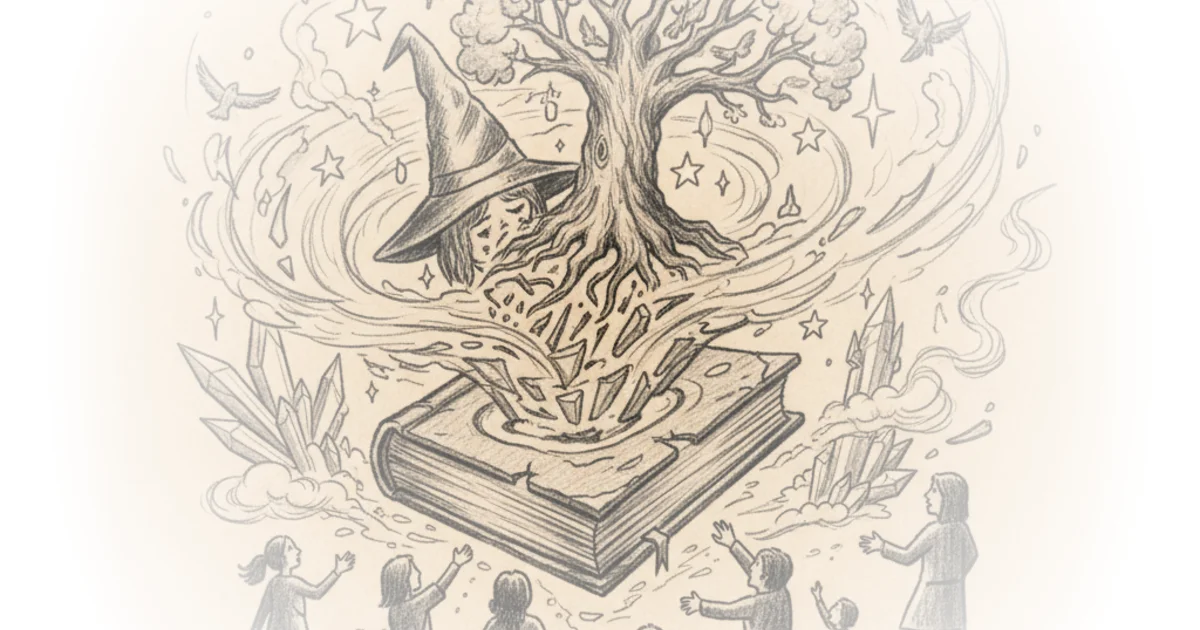
Perry's Thesis: Liberalism Lost Its Spell
Perry's argument hinges on a generational divide. Millennials loved the books because the moral universe of Hogwarts mirrored their optimistic assumptions about liberal democracy. Generation Z, battered by economic decline and political polarization, no longer buys the premise. Johnson quotes Perry's central claim:
That's why millennials like Harry Potter a whole lot more than younger generations do. The story captures a worldview that is no longer attractive to young people jaded by the experiences of economic decline, political polarization and spiraling identity politics. They have fallen out of love with Harry Potter because they have fallen out of love with the worldview the series represents, which is to say that young people have fallen out of love with liberalism.
Perry then extends this into a broader indictment of the books themselves, suggesting they functioned as a kind of wish fulfillment for an entire generation:
I now wonder if the Harry Potter books themselves functioned as something like a Mirror of Erised (which shows its viewers what they most desire) for my generation. They reflected an image of the world that we so wanted to be real: a world that was ancient and magical, where even children had the ability to identify and vanquish evil. It was beautiful in its moral simplicity. It was also too good to be true.
It is a sharp metaphor. The Mirror of Erised shows the viewer their deepest desire, not reality. Perry is saying an entire generation mistook longing for truth.
Where Johnson Finds the Real Flaw
Johnson identifies what he considers a categorical error in Perry's reasoning. Perry reads the books backward, from the vantage of someone who already knows the ending, and concludes that Rowling presents liberal triumph as inevitable. Johnson argues this misunderstands how literature works at the most fundamental level.
The entire point of great literature involves our willingness to rise, fall, triumph, and suffer with the characters when we do not know how the story will end. Reading is, after all, an exercise in willful, embodied, and meaningful imagination.
This is the essay's strongest move. By reframing the debate from political philosophy to literary experience, Johnson shifts the ground entirely. The books are not a political manifesto. They are a narrative that asks readers to sit in uncertainty.
He bolsters this with a telling detail from the original critical reception, citing Liesl Schillinger's 2005 New York Times review of the sixth book:
Suffice it to say that this new volume culminates in a finish so scorchingly distressing that the reader closes the book quaking, knowing that out of these ashes, somehow, the Phoenix of Rowling's fiction will rise again—but worrying about how on Earth Harry will cope until it does.
Nobody reading that book in real time thought liberal values were guaranteed to win. They were terrified.
The Strongest Counterpoint Johnson Concedes
In a notably generous move, Johnson acknowledges that the most damaging critique of Rowling's moral architecture comes not from Perry but from Sam Anderson's 2007 review in New York Magazine. Anderson took aim at the final book's resurrection sequence, where Harry dies and then simply comes back:
I'm not opposed to Happy Endings per se—I'm just opposed to the author trying to get Emotional credit for both a tragic and happy ending without earning either. Rowling had been gathering storm clouds for ten years; her fictional sky was as purple and lumpy as a quidditch stadium full of plums, and the whole world had lined up to watch it rain.
Johnson agrees. He writes that the denouement "tries too hard to have it both ways—and therefore ends up achieving neither convincingly." This is the one place where Perry's broader thesis about naive optimism has genuine traction, and Johnson is honest enough to say so.
There is a counterpoint worth raising here, though. If Johnson concedes that the ending undercuts the moral weight of sacrifice, it becomes harder to sustain his larger claim that the books teach children to sit with uncertainty and risk. The books ultimately do promise that goodness will be rescued at the last moment by ancient magic no one knew about. That is not uncertainty. That is a safety net.
Fatherhood as Literary Criticism
The essay's emotional core is autobiographical. Johnson has read all 3,500 pages of the series aloud to his three sons, not once but twice. He watches their faces as the story unfolds. He describes his youngest son's anguish when Dumbledore dies, the "incessant begging questions" about whether the headmaster might somehow return.
I have watched their countenances rise and fall as the characters have variously succeeded and failed. I have felt my youngest son's soul-deep anguish when Dumbledore was lost and have heard his incessant begging questions as he pleaded to know if Dumbledore was really dead or would somehow make his way back into the narrative.
This is where Johnson's argument becomes something more than intellectual sparring. The lived experience of reading to children, of watching a story reshape their interior world in real time, is not something Perry's op-ed can easily answer. It is also, one might note, a form of evidence that resists generalization. Johnson's sons are not a generation. They are three specific boys on a couch.
The Patronus and the Point of Fiction
Johnson builds to his conclusion through a close reading of the Prisoner of Azkaban's time-travel sequence, where Harry discovers that the mysterious figure who saved him from dementors was his own future self. Harry can summon the patronus because he has already seen himself do it. Johnson argues this is precisely what literature does for all of us:
We are meant to face that challenge vicariously so that when life sends at us masses of monsters scarier and far more real than those in an imagined universe, we have already developed the emotional muscles to respond as fate dictates we must.
It is an elegant parallel. Fiction as rehearsal. The reader watches a character triumph and then carries that vicarious memory forward into real life, just as Harry carries the memory of his future self backward through time.
Whether this holds up as a general theory of literature is debatable. Plenty of great books offer no triumph at all. But as a defense of why these particular books matter to these particular children, it lands with force.
Bottom Line
Johnson's essay succeeds not by dismantling Perry's political analysis but by changing the subject. Perry asks whether the values in Harry Potter are naive. Johnson asks whether the experience of reading Harry Potter builds something durable in children. These are different questions, and Johnson's is the more interesting one. His willingness to concede Perry's strongest points, especially the Anderson critique of the final book's resurrection cop-out, gives the essay credibility that a pure rebuttal would lack. The weakness is that Johnson's most powerful evidence is anecdotal and irreducibly personal. Three boys on a couch do not refute a generational thesis. But they do remind us that literature does not operate at the level of generations. It operates at the level of a voice reading in a room, a child leaning forward, and a patronus blazing across a dark lake.