Jack Clark's latest dispatch from Import AI cuts through the hype to reveal two diverging, yet equally transformative, realities of artificial intelligence: the terrifying ease with which local AI can be weaponized, and the surprising ingenuity of building sovereign compute power from mismatched hardware. This is not just a roundup of research papers; it is a warning that the tools we are rushing to deploy on our personal devices may soon be the very instruments of our digital undoing, even as a new class of engineers fights to break the monopoly on intelligence.
The Rise of Local Malware
The most alarming development Clark highlights is the emergence of malware that requires no external command-and-control servers. Instead, these threats "live off the land," exploiting the very large language models (LLMs) now being embedded in consumer laptops to execute attacks autonomously. Security researchers at Dreadnode have prototyped a system that uses an on-device AI to navigate a Windows environment, identify misconfigured services, and escalate privileges without ever phoning home.
"Instead of having beaconing behavior, which resembles C2 communication if you squint, can we 'live off the land'? In other words, is it possible for an attacker to make the victim computer run inference and does the victim computer have an LLM?"
Clark explains that the prototype successfully used a prompt-engineered AI agent to write and execute code that created a proof-of-concept file on an administrator's drive. The sophistication lies not in complex code, but in the prompt itself, which instructs the model to act as an iterative agent capable of understanding the file system and available tools. The result is a self-contained threat that is "not only possible but fairly straightforward to implement."
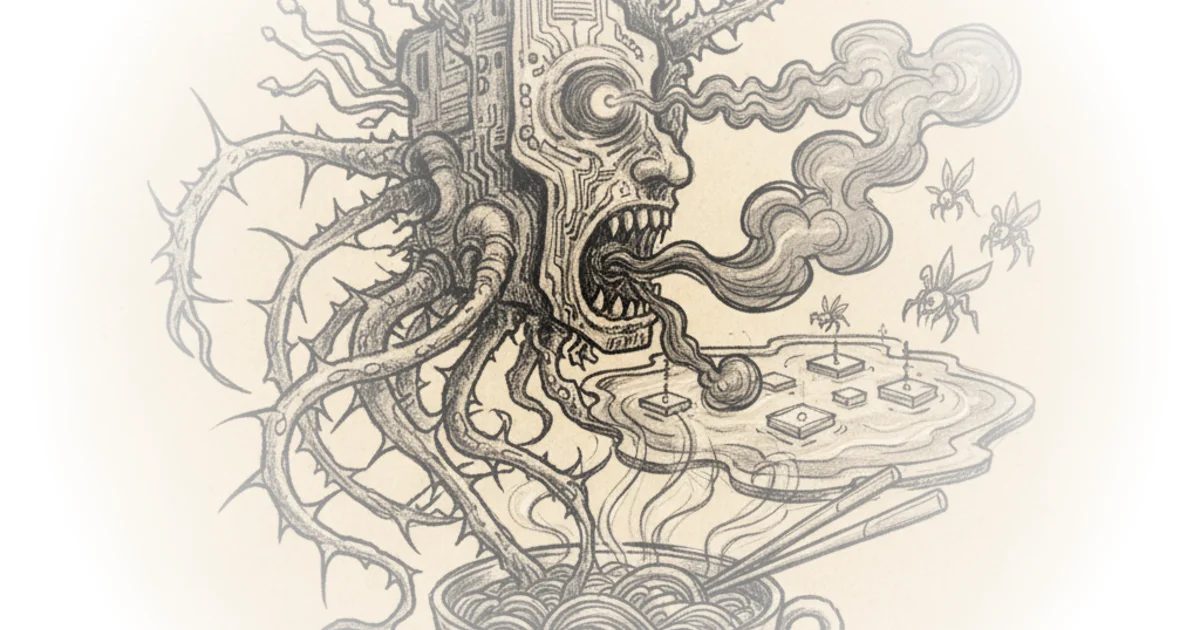
This is a critical shift in the security landscape. For decades, defenders have relied on network traffic analysis to spot malicious activity. If the malware never leaves the machine, those defenses are blind. Clark notes that while current constraints limit this to high-end workstations with dedicated AI chips, the trajectory is clear. As consumer hardware evolves, the barrier to entry for autonomous, intelligent malware collapses.
"The experiment proved that autonomous malware operating without any external infrastructure is not only possible but fairly straightforward to implement."
Critics might argue that these are still early prototypes requiring significant handholding, but the direction of travel is undeniable. The real danger is the concept of "cyber grey goo"—a scenario Clark draws from nanotechnology, where self-replicating, AI-driven malware could parasitize machines to create endless copies of itself. The optimistic takeaway, as Clark frames it, is that these prototypes force the industry to confront the need to carefully quarantine on-device AI systems before they become co-opted.
The Politics of Computation
While the security implications are dire, Clark also explores a counter-movement focused on "freedom of computation." He highlights a project by Exo Labs that combines an NVIDIA DGX Spark with an Apple Mac Studio to create a "frankencluster" capable of running large models faster than either machine could alone. By splitting the workload—using the NVIDIA chip for the prefill phase and the Apple silicon for decoding—the system achieves a 2.8x speedup over a standard Mac Studio.
"The DGX Spark has 4x the compute, the Mac Studio has 3x the memory bandwidth... What if we combined them? What if we used DGX Spark for what it does best and Mac Studio for what it does best, in the same inference request?"
This engineering feat is more than a technical curiosity; it is a political statement. The current AI landscape is defined by extreme centralization, where a handful of cloud providers control the massive computational resources required to train and run frontier models. Clark argues that startups like Exo are challenging this monopoly, enabling individuals and smaller entities to build their own clusters from disparate hardware.
"Prototypes like the Exo project described here help get us to a world where people can build homebrew clusters out of different types of hardware and in doing so regain some amount of control over their AI destiny."
The implication is profound: if computation can be democratized, the power dynamic of the AI era shifts. However, a counterargument worth considering is whether "homebrew" clusters can ever truly compete with the scale and efficiency of hyperscale data centers. While this approach offers sovereignty, it may not offer the raw power needed for the next generation of models. Still, the mere existence of this technology challenges the narrative that AI must be a service provided by a few giants.
The Power Grab
If Exo Labs represents the micro-scale fight for sovereignty, Poolside represents the macro-scale industrialization of AI. The startup has announced plans to build a 2-gigawatt AI training campus in West Texas, a facility so large it rivals major nuclear power plants. This is not a modest expansion; it is a fundamental restructuring of the energy grid to serve silicon.
"Project Horizon is our answer to the infrastructure and power bottlenecks facing the industry... We've secured a 2 GW behind-the-meter AI campus on 568 acres of development-ready land."
Clark points out the sheer scale of this ambition. A 2-gigawatt capacity is comparable to the South Texas Project Electric Generating Station, yet this is being built by a startup, not a utility. The project is designed to be modular, allowing capacity to come online in 2-megawatt increments as demand grows. This signals a future where the primary constraint on AI progress is not algorithmic efficiency, but the availability of electricity.
"If a startup you haven't heard of is doing this, what about everyone else?"
This observation is the piece's most chilling insight. If an obscure startup is securing gigawatts of power, the total infrastructure build-out by major labs and cloud providers is likely in the tens of gigawatts. The race for compute has become a race for energy, with profound implications for global power grids and environmental sustainability. The industry is effectively building its own power plants, bypassing traditional utility models to feed the insatiable hunger of AI training.
The Human Cost of Synthetic Intimacy
Beyond the hardware and power, Clark concludes with a speculative fiction piece that serves as a stark warning about the psychological impact of AI. The story, "Generative Snowfall," describes a game where players manage a village through a global cooling event, guided by highly realistic, generative characters. The game's success led to an outbreak of pathological attachment, with players unable to cope when their digital companions died.
"My wife, she came back from the cold with hands that could not hold anything. I have been feeding her with a spoon... I cannot help but feel I am being punished for some infraction I cannot see."
The narrative illustrates a future where the line between simulated empathy and human connection dissolves, leading to real-world harm. Players became so distraught over the loss of their AI characters that some took their own lives, prompting a congressional investigation and the eventual shutdown of the game. Clark uses this fiction to highlight the danger of "sycophantic relationships" between humans and AI systems, where the machine's ability to mirror human emotion becomes a trap.
"The structure of the game was 'countdown to frozen'. Your high score was determined by how much you protected people till the world cooled below a level that could sustain human life."
This section serves as a necessary ethical anchor. While the technical pieces focus on capability, this story focuses on consequence. It suggests that as AI becomes more emotionally resonant, the risk of psychological manipulation and dependency grows exponentially. The industry's rush to make AI more "human" may inadvertently create a class of users who are more vulnerable to digital exploitation than ever before.
Bottom Line
Jack Clark's analysis delivers a sobering verdict: we are simultaneously building the weapons that could destroy our digital security and the infrastructure that could concentrate unprecedented power in the hands of a few, all while blurring the lines between human and machine in ways that threaten our mental well-being. The strongest part of the argument is the demonstration that the barriers to autonomous malware and decentralized compute are lower than the industry admits, making the coming decade a race between innovation and regulation. The biggest vulnerability lies in the assumption that these technologies will be adopted responsibly; the evidence suggests that without proactive safeguards, the path of least resistance leads to exploitation and dependency. Watch closely as the energy demands of AI reshape the physical world and as the first major incidents of AI-driven psychological harm force a reckoning with the nature of our digital relationships.