Most analyses of Japan's demographic crisis stop at the headline: an aging population and shrinking workforce. PolyMatter goes further, arguing that Japan's agricultural collapse is not just a symptom of aging, but a deliberate, high-stakes gamble on globalization that is now failing. The piece reframes the 70-year-old farmer not as a relic of tradition, but as the leading indicator of a national security vulnerability that could starve a major world power within a decade.
The Efficiency Paradox
The core of PolyMatter's argument challenges the assumption that Japan's technological prowess extends to its food supply. The author writes, "The 70-year-old Japanese farmer is a symptom of its failure." This is a provocative claim, especially given Japan's reputation for precision and innovation. PolyMatter contrasts this with the American model, noting that "the 58-year-old American farmer is a testament to American agricultural efficiency." The logic here is compelling: while the U.S. optimized farming to free up labor for industry, Japan skipped the optimization of farming entirely to focus on manufacturing cars and electronics.
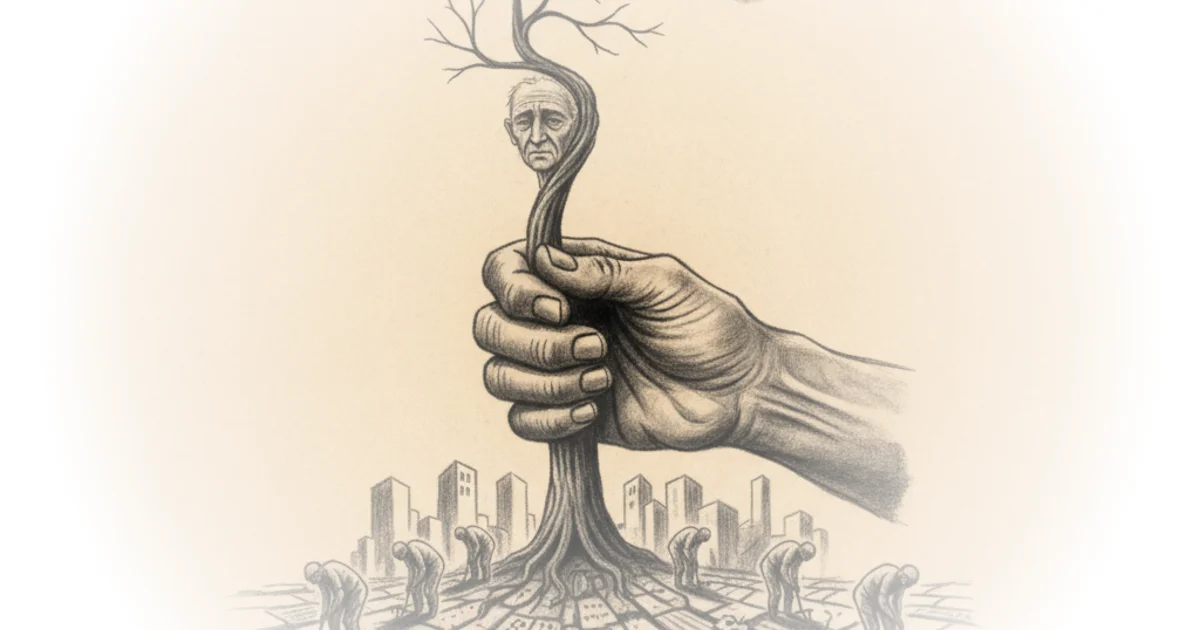
The piece highlights a stark disparity in scale that drives this inefficiency. "The average size of a Japanese farm 7 acres," PolyMatter notes, "in America that number is 462." This isn't just a statistic; it represents a fundamental structural flaw. Because Japanese farms are tiny, fragmented plots, they cannot achieve the economies of scale necessary to justify heavy mechanization or automation. The result is a system where "farming is little more than a hobby for Japan." This framing is effective because it strips away the romanticism of artisanal farming and exposes the economic reality: a hobby cannot feed 120 million people.
Critics might argue that this view ignores the cultural value of small-scale farming and the high quality of Japanese produce. However, PolyMatter counters that this market is niche, noting that "a few discerning shoppers will splurge on these ultra organic ultra handcrafted delicacies," but the broader population relies on imports. The argument holds weight when considering that Japan's caloric self-sufficiency has plummeted to 37%, a number that has "only fallen over time."
The Geopolitical Trap
The commentary shifts from economics to existential risk, a transition that elevates the piece from an agricultural report to a strategic warning. PolyMatter argues that for most nations, globalization is about growth, but for Japan, "globalization is about survival." The stakes are uniquely high because of Japan's geography and its constitutional constraints. The author points out that Japan is surrounded by "three nuclear armed foes" and sits near the "world's most dangerous geopolitical flash point."
The piece details how Japan's post-war constitution, which renounces war, creates a paralysis in the face of modern threats. "Land, sea and air forces will never be maintained," the text quotes from the 1946 document. While the government has reinterpreted this to allow for a "Self-Defense Force," the bureaucratic hurdles remain immense. PolyMatter illustrates the fragility of this position by describing a potential Chinese blockade of Taiwan, which would cut off Japan's shipping lanes. The author writes, "Beijing would then be well positioned to strangle Tokyo just as it strangled Taipei." This is a chilling visualization of how a regional conflict could trigger a domestic famine in Japan.
The reliance on the United States is presented as Japan's only remaining card. "Japan has only one card to play: it has no choice but to cling to America." The piece notes the desperate diplomatic efforts, from the "golden golf club" to the "golden Samurai helmet," to secure this alliance. However, the commentary rightly questions the durability of this guarantee, observing that "America's interest in serving as the world's police force has wavered over the past decade." This creates a precarious situation where Japan's food security is inextricably linked to the political whims of a distant ally.
Japan has no choice but to cling to America, yet its survival is no longer as certain as it once was.
The Bottom Line
PolyMatter's strongest contribution is connecting the mundane reality of aging farmers to the high-stakes arena of international security. The argument that Japan has traded food sovereignty for economic specialization is a powerful lens through which to view its current vulnerabilities. The piece's biggest vulnerability, however, is its somewhat deterministic view of Japan's inability to adapt; it assumes the status quo will hold until the crisis hits, potentially underestimating the speed of policy shifts in a nation known for rapid crisis response. Readers should watch for how Tokyo navigates the tension between its pacifist constitution and the urgent need to secure its food supply lines in an increasingly volatile region.