L. M. Sacasas challenges the popular narrative that we are merely victims of a "dopamine culture" engineered by tech giants, arguing instead that we are actively fleeing the terrifying quiet of our own thoughts. While many accept the diagnosis of addiction as a biological inevitability, Sacasas reframes the crisis as a profound failure of solitude, suggesting that our devices are not just hijacking our brains but shielding us from the human condition itself.
The Limits of the Dopamine Frame
The piece begins by engaging with a widely circulated argument by cultural historian Ted Gioia, who posits that digital platforms have shifted culture from entertainment to addiction. Gioia claims that "the tech platforms aren't like the Medici in Florence... They don't want to find the next Michelangelo or Mozart. They want to create a world of junkies—because they will be the dealers." Sacasas acknowledges the power of this framing but finds it ultimately reductive. He argues that the "dopamine" label is a blunt instrument that strips away human agency and complexity.
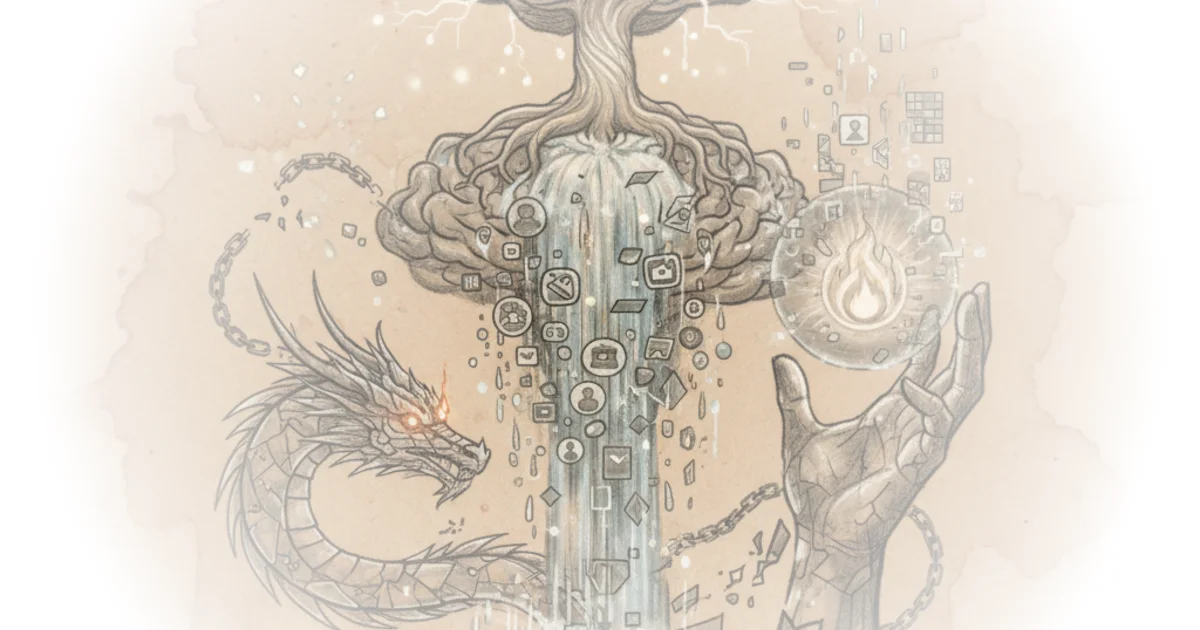
By focusing solely on neurochemistry, the addiction model ignores the underlying reasons we seek distraction. Sacasas writes, "What are the underlying fears and aspirations that might be driving our compulsive relationship to digital media?" He suggests that the framing tells us too little about the human experience while claiming too much about our helplessness. If we view ourselves merely as addicts, we absolve ourselves of the responsibility to change. As Sacasas puts it, "It may be tempting to believe we have less agency than we, in fact, possess precisely because it frees us from the burden of responsibility."
The dopamine framing at once tells us too little and also claims too much.
Critics might argue that the biological reality of algorithmic design is so potent that distinguishing between compulsion and addiction is a semantic luxury most people cannot afford. However, Sacasas maintains that even if the line is blurry, the distinction matters for how we approach recovery and personal growth.
The Poverty of Concepts
Sacasas moves beyond the chart and the chemistry to question the vocabulary we use to describe our relationship with technology. He points out that we may be suffering from a "poverty of concepts," unable to articulate the specific nature of our discomfort. He illustrates this with an anecdote from Dr. Anna Lembke's work, where a student, when asked to walk without her phone, responds with genuine terror: "Why would I do that?" This reaction, Sacasas notes, suggests that many people have grown up unable to imagine a life without a steady stream of external stimuli.
The author argues that this inability to sit with one's own thoughts is not just a habit but a loss of a fundamental human skill. We have been "deskilled" in the practice of solitude. Sacasas observes, "Have we grown uncomfortable in our own company and has this amplified the preponderance of loneliness in contemporary society?" This shifts the blame from a purely external force to an internal void that we are desperate to fill. The tech companies are certainly exploiting this void, but they are not the sole architects of it.
The Ancient Cure for Modern Distraction
To deepen the analysis, Sacasas reaches back to the 17th-century French polymath Blaise Pascal, whose observations on "diversion" offer a more nuanced lens than modern neuroscience. Pascal argued that humans seek distraction not because of a chemical imbalance, but to avoid confronting their own mortality and the "frailty of the human condition." Sacasas highlights Pascal's insight that even a king, surrounded by every pleasure, is unhappy if he is left alone with his thoughts.
"The king is surrounded by persons whose only thought is to divert the king, and to prevent his thinking of self," Sacasas quotes, noting the eerie parallel to our current digital landscape. We are all kings now, surrounded by devices whose only purpose is to prevent us from thinking about ourselves. Pascal's warning that without diversion people would be "bored to extinction" and feel their "nullity" resonates deeply in an era of constant connectivity. Sacasas suggests that our fear of silence is a fear of facing the self, a fear that technology has monetized and amplified.
We are all of us kings now surrounded by devices whose only purpose is to prevent us from thinking about ourselves.
This historical perspective does not let the tech industry off the hook; rather, it explains why their products are so effective. They are selling a sedative for the anxiety of existence. However, Sacasas implies that the solution cannot be found in fighting the algorithm alone, but in reclaiming the capacity to endure one's own thoughts.
Bottom Line
Sacasas's strongest move is reframing the digital crisis from a biological addiction to an existential avoidance, offering a path forward that relies on human agency rather than just detox protocols. The argument's vulnerability lies in its demand for a level of philosophical introspection that may feel inaccessible to those genuinely struggling with severe behavioral dependency. Readers should watch for how this shift in vocabulary changes the conversation from "how do we stop the apps" to "how do we learn to be alone again."