This piece cuts through the romanticized narratives of empire to reveal a stark, data-driven reality: India's economic decline began long before the British Empire formally consolidated power. Brad DeLong, commenting on the rigorous work of Ilari Mäkelä, Steven Broadberry, and Bishnupriya Gupta, challenges the listener to abandon simple stories of colonial extraction as the sole cause of the "Great Divergence" and instead confront a complex web of agricultural failure, fiscal weakness, and demographic traps that spanned centuries.
The Myth of the Golden Age
DeLong immediately frames the conversation around a jarring historical pivot. He notes that around 1600, living standards in India and Britain were surprisingly similar, yet by 1750, Indian real wages had plummeted to less than half of British levels. This isn't a story of a sudden British takeover ruining a paradise; it is a story of a slow, grinding collapse that started under the Mughals. As DeLong writes, "India's agricultural productivity declines from the 1650s; by the late colonial era, yields per acre are below 1600 levels."
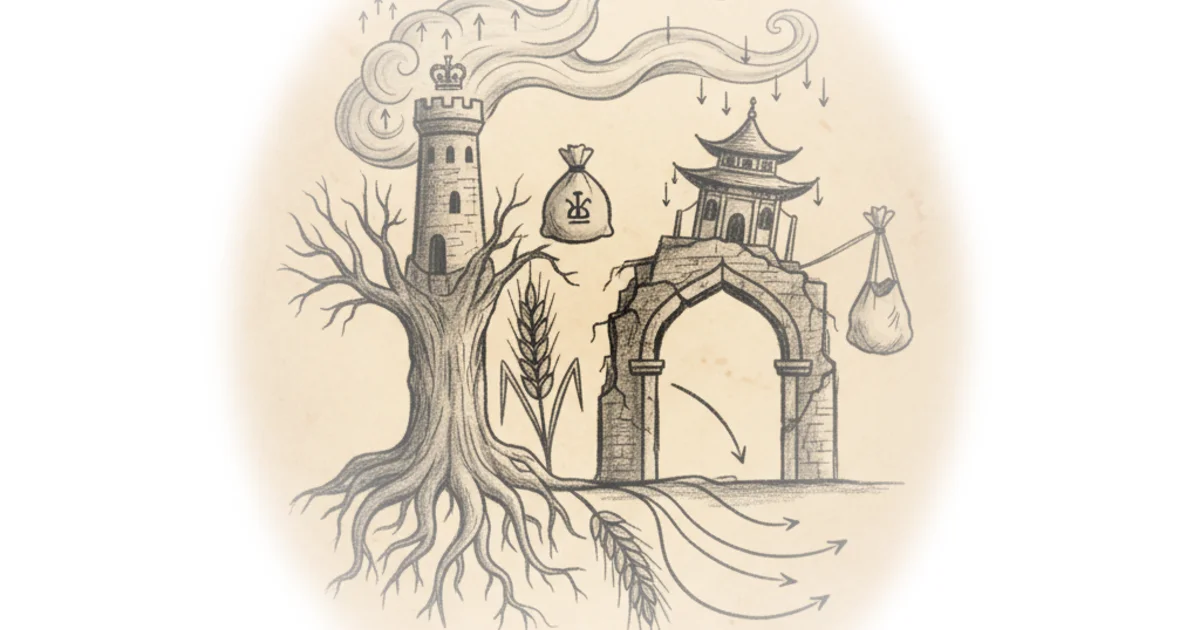
This framing is crucial because it forces us to look at the internal dynamics of pre-colonial empires rather than just the external shock of colonization. Bishnupriya Gupta, one of the study's authors, admits her initial bias was to prove colonialism was the primary driver. "We need to show that colonialism was driving this," she recalls, yet the data told a different story. "India's fall started before British colonisation," Gupta explains. The British did not invest in agriculture; they simply extracted what remained. In fact, the decline was so severe that in the final decades of British rule, agricultural yields were still below the levels of the early 17th century. This suggests that the "lost golden era" under Emperor Akbar was indeed real, but it was also fragile, susceptible to a long-term stagnation that no amount of later colonial administration could reverse.
The riches of a court told little about what was going on for the average Indian family, its prospects tied to a decent harvest.
Critics might argue that focusing on agricultural yields ignores the vibrant textile trade that made India famous. However, the authors dismantle this counter-narrative effectively. As Gupta notes, "India's economic decline begins during the time of booming textile trade." The prosperity of weavers was a small, isolated bubble in an economy where the vast majority of people were starving. The glittering courts of the Mughals, often cited by polemicists as proof of pre-colonial wealth, masked a reality where the average family's survival depended entirely on the harvest. The data shows that while the elite may have hoarded silver, the structural capacity to feed the population was eroding for over a century before the East India Company took power in Bengal.
The Fiscal Capacity Gap
Perhaps the most striking insight DeLong highlights is the role of state capacity. The divergence wasn't just about technology or culture; it was about the ability of the state to tax and invest. In early 19th-century China, a typical person worked about two days a year to pay taxes. In Britain, it took roughly 17 to 20 days. This disparity reflects a massive difference in fiscal capacity. As DeLong paraphrases the authors' findings, small European states had the administrative machinery to extract resources from their populations to fund infrastructure, defense, and innovation, while large empires like China and India were too reliant on local elites to impose such burdens.
This connects directly to the broader historical context of fiscal capacity. Just as the inability to tax prevented India from modernizing its agriculture, the low tax burden in China meant the state could not mobilize resources for the kind of public goods that fueled the Industrial Revolution. DeLong emphasizes that this is not a moral judgment on the fairness of the tax system, but a functional analysis of state power. "One difference between Europe and Asia lies in the capacity of states," Gupta says, explaining that large empires kept local elites happy by taxing them lightly, thereby sacrificing long-term growth for short-term political stability. This dynamic echoes the historical analysis of how fiscal strength correlates with economic resilience, a theme explored in depth in related discussions on grain entrapment and state formation.
The Malthusian Trap and Demographic Luck
DeLong then turns to the demographic forces that either accelerated or mitigated these economic shifts. He outlines a framework where technological gains are often swallowed by population growth, a phenomenon he calls the "braking force exerted by our ensorcellment by the Devil of Malthus." In most of the world, any increase in productivity simply led to more people, not more wealth per person. However, Northwestern Europe managed to break this cycle, and the reasons are grim.
Broadberry and Gupta suggest that Europe's escape from the Malthusian trap was partly due to high mortality rates in rapidly urbanizing centers like London and Amsterdam. "These areas were urbanising fast, and people died in unhygienic cities," Gupta notes. The high death rates from disease and warfare acted as a brutal brake on population growth, allowing the survivors to capture the economic gains. It is a dark irony that the very conditions that made life miserable for the urban poor—disease and overcrowding—may have inadvertently secured a higher standard of living for the remaining population by preventing the population from exploding and diluting resources. This stands in stark contrast to the situation in India, where population growth continued to outpace agricultural productivity, dragging real wages down.
The British owned more luxury goods.
This observation from Broadberry, based on inventories of what people left behind, underscores the tangible difference in living standards. While the average Indian worker struggled to buy food, the British middle class was accumulating goods. This wasn't just a matter of silver flowing from the Americas; it was a structural shift toward a high-productivity economy with specialized sectors in trade, banking, and manufacturing. The data suggests that the "Great Divergence" was not a sudden event triggered by the Industrial Revolution, but a slow drift that began centuries earlier, rooted in these deep structural differences in agriculture, taxation, and demographics.
The Bottom Line
The strongest part of this analysis is its refusal to simplify history into a binary of "good colonizers" or "bad colonizers." By showing that India's decline began before British rule, the authors force a more honest conversation about the internal weaknesses of pre-modern empires and the specific institutional advantages of Northwestern Europe. The biggest vulnerability, however, lies in the reliance on fragmented data from centuries ago; while the trends are clear, the precise mechanisms remain open to debate. As the world looks toward a new era of convergence, understanding these deep historical roots is not just an academic exercise—it is essential for grasping why some nations broke the cycle of poverty while others remained trapped for centuries.
Bottom Line
DeLong's commentary on the work of Mäkelä, Broadberry, and Gupta provides a necessary corrective to popular histories, revealing that the Great Divergence was a slow, structural process driven by fiscal capacity and agricultural stagnation rather than a sudden colonial theft. The argument's greatest strength is its data-driven dismantling of the "golden age" myth, though it leaves open the question of whether these historical path dependencies are truly irreversible in the modern era.