Kenny Easwaran guides busy readers through a 1748 philosophical text that dismantles the very foundation of how we predict the future, arguing that our confidence in cause and effect is built on habit, not logic. This is not a dry history lesson; it is a radical challenge to the certainty of scientific inquiry itself, suggesting that the patterns we rely on to navigate the world have no rational guarantee of continuing tomorrow.
The Limits of Pure Reason
Easwaran begins by situating David Hume within the Scottish Enlightenment, noting that while contemporaries like Adam Smith and James Watt were revolutionizing economics and engineering, Hume was dismantling the epistemological certainty of his age. The author highlights Hume's empiricist stance: "reason is only the slave of the passions," meaning that logic cannot dictate our goals, only the means to achieve them. Easwaran explains that Hume's most disruptive insight is the inability to derive an "ought" from an "is," a concept that remains a cornerstone of modern ethics and philosophy.
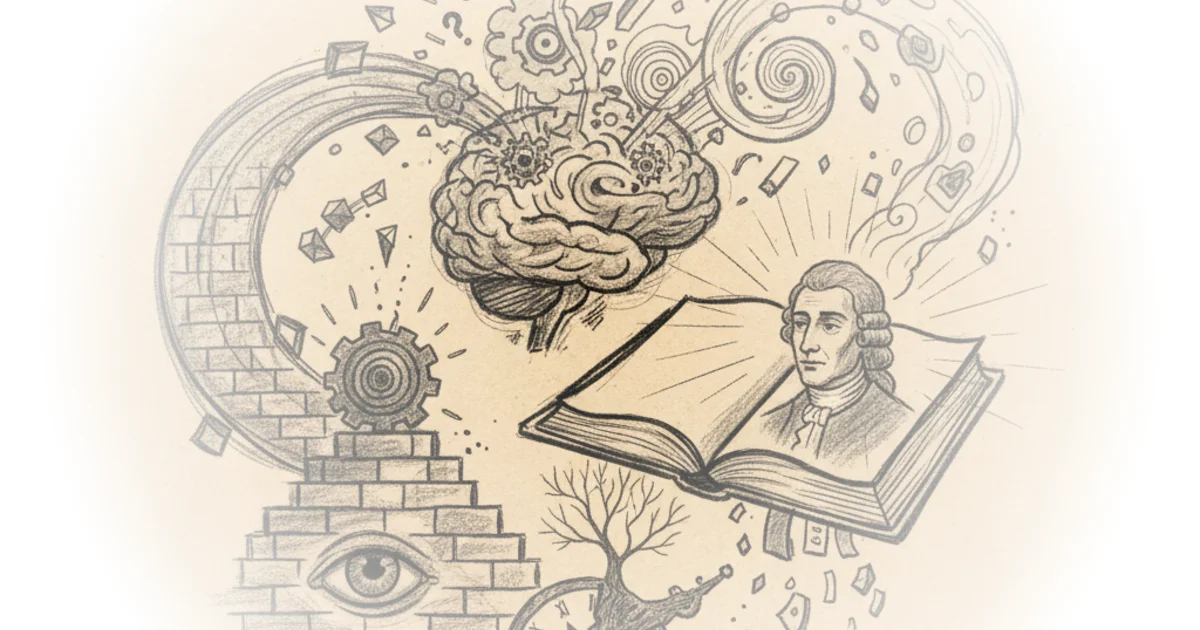
The commentary then shifts to Hume's distinction between two types of knowledge. Easwaran writes, "all the objects of human reason or inquiry may naturally be derived into two kinds to wit relations of ideas and matters of fact." He clarifies that "relations of ideas"—like mathematics and geometry—are certain because they rely on internal logic, not the physical world. As Easwaran notes, "the truths demonstrated by euclid would forever return their retain their certainty and evidence" even if no perfect triangles existed in nature. This distinction is crucial because it isolates the realm of absolute certainty from the messy reality of the physical world.
The square of a hypotenuse is equal to the square of the two sides is a proposition which expresses a relation between these figures... though there never were a circle or triangle in nature the truths demonstrated by euclid would forever return their retain their certainty and evidence.
However, Easwaran points out that this certainty vanishes when we look at "matters of fact." He paraphrases Hume's assertion that "the contrary of every matter of fact is still possible because it can never imply a contradiction." This means that no amount of logical reasoning can prove that the sun will rise tomorrow; it is merely a belief based on past experience. Easwaran emphasizes the radical nature of this claim: "if you can imagine something then there is some sense in which that thing is possible," and since we can imagine the sun not rising, we cannot logically prove it will.
The Problem of Induction
The core of Easwaran's analysis focuses on how we bridge the gap between what we have seen and what we expect to happen. He explains that all reasoning about matters of fact beyond our immediate senses relies on the relation of cause and effect. Easwaran illustrates this with Hume's example of a letter: if a friend sends a letter, we infer their location based on the cause of the letter's existence. "A man finding a watch or any other machine on a desert island would conclude that there had once been men on that island," Easwaran writes, noting that this reasoning assumes a necessary connection between the object and its creator.
This is where Hume's skepticism strikes hardest. Easwaran argues that Hume is essentially an early psychologist, asking how the mind actually works rather than how it should work. The author writes, "there is no necessary connections he sees between distinct existences one thing can be one way and another thing can be another way and your reason alone can never tell you what has to be the case." We assume patterns will continue because they have in the past, but as Easwaran puts it, "to attempt to say that it will therefore continue to serve us well in the future is to make a circular appeal to this very principle in trying to justify itself."
Critics might note that this radical skepticism could paralyze scientific progress if taken to its logical extreme, yet Hume's point is descriptive, not prescriptive. He is not saying we shouldn't trust induction; he is saying we have no rational justification for it other than our own psychological conditioning. Easwaran captures this perfectly: "if we think we see patterns in it we can never be justified in believing that these patterns will continue."
All our reasonings concerning fact are of the same nature and here it is constantly supposed that there is a connection between the present fact and that which is inferred from it were there nothing to bind them together the inference would be entirely precarious.
The Wake-Up Call for Philosophy
Easwaran concludes by connecting Hume's 1748 text to its profound historical impact, specifically on Immanuel Kant. The author notes that Kant credited this work with "waking him from his dogmatic slumber," prompting a philosophical revolution that attempted to solve the problem Hume had exposed. Easwaran writes that Hume's argument "has served us well in the past but to attempt to say that it will therefore continue to serve us well in the future is to make a circular appeal." This circularity is the "problem of induction," a term Hume didn't use but which defines the modern understanding of scientific uncertainty.
The commentary highlights that Hume's work was not just a theoretical exercise but a practical challenge to the "implicit faith and security which is the bane of all free reasoning and inquiry." By exposing the lack of logical foundation for our most basic beliefs about the world, Hume forced philosophy to grapple with the limits of human understanding. Easwaran suggests that this "discovery of defects in the common philosophy" was not a discouragement but an "incitement" to seek a more satisfactory explanation of how we know what we know.
Bottom Line
Easwaran's commentary effectively reframes a dense 18th-century text as a vital critique of modern certainty, showing that our reliance on cause and effect is a psychological habit rather than a logical necessity. The strongest part of the argument is its clear distinction between the absolute certainty of mathematics and the fragile, unprovable nature of empirical prediction. However, the piece leaves the reader with an unsettling vulnerability: if our entire understanding of the physical world rests on an unjustified leap of faith, then the stability of science itself is more precarious than we admit. Watch for how this skepticism influences current debates on AI prediction models, which, like Hume's observer, rely entirely on past patterns to forecast the future.