Daniel Tutt reframes a classic American war novel not as a story of battlefield glory, but as a philosophical manual for how anxiety can shatter the self and force a radical rebirth. In an era where public discourse often reduces courage to a simple matter of willpower or political loyalty, this piece offers a startlingly different map: one where true bravery emerges only when the familiar structures of time, law, and social role collapse entirely.
The Architecture of Anxiety
Tutt begins by dismantling the traditional, Aristotelian view of virtue, which suggests that courage is a stable character trait honed over a lifetime to maintain social balance. Instead, he leans on the work of philosopher Alain Badiou and the ancient Greek tragedian Sophocles to argue that courage is an event, not a habit. "I believe that this subjective figure, whose dialectic is built on anxiety and the superego, always prevails in times of decadence and disarray," Tutt writes, setting the stage for a reading of Stephen Crane's The Red Badge of Courage that treats the battlefield as a laboratory for the soul.
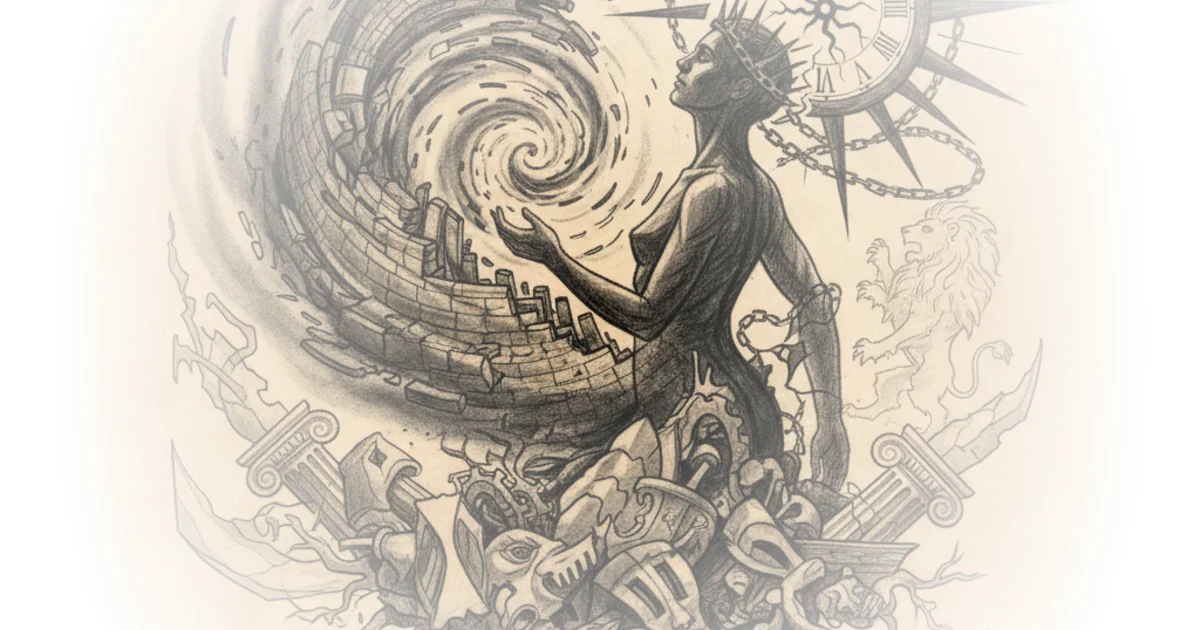
The author's central insight is that anxiety is not merely a weakness to be overcome, but the necessary catalyst that breaks a person out of their assigned social script. In the novel, the protagonist, known only as "The Youth," is initially paralyzed by a "wild metonymic daze of anxiety," bouncing around the army formation like a pinball unable to find his place. Tutt notes that this state is crucial because it strips away the illusion of a stable identity. "His failure to discover any mite of resemblance in their viewpoints made him more miserable than before," the author quotes, highlighting how the protagonist's isolation is actually the first step toward a new kind of subjectivity.
This framing is powerful because it validates the experience of disorientation rather than pathologizing it. However, critics might argue that applying such dense continental philosophy to a Civil War narrative risks obscuring the brutal, material reality of the war itself. While the psychological transformation is compelling, the human cost of the conflict—the actual dying and the suffering of the civilian population—remains in the background of this theoretical exercise.
Anxiety is the primary affect because it challenges the fixed symbolic place as it works to deaden the law, anxiety interrupts the law with an excess of emotion that cannot be contained.
The Rhythm of the Machine
Tutt then traces the protagonist's movement from chaotic anxiety into the rigid, mechanical order of the military unit. This shift represents a transition from a state of panic to a state of submission to "iron laws of tradition and law." The author describes this as a "disembodying phenomenon" where the individual's body is contorted to match the "instrumental rhythm of the unit itself." Inside this formation, the chaotic time of the battlefield is replaced by "chronos," a regimented, orderly time dictated by set intervals.
The analysis here is sharp, revealing how the military machine functions by erasing the individual's internal chaos through external discipline. "His actions had been sagacious things. They had been full of strategy. They were the work of master's legs," Tutt quotes, illustrating how the Youth finds a false sense of confidence by becoming a perfect cog in the machine. Yet, this is not true courage; it is merely the suppression of fear through conformity.
The piece effectively argues that this mechanical obedience is a dead end. The Youth must eventually break free from this "chronos" to access a deeper form of bravery. The danger in this line of reasoning, however, is that it can inadvertently romanticize the dehumanizing aspects of war. By focusing so heavily on the metaphysical "event," the commentary risks glossing over the fact that the "iron laws" of the army are designed to kill, not to liberate the human spirit.
The Scission of Time
The climax of Tutt's argument arrives when the protagonist re-enters the battle not as a soldier following orders, but as a witness to an "impersonal global event." This is the moment of "scission," where the law is split and the individual transcends their social role. "He had slept and, awakening, found himself a knight," Tutt writes, capturing the sudden, almost mystical shift in the protagonist's perception.
In this final movement, the Youth is no longer bound by the fear of death or the need for glory. He inhabits what the author calls "Aion," a time of eternity that exists outside the linear progression of cause and effect. "The Sophoclean hero inhabits a time of eternity or Aion in the present—a time that is fundamentally atheistic, a time in which both man and god turn their backs on each other," Tutt explains. This is the core of the piece's philosophical ambition: courage is the ability to act when all external guarantees—God, law, community, and even the self—have vanished.
This is a profound, if demanding, definition of bravery. It suggests that in moments of extreme crisis, the only way to act is to abandon the safety of established roles. While this offers a stirring vision of human potential, it also presents a stark challenge to readers: are we willing to face the "emptiness of pure time" where no one is watching and no rules apply? The argument holds together logically within its own philosophical framework, even if it demands a level of abstraction that might feel detached from the gritty reality of modern conflict.
Courage splits the law in two, revealing the law to be without assurance.
Bottom Line
Daniel Tutt's piece is a masterful synthesis of literary criticism and high theory, successfully arguing that courage is a disruptive event rather than a stable virtue. Its greatest strength lies in reframing anxiety not as a failure of character, but as the essential spark that forces a break from the status quo. The argument's vulnerability, however, is its tendency to elevate the internal psychological drama over the external human tragedy of war, leaving the actual cost of these "events" unexamined.