A Secret Circuit Discovered in Bob Meyer's Flooded Workshop
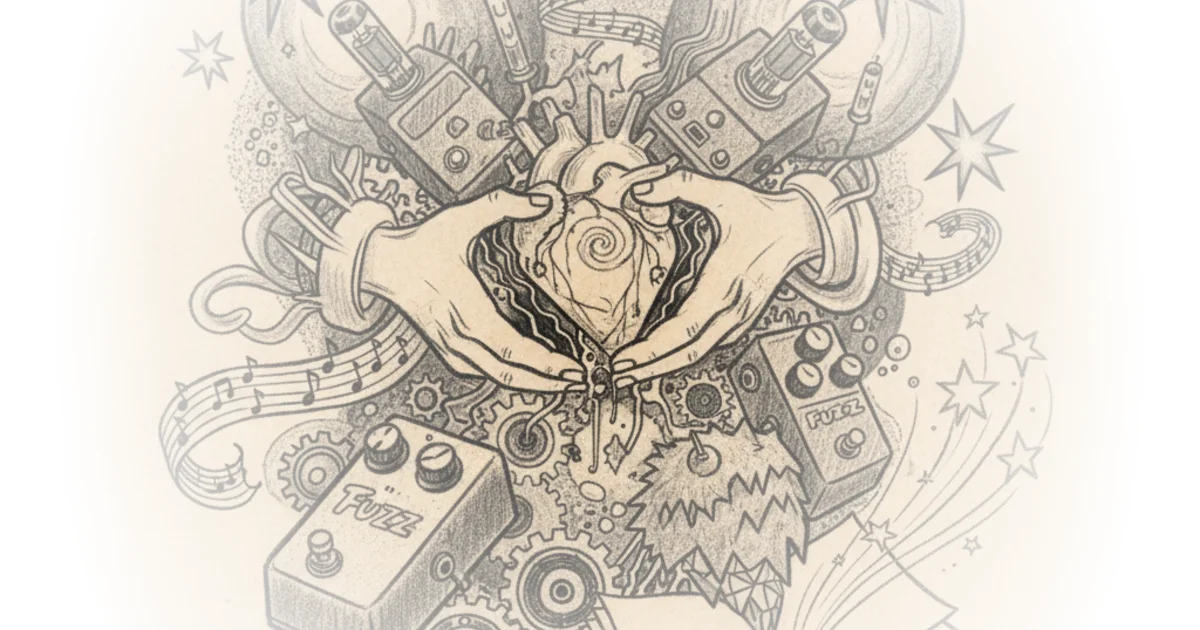
Josh Scott and Daniel Danger have spent four years compiling what they call the most comprehensive visual history of Electro-Harmonix ever assembled. The book, titled Made on Earth for Rising Stars, is being published by Thirdman Books, Jack White's publishing company. It covers the company's founding through 2008 and includes rare prototypes, original documents, and items that have never been seen publicly.
But one discovery exceeded anything they expected to find.
In 2021, Scott received a phone call from Bob Meyer—the inventor of the Big Muff—whom many believed was dead. Meyer had read an obituary for himself and found it amusing. He invited Scott to his New Jersey home, where he had lived since purchasing the house in 1960.
When Scott and Danger arrived at Meyer's driveway, they learned the workshop had flooded in 2012 and never fully recovered. The inventor, being in his nineties, rarely visited the space. What they found was an untouched time capsule of Electro-Harmonix history—exactly as it had been left years before.
The workshop contained boxes filled with rare pedals, prototype units, and components the two had spent decades searching for. One wall was lined with speakers that transformed the room into what Scott described as a giant speaker cabinet.
"This is heaven," said Danger. "Every single thing you pick up is something."
Among the treasures were schematics that neither researcher recognized—water-damaged documents labeled "Big muff using two dual op amps." The discovery suggested Howard Davis wasn't the only designer working on the op-amp version of the Big Muff in the late 1970s.
The original op-amp Big Muff was produced for only about a year and sold poorly before being discontinued. Then Billy Corgan of Smashing Pumpkins used it, and the reissue became highly collectible.
But this version was different—Bob Meyer's take on what could have been. It used dual op-amps, creating simpler circuitry that turned input sine waves into square waves with significant distortion. The guitar community loved it.
What Scott and Danger found wasn't what Mike (the founder) had selected for production. But it sounded remarkably modern—a crossover between aggressive Big Muff tone for metal players and smooth overdrive capability.
The pair decided to bring the lost circuit back to life as a recreation. They called it the "Big Muff 2"—a reference to bringing back an original pedal that never made it to production but sounds exceptional.
The new version feels heavier than classic models, with more dynamic tone control. It delivers both the aggressive distortion people associate with metal and clean overdrive on the opposite end of the spectrum.
They tested it against a highly collectible B1 Big Muff, known for its gnarly higher-end sound that players often described as lacking "girth." The new version produces more mids and a classic tone while maintaining quieter operation than older models.
The result is something distinctly different from normal Big Muffs—meeting in the middle between aggressive distortion and smooth overdrive. It's what might have been if Meyer's version had gone into production instead of the one that became famous.
Bottom Line
Scott and Danger's discovery represents a lost branch of guitar pedal history. Their recreation brings back a circuit that was designed but never produced—a variant that could have changed how players understood the Big Muff. The biggest strength is hearing this forgotten prototype brought to life; the vulnerability is that we'll never know exactly what Mike chose instead of Meyer's design, and why. But now players can finally hear what might have been.