T.S. Eliot's Four Quartets stands as one of the twentieth century's most significant poems. It carries weight that even experienced instructors approach with genuine reverence, aware they are encountering something truly great—a deep mystery in verse form. The poem is so powerful that poet laureate W.H. Auden praised Eliot as the greatest living poet of his age, and that praise has never been easy to earn.
Reading Four Quartets takes between 90 minutes and two hours, but readers should move slowly through its dense and difficult language. It remains Eliot's most challenging poem—though one that always leaves readers struck by its sheer greatness."}, {"type": "section", "heading": "A Poem for Our Moment", Eliot began writing Four Quartets around 1934, just before the world would be reshaped by war and cultural transformation. The publication of Burnt Norton—the first quartet—arrived in 1936. During those years, the world was genuinely falling apart.
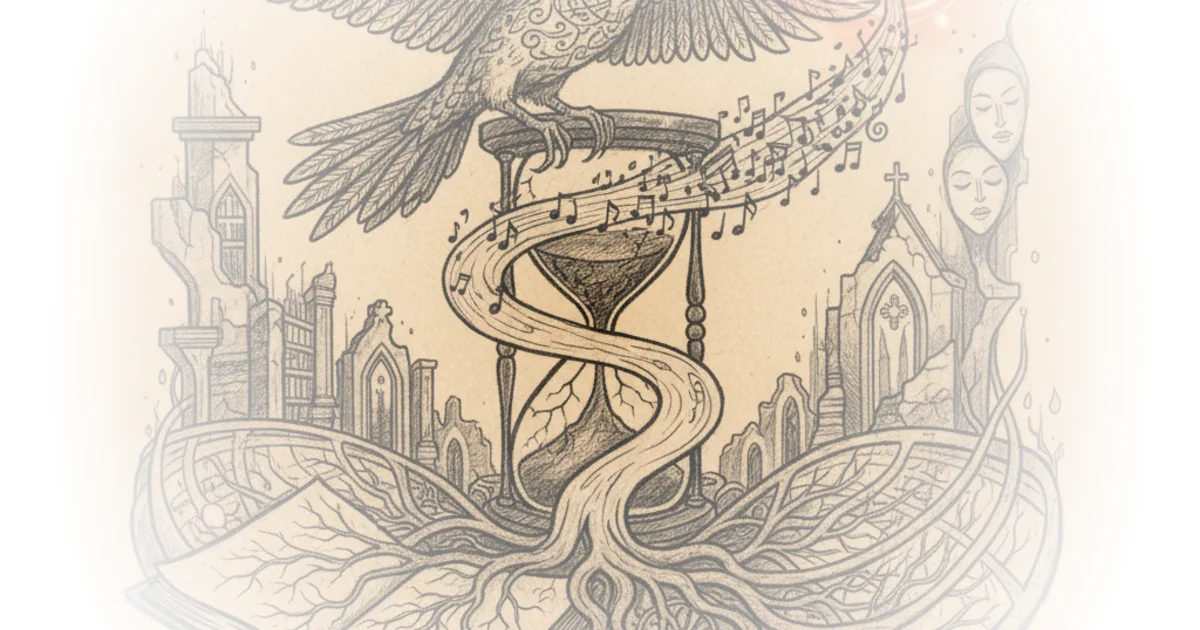
In America, the Great Depression still gripped the economy, while labor movements saw farmers fighting for the right to organize. Abroad, fascism rose as nations militarized and Hitler broke the Versailles Treaty by moving troops into the Rhineland. People knew war was coming; British authorities were desperate to avoid conflict and attempted to appease Germany. The news was uniformly bad.
This poem emerges from Eliot's deep struggle during this tense period—asking what poetry can possibly do in such times. Four Quartets offers an answer.
Burnt Norton contains a haunting description of the cultural moment: "Neither plenitude nor vacancy, only a flicker over the strained time-ridden faces, distracted from distraction by distraction, filled with fancies and empty of meaning, tumid apathy, with no concentration, men and bits of paper."
These lines pierce into our present moment. The description captures today's social media environment—smartphones illuminating faces in the dim twilight of digital disconnection, the mutual apathy, and those whose emotions are prey to every raging voice online.
Part five of Burnt Norton offers an even more prescient vision: "Words strain, crack, and sometimes break under the burden, under the tension, slip, slide, perish, decay with imprecision. Will not stay in place, will not stay still. Shrieking voices, scolding, mocking, or merely chattering always assail them."
We are experiencing the collapse of discourse and social dialogue—we are the children of the moment in which Eliot wrote this poem. This is a poem for us now."}, {"type": "section", "heading": "How to Read It", Begin by breathing deeply. Quiet your mind. Exhale all the breath from your lungs, then begin a new pattern of respiration while preparing your attention for the poem.
Read slowly and aloud. You will not catch everything in this poem—and that is not your job. The passage you need to hear will find you. Instead of seeking understanding, experience the poem and receive whatever meets you from it.
If you don't understand a word, underline it so you can return later, but do not break the rhythm."}, {"type": "section", "heading": "The Poem's Opening", Here is how Four Quartets begins:
"Time present and time past are both perhaps present in time future. Time future contained in time past. If all time is eternally present, all time is unredeemable. What might have been is an abstraction remaining a perpetual possibility only in a world of speculation. What might have been and what has been point to one end which is always present. Footfalls echo in the memory down the passage which we did not take towards the door we never opened into the rose garden. My words echo thus in your mind."
The poem balances spiritual abstraction on time with a concrete, dislocated setting of rose gardens—the abstract and the concrete together."}, {"type": "section", "heading": "Eliot's Sources", Lines one through three are informed partly by Eliot's reading of Western mysticism. In The Cloud of Unknowing—a medieval work of Christian mysticism—Eliot had underlined a passage that read: "Time is precious. For God, the giver of time, never gives two times together, but each one right after the other."
Eliot was already thinking about tensions of time in his own intellectual life. He weaves into a coherent spiritual vision insights from Christianity, Hebrew scriptures, Buddhist traditions, and Upanishad philosophy. Readers informed by particular traditions will find resonant passages throughout.
The phrase "point to one end" uses the verb pointing, but he will write in the second section of Burnt Norton: "At the still point of the turning world, neither flesh nor fleshless, neither from nor towards. At the still point there the dance is but neither arrest nor movement."
This becomes the noun—the place that space is occupied in this poem, both concretely and abstractly. The verb pointing is being done by the poem itself; it is a poem to reread."}, {"type": "section", "heading": "The Structure Revealed", Upon first reading, readers might think Four Quartets lacks coherent structure—nothing seems to have a plan—but repeated readings reward with connection between movements.
Critic Helen Gardner reveals the underlying structures in her book The Art of T.S. Eliot. She outlines what each movement performs:
Each quartet contains five parts or movements—the poem draws from musical metaphor here. Burnt Norton has five parts; East Coker, five parts; The Dry Salvaves, five parts; Little Gidding, five parts.
According to Gardner, the first movement of each quartet contains a statement and counter-statement—sometimes in thesis and antithesis form, sometimes with contrasting images or subjects. Burnt Norton's first section plays abstract time against the still point, speculation against possibility and concrete rose gardens. The Dry Salvaves plays the river against the sea.
The second movement involves a single subject handled differently—it often begins with lyrical qualities, strong presence of patterned rhythm, then shifts into more mundane or colloquial ways of speaking. This creates modulation from lyrical, figurative expressions to something conversational.
The third movement contains what Gardner calls the core of each poem—the reconciliation of two ideas in tension. In East Coker's third section, this happens through repetition—what Gordon Linde calls "the very sermon" of Four Quartets. In Burnt Norton, it is a change of mind."}, {"type": "section", "heading": "The Rose Garden", In the rose garden image appears after all that philosophical abstraction—very physical and real. Keep this in mind because the poem returns to the rose garden and focuses intensely on the image of the rose.
The rose in Four Quartets carries rich philosophical meaning, symbolic meaning drawing from literary and philosophical traditions: alchemy, some of the metaphysical poets, love, Platonism, Neoplatonism. The rose symbolizes beauty, perfection, transience, spiritual enlightenment, divine love. In Four Quartets, it also suggests unity of opposites—time and eternity, resolution of spiritual conflict."}, {"type": "section", "heading": "Auditory Imagination", There is an important truth worth repeating: a poem can work upon you without the aid of your intellect. It can change your consciousness without your intellect or awareness knowing how that works—but it is true.
This relates to what Eliot calls "auditory imagination," from his essay on Matthew Arnold. He describes it as "the feeling for syllable and rhythm, penetrating far below the conscious levels of thought and feeliing, invigorating every word, sinking to the most primitive and forgotten, returning to the origin and bringing something back, seeking the beginning and the end."