Yascha Mounk exposes a silent crisis in American classrooms: the rapid, unchallenged infusion of screens into early childhood education, driven less by pedagogy and more by institutional inertia. This is not a story about technology itself, but about a system that has weaponized the language of equity to justify policies that many parents find actively harmful to their children's development.
The Parental Awakening
Mounk begins with a relatable vignette: a mother expecting traditional school supplies like crayons and notebooks, only to receive an email demanding "WIRED HEADPHONES FOR IPADS" for her four-year-old. This jarring moment captures the broader disconnect between parental intuition and administrative policy. Mounk writes, "The average parent of a young American child is now a Millennial... They are often deeply shocked when they find out that their 4 year-old is about to be given a Chromebook or an iPad upon entry to kindergarten." The shock is palpable because these parents grew up with technology; they know its value and its pitfalls. Yet, the current trajectory suggests a departure from common sense.
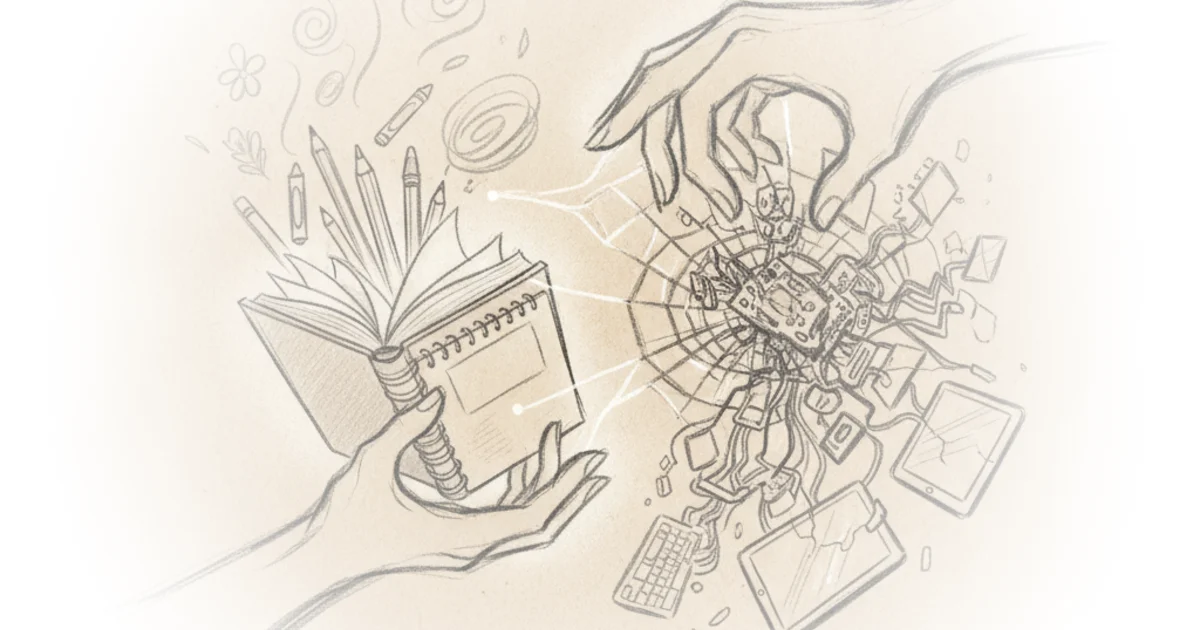
The author highlights how pandemic-era emergency measures have calcified into permanent fixtures. As Mounk notes, "COVID-era tech policies, which may have been necessary during the pandemic, have not just been continued, but mysteriously ramped up." This observation is crucial. It reframes the issue from a technological inevitability to a policy choice that has gone unexamined. The sheer scale is staggering: 73% of K-2 classrooms now operate on a one-to-one device policy. Critics might argue that digital fluency is essential for future economic competitiveness, but Mounk's reporting suggests that the rush to digitize has outpaced any evidence of educational benefit.
Equity as a Trojan Horse
One of the most compelling sections of the piece dismantles the primary defense used by school administrators: equity. The argument goes that denying devices to some students creates an unfair gap. Mounk counters this with surgical precision, writing, "It wouldn't be equitable for kids from wealthier families to have fancy laptops while kids from families without those resources go without." However, he quickly pivots to the absurdity of the implementation. He argues that loaner programs or targeted computer labs could achieve equity without forcing every single child to carry a distraction device.
The author points out a tragic irony: these policies often harm the very children they claim to protect. For students with ADHD or autism, the constant access to screens can be devastating. Mounk shares the heartbreaking story of Lisa Sunbury, whose daughter was prescribed an Individualized Education Program (IEP) to limit screen time, yet still found herself awake at 3 a.m. playing video games on her school-issued Chromebook. "Because of their disabilities, millions of children are highly predisposed to develop addictive, unhealthy relationships with screens," Mounk writes. This is not a minor side effect; it is a systemic failure that exacerbates the vulnerabilities of disabled students.
School computers aren't just impeding book-based literacy; they are ending it.
The Rise of Book-Free Education
The erosion of traditional literacy forms another pillar of Mounk's argument. He introduces Jonathan, a father who watched his son's love for reading vanish as homework shifted to gamified apps. By middle school, the child was rushing through assignments merely to access YouTube and games on his device. The result is a generation that can navigate an interface but struggles with deep engagement. Mounk observes, "Literacy isn't just the ability to read; it's the desire to read." When schools replace physical books with e-books and AI-generated summaries, they are not just changing the medium; they are altering the cognitive process of learning.
This shift mirrors concerns raised in broader discussions about the digital divide, where access is often conflated with quality. Just as historical data on screen time suggests a correlation between heavy usage and attention deficits, Mounk's anecdotes suggest that the school environment itself has become a vector for these issues. The move to "book-free" education is not an organic evolution of learning; it is a forced migration that ignores the developmental needs of young minds.
Weaponized Fake Expertise
Perhaps the most frustrating aspect of this rebellion, as Mounk frames it, is the bureaucratic wall parents face when they question these decisions. School officials often retreat behind "fake expertise," citing frameworks like the Triple E model which rely on subjective teacher ratings rather than rigorous science. Mounk describes this dynamic sharply: "Officials are tasked with managing some system... But when strange new situations arise, they must somehow justify their right to make this novel kind of decision."
He recounts how a parent in Virginia, who is herself an addiction researcher, was dismissed by "reading specialists" who could not produce independent evidence for the apps they mandated. The response from school boards often amounts to a closed loop: "They continue to believe they have shared all relevant information... and are comfortable with the process." This refusal to engage with external critique creates an environment where policy is driven by vendor relationships rather than student outcomes. As Mounk puts it, "This is the voice of weaponized fake expertise: no details, no extended conversation, no response to particulars."
The Bottom Line
Yascha Mounk's argument is a powerful indictment of an education system that has lost its way, prioritizing devices over development and bureaucracy over parent-child partnership. Its greatest strength lies in grounding abstract policy failures in the visceral experiences of families who feel powerless against a monolithic system. However, the piece stops short of offering a comprehensive roadmap for systemic reform beyond opting out or legislative bans, which may be difficult to scale nationally.
It is time for education systems to regain public trust by respecting a parent's right to a human, book-based education for their children.
The bottom line is that this is not merely a debate about screen time; it is a crisis of institutional legitimacy. As Mounk warns, if schools continue to ignore the mounting evidence and parental concerns, they risk alienating the very communities they serve, leading to a mass exodus from public education that could fundamentally reshape American schooling.