Freddie deBoer challenges a sacred cow of literary instruction with a provocation that feels both obvious and radical: the most celebrated writers in history have ignored the rule to "show, don't tell" because the rule is fundamentally incompatible with the nature of prose. In an era where writing workshops often prioritize cinematic neutrality over narrative voice, deBoer argues that this dogma is a relic of drama and screenwriting that has been misapplied to fiction, stripping authors of their most potent tool—their ability to tell.
The Medium is the Message
The core of deBoer's argument rests on a linguistic and structural truth that is often overlooked in creative writing classrooms. He points out that the axiom "show, don't tell" migrated from visual and performance arts where physical action replaces exposition. In those mediums, a playwright cannot simply have a character announce their feelings without breaking the fourth wall; they must act them out. But in prose, deBoer writes, "in fiction, there is no 'showing.' There is literally only telling. Every word on the page is narrated!"
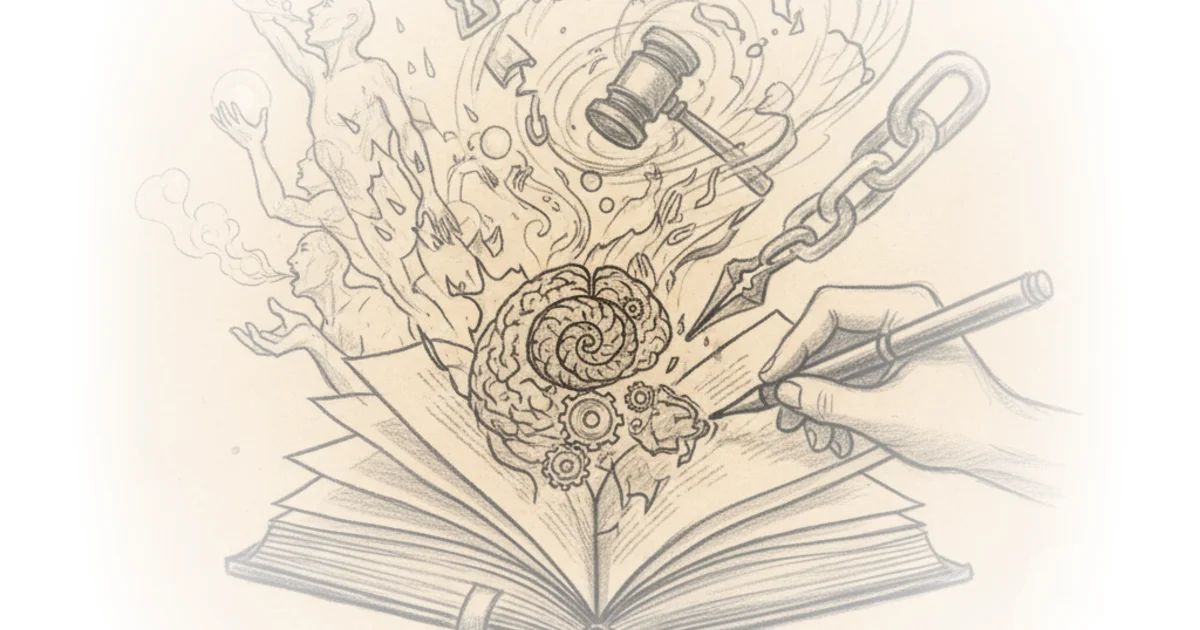
This distinction is crucial. When a writer describes a gray sky or a character's internal monologue, they are not showing the reader an image; they are telling the reader about it. The medium of fiction is irreducibly narrative. DeBoer suggests that by trying to mimic the constraints of film, inexperienced writers often sabotage the very thing that makes prose unique: the narrator's voice. He notes that the etymology of "narrate" stems from the Latin narrare, meaning "to tell, relate, recount, or explain." To demand that writers stop telling is to demand they stop narrating.
"The instruction, in other words, is bound to the constraints of the formats of plays and movies. When it crosses over into prose fiction, something important gets lost: in fiction, there is no 'showing.'"
Critics might argue that this defense of "telling" is a semantic trick, suggesting that great writers still "show" through their descriptions. However, deBoer's point is that the mechanism of delivery is always verbal, not visual. The reader's mind constructs the image, but the author's job is to provide the verbal instruction. This reframing is effective because it liberates the writer from the anxiety of constantly performing a scene when a direct statement might carry more thematic weight.
The Masters of the Direct Address
To dismantle the dogma, deBoer marshals an impressive roster of literary giants who built their reputations on the very thing they are told to avoid. He highlights Leo Tolstoy's opening to Anna Karenina: "All happy families are alike; each unhappy family is unhappy in its own way." DeBoer calls this "one of the most baldly declarative sentences in the canon," noting that it is not showing but a novelist stepping forward to announce a thesis. Similarly, he points to Jane Austen, whose narrators frequently editorialize and judge. In Sense and Sensibility, Austen tells the reader a character "had an excellent heart" and "knew how to govern" strong feelings, rather than dramatizing every instance of that governance.
The argument gains further traction with George Eliot. DeBoer observes that Eliot's famous narratorial intrusions in Middlemarch are not failures of craft but the craft itself. He quotes Eliot's reflection that if we had a keen vision of ordinary life, "it would be like hearing the grass grow and the squirrel's heart beat, and we should die of that roar which lies on the other side of silence." DeBoer argues that no dramatized scene could achieve the philosophical depth of that sentence. It requires the narrator to step forward and think out loud.
This connects to the broader tradition of the unreliable narrator, a device that relies entirely on telling. DeBoer notes that Vladimir Nabokov's Lolita depends on Humbert Humbert "telling us, shaping us, manipulating us, performing for us." If Humbert were to "show" instead of tell, the novel would collapse because the tension lies in the gap between his narration and the reader's moral judgment. As deBoer puts it, "The unreliable narrator, one of fiction's richest devices, is entirely a product of telling."
"To scrub that voice in pursuit of cinematic neutrality does not help to achieve transparency. Instead, it's a kind of amputation, a disarmament, stripping the author of some of their most potent tools."
The Trap of Static Advice
Beyond the literary analysis, deBoer offers a sharp critique of how writing advice is consumed and applied. He argues that the utility of "show, don't tell" for inexperienced writers is "near zero." The problem, he suggests, is that the wisdom required to use the advice effectively is precisely what the novice lacks. When advice hardens into dogma, it leads to tortured constructions where writers avoid adverbs or passive voice in ways that make their prose clunky rather than clear.
DeBoer draws a parallel to the criticism of adverbs and the passive voice, noting that experts often claim they don't mean to condemn all instances, only specific ones. But the writers seeking the advice "don't know how to parse fine points of language." They cannot distinguish between a necessary passive construction and a weak one. Consequently, the advice becomes a blunt instrument that pathologizes some of the greatest prose ever written. He writes, "Lists of static writing advice that never change and which have already been absorbed by the worst writers you've ever read in your life? I just don't recognize the value in them."
This critique of the MFA workshop culture is particularly biting. DeBoer suggests that the obsession with "showing" creates a homogenized style where the author's unique voice is suppressed in favor of a generic, cinematic neutrality. He argues that the "performative 'I'm a writer who hates writing!' bit" prevalent in modern literary culture often stems from this confusion, where writers feel alienated by the very act of narration.
Bottom Line
DeBoer's essay is a necessary corrective to a pervasive piece of writing dogma that has stifled narrative voice in contemporary fiction. His strongest move is demonstrating that the "show, don't tell" rule is a category error, born from the constraints of visual media and ill-suited for the verbal nature of prose. The argument's vulnerability lies in its potential to be misused by beginners who might interpret it as a license to write lazy, expository summaries rather than engaging narratives. However, for the seasoned writer or the astute reader, the piece serves as a powerful reminder that the narrator's voice is not a flaw to be hidden, but the very engine of the story.
"'Show, don't tell' is advice for a particular problem, not a law. Stop treating it like one."
The piece also resonates with the historical concept of ekphrasis, where literature attempts to describe visual art; just as ekphrasis acknowledges the limits of words in capturing images, deBoer reminds us that words have their own unique power to tell what images cannot. Ultimately, the article urges a return to the confidence of the greats who trusted their readers to accept their telling as a feature, not a bug.