More Perfect Union exposes a chilling convergence of Wall Street speculation and Texas's archaic water laws, revealing how a single hedge fund manager is poised to profit from a potential ecological collapse. The author's most striking claim is not just that water is becoming a commodity, but that the legal framework of the "rule of capture" effectively allows one man to drain an entire region while claiming he is saving the state. This is not a distant climate fiction; it is a legal battle happening right now in East Texas, where the biggest pump wins, and the stakes are the survival of rural communities and major cities alike.
The Rule of Capture and the New Gold Rush
The piece anchors its investigation in a legal doctrine that sounds like something from the Wild West. "Since 1904, Texas has had a groundwater law called the rule of capture. Essentially, landowners can pump as much water as they want from their property without getting sued by their neighbors." More Perfect Union writes, "The rule of capture basically says whoever has the biggest pump wins." This framing is devastatingly effective because it reduces a complex hydrological crisis to a simple, brutal mechanic: size matters more than sustainability. The author argues that this antiquated law is the engine driving a modern land grab, allowing Kyle Bass to legally extract billions of gallons even if it dries up his neighbors' wells.
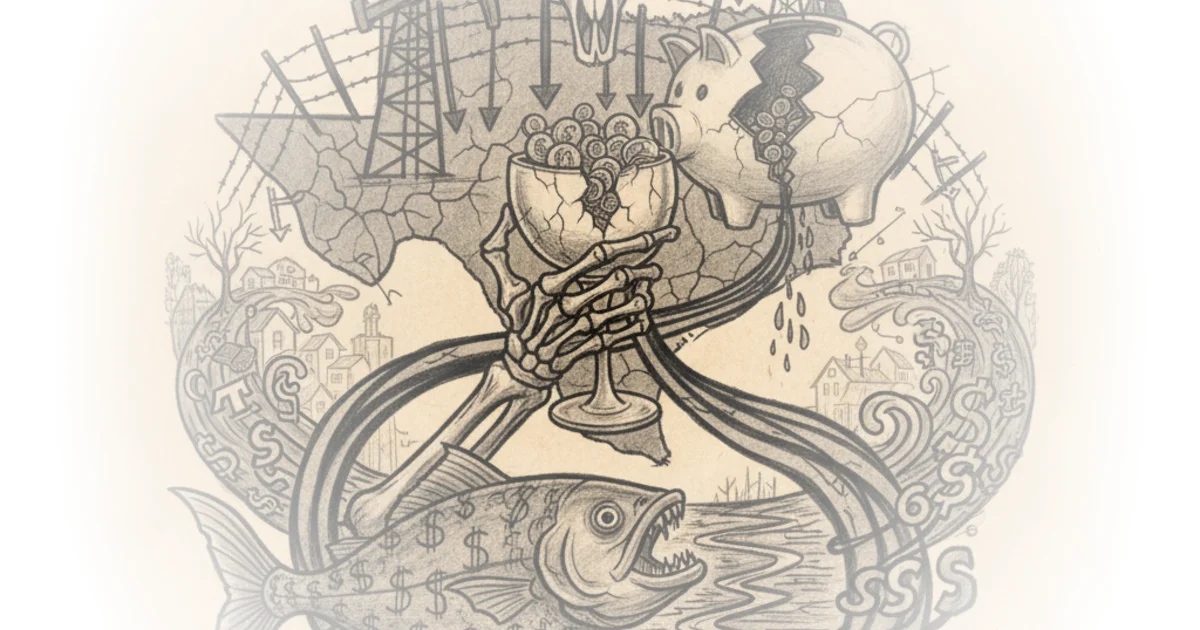
The commentary highlights the sheer audacity of the financialization of a basic human need. "Private investors are betting that in a hotter and drier future, water is the new oil." This comparison is apt, but the author goes further to suggest that unlike oil, which is often extracted from public lands or regulated reserves, groundwater in Texas is treated as private property. The piece notes that Bass's plan involves pumping from the Carrizo-Wilcox aquifer, a source connected to the Trinity River, meaning the water Bass sells to cities like Dallas might actually be water those cities already depend on. "So if somebody like Dallas wants to buy from these wells, they're going to be buying their own water back." This paradox underscores the absurdity of the current market logic.
This is not a philanthropic effort. We are doing our best to do things right, but there actually is a world where you don't have to give up returns.
Critics might note that Bass's argument—that he is solving a water shortage by moving water from areas of surplus to areas of need—has a logical core. However, the author effectively dismantles this by pointing out that Bass specifically targets groundwater because surface water is state-owned and less profitable to exploit. "That's exactly what I think this is all about. In Texas, the state owns surface water like rivers and reservoirs. But land owners own the water that comes from aquifers under their land." The author's insight here is crucial: the profit motive is driving the choice of resource, not the most efficient or equitable solution to the water crisis.
Disaster Capitalism on the Front Lines
The human cost of this financial maneuvering is brought into sharp focus through the stories of local residents. More Perfect Union writes, "When they talk about my water, they're talking about their commodity. It's immoral." This quote from a local rancher captures the emotional weight of the issue better than any statistic could. The author juxtaposes the cold calculus of Wall Street with the visceral reality of a farmer watching his well run dry. "I wake up every morning and that's the first thing that that I that I open my eyes to. It's scary... this is my home. Um, I love it here, you know, and it's a shame that somebody could actually force me out."
The piece argues that this is a classic case of "disaster capitalism," where investors profit from the very crisis they help exacerbate. "While Bas claims that this is a societal benefit, I think this is actually a classic case of disaster capitalism, turning a crisis into a return for investors." The author supports this by detailing Bass's history of profiting from the subprime mortgage crisis, suggesting a pattern of predatory behavior. "We're talking to Kyle Bass. He made $500 million shorting the subprime market. And we made hundreds of millions of dollars in a day." This context is vital; it frames Bass not as a savior, but as a speculator who sees human vulnerability as a market opportunity.
The legal tactics employed by Bass's team are described as intimidating and aggressive. "McCarthy has a history of using cunning legal tactics on poorly funded groundwater districts to secure water rights." The author notes that Bass's lawyer once sued every single member of a groundwater district board, a move that effectively paralyzed the local governance structure. This highlights a significant power imbalance: well-funded private interests versus under-resourced community districts. "My clients have no interest in drying up the aquifer... and there's just the right thing." The author's skepticism here is well-placed, given the history of such claims in environmental disputes.
The Political and Scientific Battleground
The political response to this threat is portrayed as a fragile alliance of unlikely allies. "Democrat, Republican, black, white, everybody is in agreement. We got to protect our water." More Perfect Union writes, "Representative Cody Harris and Senator Robert Nichols are leading the fight to protect water in East Texas, but they'll need support from lawmakers across the state." The author details the legislative struggle, noting that a bill to impose a moratorium on drilling was stripped of its key provisions in the Senate. "I did not feel like I had the votes to do the 2-year moratorum." This admission reveals the immense pressure exerted by lobbyists, who the author describes as "massive" and "expensive."
The scientific uncertainty is another layer of the problem. "How much groundwater can be pumped from an aquifer without causing groundwater declines? Well, if it's that simple, we can all go home cuz that answer is zero." The author points out that even the data is contested, with Bass hiring his own hydrologists to produce favorable studies. "But even the aquifer data that Representative Harris wants is contentious. People like Kyle Bass can distort the science by hiring their own hydraologists to produce data that supports their groundwater projects." This creates a paralyzing environment where decision-making is stalled by conflicting data, a common tactic in environmental regulation battles.
The piece also highlights the financial strain on the very entities meant to protect the water. "The problem is these districts run on tight budgets. They have to choose between funding science about aquifers and fighting lawsuits." This structural weakness is a critical vulnerability in the defense of public resources. The author suggests that without state funding and support, these local districts are doomed to lose the legal war against deep-pocketed corporations.
This is the front lines of America's new water wars.
Critics might argue that the piece leans too heavily on the emotional appeal of rural life, potentially downplaying the genuine need for water in growing urban centers like Dallas and Houston. However, the author counters this by showing that the proposed solution—pumping from the aquifer—threatens the very cities it claims to help, creating a zero-sum game where everyone loses in the long run.
Bottom Line
More Perfect Union delivers a compelling and urgent exposé on the intersection of finance, law, and ecology, successfully arguing that Texas's "rule of capture" is a ticking time bomb for its water security. The strongest part of the argument is the clear demonstration of how financial incentives are driving the exploitation of a shared resource, turning a public good into a private asset. The biggest vulnerability remains the political will to change the law, as the piece reveals a system heavily tilted toward those with the deepest pockets. Readers should watch for the outcome of the ongoing lawsuits and the potential for a broader legislative overhaul, as the decisions made in East Texas could set a precedent for water rights across the entire American West.