In a live broadcast format that strips away the polish of pre-recorded segments, Chris Chappell exposes a terrifying disconnect between the Chinese state's narrative of control and the chaotic reality on the ground. While official headlines proclaim a "people's war" led from the top, the evidence presented suggests a system buckling under the weight of its own opacity, where the true scale of the outbreak is obscured by rationed testing and a culture of fear. This coverage matters because it moves beyond the viral headlines to dissect the structural failures that turn a health crisis into a systemic catastrophe.
The Illusion of Control
Chappell immediately dismantles the official statistics, noting that the reported figures of over 20,000 cases and 400 deaths are likely a gross undercount. He points to the logistical nightmare facing medical workers, citing a doctor who told Inkstone News that hospitals were rationing test kits, receiving only about a hundred a day with results taking 48 hours. "Every day the numbers that you're seeing are actually already a few days behind," Chappell observes, highlighting how the data is inherently stale. The situation is further compounded by the sheer volume of patients; with the mayor of Wuhan admitting that 100,000 hospital beds were fully occupied across 24 facilities, the official suspected case count seems implausibly low.
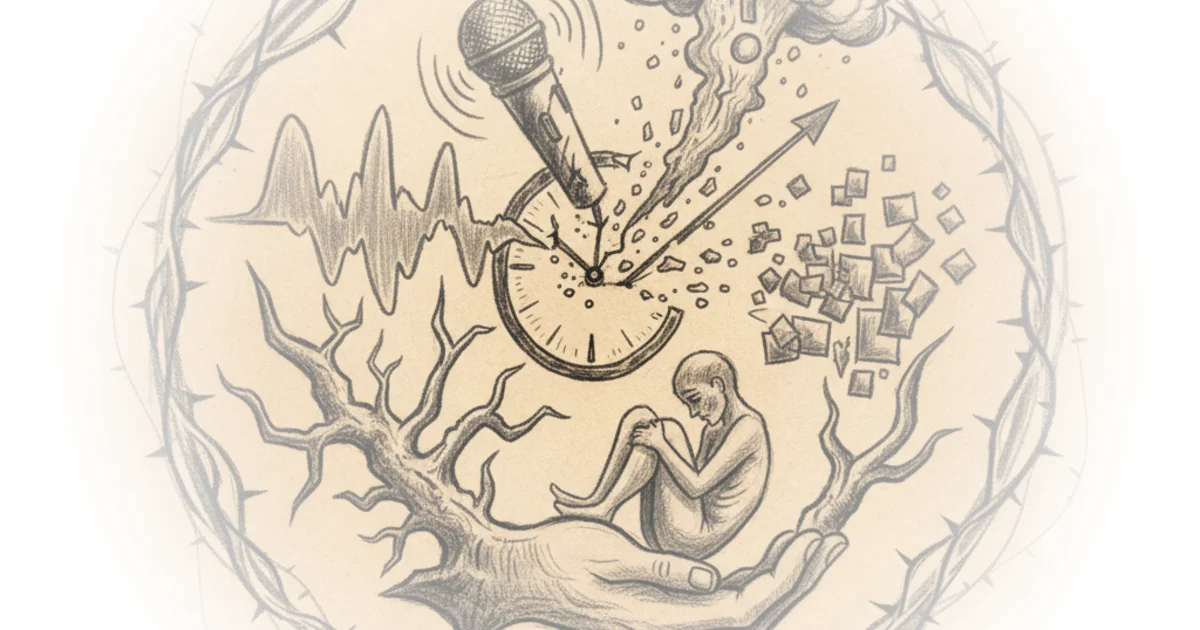
The commentary underscores a grim reality: the lack of capacity is forcing difficult choices. Chappell notes that overcrowded housing and the risk of infection in waiting rooms have led many to stay home, effectively removing them from the official count. "You can't really blame them when you're... stories about people going to four to four or five or six hospitals a day trying to get seen," he explains. This framing shifts the blame from individual negligence to institutional failure, suggesting that the "mess" in China is a direct result of a system that cannot absorb the shock of a pandemic.
"It's not a conspiracy theory, it's a fact."
Chappell argues that the initial suppression of information was not a fringe theory but an established reality. He references the detention of doctors who attempted to warn colleagues in private WeChat groups in late December, illustrating how the lack of independent watchdogs and an independent judiciary prevents early detection. The administration's response, framed as a "people's war," relies on blanket cover-ups and the punishment of officials rather than transparent data sharing. "There is no way for people to blow the whistle on corruption that would require... an independent judiciary," Chappell asserts, pointing out that the recent introduction of a whistleblower hotline on WeChat is a performative gesture in a system where trust has already been eroded.
The Politics of Secrecy and Speculation
As the broadcast progresses, Chappell addresses the rumors swirling around the highest levels of the Chinese government. The sudden absence of state media appearances by President Xi Jinping and the circulation of clips showing him coughing have fueled speculation about his health or even a coup. Chappell is careful to distinguish between spreading rumors and analyzing the political vacuum they create. "I am spreading the news about the rumors; it's a very different thing," he clarifies, while noting that the state media's insistence on Xi's personal direction of the response feels increasingly like a desperate attempt to project stability.
The discussion also turns to the geopolitical implications, particularly regarding Hong Kong. Chappell highlights the tension between the virus and the ongoing protest movement, noting that while the virus might temporarily dampen street protests, it ultimately fuels anger against the Communist Party. "Any CCP official that's hoping that is ridiculously short-sighted because one of the results of this is gonna be that it just makes people more angry," he argues. The virus has become a flashpoint for distrust, with residents protesting the placement of quarantine centers and demanding transparency that the government is unwilling to provide.
Critics might note that Chappell's reliance on rumors regarding the leadership's health, even when framed as speculation, risks lending credence to unverified claims that could destabilize markets further. However, he balances this by emphasizing the historical context of SARS and MERS, where the true origins and timelines of outbreaks were often only understood years later. "We don't have the real numbers of SARS only today," he reminds the audience, suggesting that the current confusion is a predictable outcome of a closed system.
The Origin Question and the Cost of Censorship
The conversation inevitably drifts to the origin of the virus, with Chappell addressing the debate over whether it stemmed from bats, civet cats, or a laboratory leak. He notes the confusion surrounding the location of the Wuhan Institute of Virology relative to the wet market, acknowledging that while the "wet market" narrative is dominant, the scientific consensus is still evolving. "I think we won't know for months if not years," he cautions, drawing parallels to the delayed understanding of SARS and MERS origins.
Perhaps the most poignant moment of the commentary comes when Chappell addresses the platform censorship he faces. He reveals that YouTube has demonetized their coronavirus coverage, a move he interprets as a form of indirect censorship. "If for a news show that needs money to function if they can't talk about the news right then there you go," he says, linking the financial suppression of news to the broader theme of information control. This parallel between the Chinese government's suppression of facts and the platform's suppression of revenue streams creates a powerful, if uncomfortable, symmetry.
Bottom Line
Chappell's most compelling argument is that the Chinese Communist Party's refusal to allow independent verification has turned a manageable health crisis into an unmanageable political disaster. The strongest part of this analysis is the connection drawn between the lack of rule of law and the inability to contain the virus early. The biggest vulnerability, however, remains the reliance on anecdotal evidence and rumors in the absence of official data, a necessary evil in a closed information environment. Readers should watch for how the administration's attempt to reframe the narrative as a unified "people's war" will hold up as the true death toll and economic costs become undeniable.