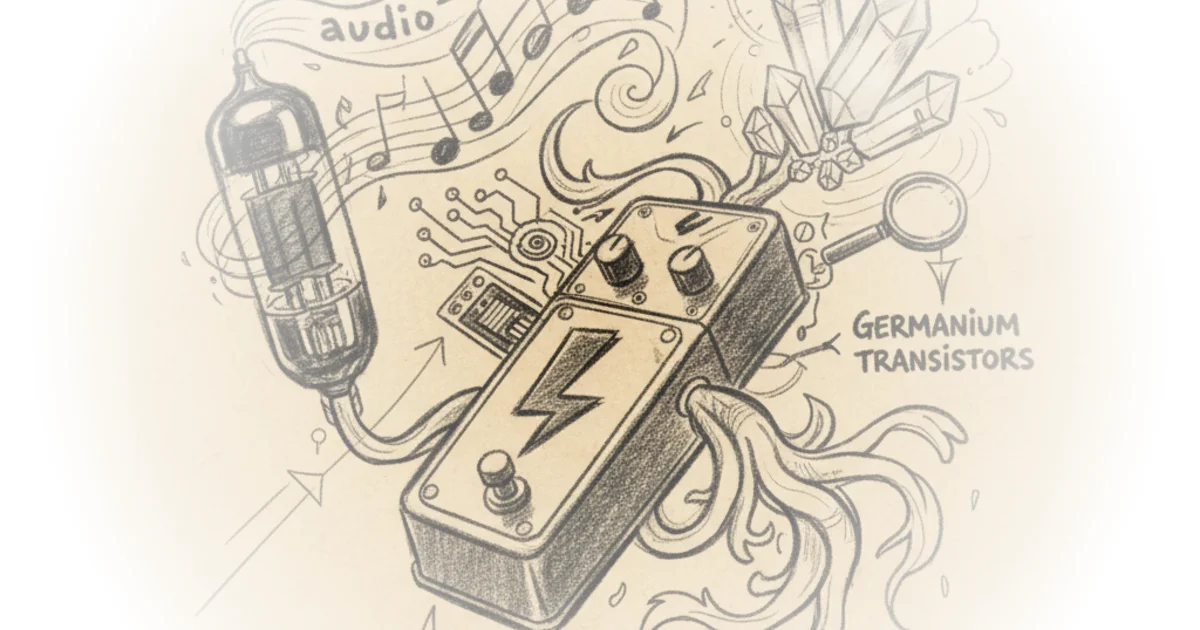
There's something almost mythological about germanium in guitar effect circuits — and Josh Scott's coverage makes that mythos tangible. In this episode, he's rebuilding an Electra circuit from scratch, walking through the classic schematic piece by piece while explaining why germanium transistors behave so differently from their silicon counterparts.
The Circuit Basics
Scott opens with a framing that's both informative and slightly humorous: "germanium is old it's finicky we love the word germanium it's in all the old fuzz faces all the old tone Benders it's exciting right it's finicky it's complicated it's kind of like Protools or some other software that hates you when you go to use it." The analogy works because it captures exactly what makes germanium so polarizing — it's notoriously difficult to work with, but when it clicks, something magical happens. He continues: "any Adobe people out there you know there's always the update it doesn't work and you're like my God I just need to edit that's what germanium is like but when it works It's So Glorious." This is Scott's thesis in action: germanium isn't for everyone, but the payoff justifies the struggle.
When it works, it's so glorious.
The core argument here centers on why this matters. Scott makes a critical distinction between silicon and germanium transistors: "your first question is how do I know what to buy any germanium transistor that's npn will work in this circuit if you buy p and p that's a different polarity." He's explaining that not all germanium transistors are created equal — specifically, the NPN versus PNP polarity determines whether they'll work at all. This matters because most hobbyists don't realize that grabbing random germanium parts from a grab bag could render their circuit completely non-functional.
The Bias Question
Scott walks through the collector resistor — 47k in this case — and frames it as something more than just a component value: "this is your collector right here so I'm going to run a 47k over to the red Power because that's what the schematic says to do now we learned again this is a variable part you can put a potentiometer here you can play around with it it's setting the bias of the circuit." The editorial framing is key: he's not just describing a circuit diagram, he's explaining how tone emerges from seemingly arbitrary component choices. The 47k resistor isn't just power regulation — it's the thing that determines how hard the transistor works, which directly controls gain and clipping behavior.
What Scott does well is connect this technical detail to actual sound outcomes. He's discussing feedback loops, emitter resistors (680 ohm to ground), and coupling capacitors (0.1 microfarad) not as abstract theory but as practical building blocks that shape tone. When he describes putting the 2 meg resistor between base and collector, he's explicit: "what this does is it allows current flow or proper definition leakage to happen between the base and The Collector."
The Modifications
A crucial part of Scott's coverage involves what happened when hobbyists modified the original Electra circuit. He describes how someone added hard clipping with two diodes, creating the classic modification many builders pursue: "they added this and this is key this is hard clipping they added two diodes and then they added a master volume and that changed the game." This is where his narrative gets interesting — he's showing how the original circuit was just a boost, but adding clipping diodes transformed it into something more aggressive. The history of tone bending, as he notes, involves these incremental discoveries by people working in their own shops.
The Practicalities
The most actionable part of Scott's coverage involves his breadboarding methodology. He explains the wiring sequence step-by-step: input jack tip to first line, ground path to blue line, VCC positive to the other side — but he frames it as something worth understanding rather than just copying. "a breadboard is only as good as it is you have to hook things up is what I'm saying you have to like actually hook things up to use it so it's all pretty but we got to do the connections." This is practical wisdom that distinguishes experienced builders from newcomers: the physical setup matters, and sloppy wiring creates noise.
Scott also discusses his own equipment choices — using a Switchback for true bypass, running signal through an Oxbox direct into a mixer — as part of a broader setup philosophy. The point isn't just building the circuit; it's understanding how the circuit fits into a complete signal chain.
Counterpoints
Critics might note that Scott's coverage assumes significant prior knowledge from earlier episodes in this series. For someone entirely new to building, jumping into episode 11 could be confusing — he references past lessons without fully restating them. Additionally, his approach to germanium selection (measuring specific gains) is mentioned but not demonstrated — viewers only see the end result, not the process of testing dozens of transistors to find ones that work.
Bottom Line
Scott's strongest contribution here isn't just technical instruction — it's the way he frames germanium as a kind of challenge worth pursuing. His argument that "when it works It's So Glorious" captures why hobbyists persist through finicky behavior, temperature sensitivity, and component variability. The biggest vulnerability is practical: building with germanium requires patience and deep knowledge that this single episode can't fully provide. But Scott's framing makes the case that persistence is rewarded — something every maker already knows in their bones.