Dave Borlace dismantles the prevailing narrative that Australian wildfires are merely a series of unfortunate, isolated weather events, revealing instead a terrifyingly precise recipe for disaster driven by human-induced climate change. While the world watched the smoke, Borlace dissects the scientific data to show how rising temperatures, altered ocean currents, and even the plants themselves are conspiring to create a self-reinforcing cycle of destruction that defies traditional fire management.
The Perfect Storm of Conditions
Borlace begins by grounding the catastrophe in the four non-negotiable requirements for a wildfire: weather, fuel, dryness, and a spark. He notes that while bushfires are natural, their current scale is not. "The overwhelming scientific evidence is that human emissions of carbon dioxide and other greenhouse gases are by far the main driver of increased average atmospheric temperatures," Borlace writes, citing data that 2019 was the hottest year on record for Australia. This is not a debate about whether the planet is warming; it is a forensic accounting of how that heat translates to ash.
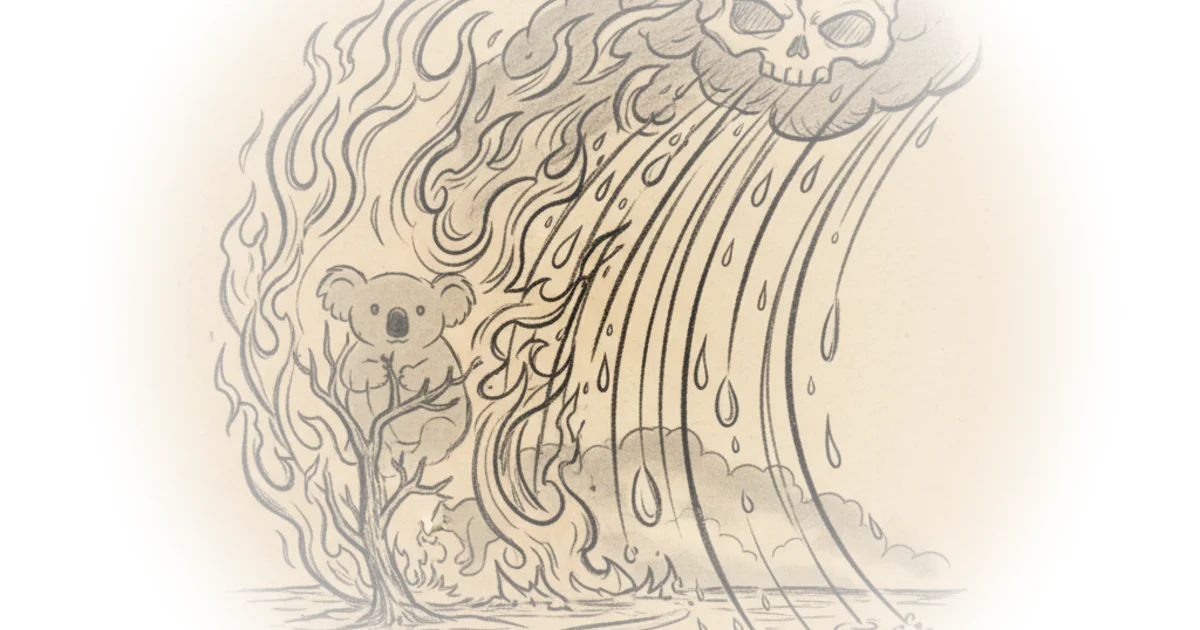
The most surprising insight Borlace offers concerns the fuel itself. He draws on research by Professor Andy Pitman to explain a counterintuitive phenomenon: higher carbon dioxide levels act as a fertilizer, causing vegetation to grow more lush and dense. "More carbon fixed or locked up in woody matter means more fuel for fire," Borlace explains. This creates a paradox where the very mechanism that seems to help plants grow actually loads the gun for the next fire. Critics might argue that more greenery implies a healthier ecosystem, but Borlace correctly identifies that without the water and nutrients found in controlled agricultural settings, this extra biomass simply becomes tinder waiting for a spark.
More carbon fixed or locked up in woody matter means more fuel for fire, and when that green vegetation drops its leaves, you've got even more potential fire fuel lying around on the ground.
The Mechanics of Drying
The commentary then shifts to the critical element of dryness. Borlace points out that 2019 was not just hot; it was the driest year on record, with rainfall 40% below average. He goes deeper than simple evaporation, highlighting how extended growing seasons—driven by climate change—cause vegetation to suck more moisture from the soil. "These longer growing seasons mean more moisture is being sucked up from the ground by trees and vegetation," Borlace notes, creating a feedback loop where the land is stripped of its ability to resist fire.
He further complicates the picture by examining oceanic patterns like the Indian Ocean Dipole and the Southern Annular Mode. These are not random fluctuations; Borlace cites a 2018 study in Nature Communications suggesting that as global temperatures rise, extreme positive phases of the Indian Ocean Dipole will double in frequency. "The frequency of extreme positive phase dipoles in the Indian Ocean looks set to double," he writes, linking a specific meteorological shift directly to human emissions. This reframes the disaster from a "bad luck" event to a predictable outcome of current policy trajectories.
The Ignition Myth and the New Normal
Perhaps the most vital part of Borlace's analysis is his dismantling of the arson narrative that gained traction in social media and political circles. He contrasts viral claims of a massive arson wave with the actual police data: only 24 people charged in New South Wales. "The main cause of fire ignition of Australia's bush fires is dry lightning," Borlace asserts, citing Professor David Bowman. This distinction is crucial; it shifts the blame from individual malice to systemic environmental failure.
The stakes are raised further by the emergence of pyrocumulonimbus storms—fire-generated weather systems that create their own lightning and winds. Borlace describes these as "horrendous meteorological events" that make fires "much more dangerous" and unpredictable. The conclusion is stark: the conditions are not just worsening; they are fundamentally changing the rules of engagement for fire management.
We're looking more like 3 degrees Celsius, and that's worrying because we're talking about this as a new normal.
Bottom Line
Borlace's strongest asset is his ability to connect disparate scientific threads—from soil moisture to ocean currents—into a single, coherent narrative of human causality. His argument is vulnerable only in its optimism that this analysis alone will spur action, given the political inertia surrounding climate policy. The reader must now watch not just for the next fire season, but for whether the global community can accept that the "new normal" is a trajectory toward three degrees of warming, a reality that renders current fire strategies obsolete.