The most counterintuitive finding in education research isn't that learning styles don't work — it's that nearly everyone who teaches believes they do. Derek Muller, a physicist turned video producer, wades into one of education's most persistent myths and emerges with evidence that's been hiding in plain sight for decades.
The Claim That Stuck
Muller opens by describing what every educator already knows: the VARK model divides learners into visual, auditory, reading/writing, and kinesthetic categories. "If information is presented in accordance with the learning style," he explains, "well then they'll learn better." This idea has become so embedded in teacher training that 90% of educators believe it — a statistic from a survey of nearly 400 teachers in the UK and Netherlands.
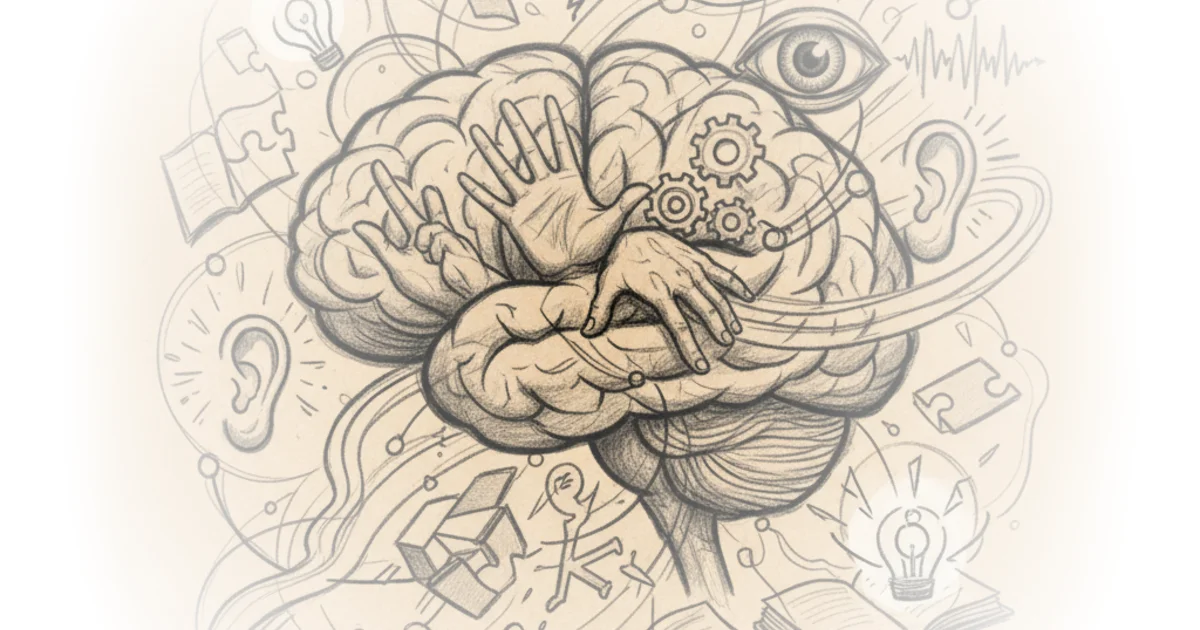
The argument gains weight when Muller points out what actually matters: multimodal approaches. "There's going to be words as well as the picture," he says, describing the multimedia effect. "We're going to see if this is any better... with 100% ultimately the most important thing for learning is not the way the information is presented but what is happening inside the learner's head."
Everyone learns better with multimodal approaches where words and pictures are presented together rather than either words or pictures alone.
The Experiments That Should Kill the Myth
Muller doesn't rely on anecdotes. He walks through a study that tested visualizers versus verbalizers — students who claimed they learned better from diagrams versus those who preferred text. The randomized control trial assigned students to picture-based or text-based lessons randomly, then gave everyone the same test. The results were unambiguous: "The students whose preferred learning style matched their instruction performed no better on the tests than those whose instruction was mismatched."
A 2018 study at an Indiana university adds more damning evidence. Over 400 students completed both a VARK questionnaire and a study strategy questionnaire. An overwhelming majority used strategies supposedly incompatible with their identified style — and the minority who didn't had no significant performance difference on assessments.
Where This Gets Uncomfortable
Muller makes a crucial observation about belief and evidence: "When we already believe the world to be a certain way then we interpret new experiences to fit with those beliefs whether they actually do or not." Teachers experience this constantly. When a visual learner responds well to a diagram, both teacher and student attribute success to learning styles — ignoring that the diagram might simply be a good diagram.
Critics might note that this analysis oversimplifies individual . Some students genuinely prefer certain modalities for specific tasks — geography with maps, music with audio. The claim isn't that people don't have preferences but that these preferences don't predict outcomes across domains. Muller acknowledges this nuance but argues the consistency is missing.
The origin story of VARK deserves skepticism too. Neil Fleming, a school inspector in New Zealand, created the model not from rigorous research but from observing teachers who reached some students and not others: "I was puzzled when I observed served excellent teachers who did not reach some learners and poor teachers who did... one topic that seemed to hold some magic... was preferred modes of learning." The word 'magic' is doing heavy lifting here — and Muller is right to highlight it.
What Actually Works
The multimedia effect isn't a theory in waiting. Research consistently shows that combining modalities improves retention by roughly 50%. Muller cites his own PhD work on physics education: explicit discussion of misconceptions was essential for learning. Active engagement — solving problems, imagining what happens when variables change — outperforms passive presentation regardless of style matching.
The practical takeaway cuts against everything teachers spend money on: "You are not a visual learner nor an auditory learner... you are all these kinds of learners in one." The best strategy involves multiple modalities for everyone, not customized approaches per student.
Bottom Line
Muller's strongest contribution is the empirical rigor applied to something most people consider sacred. His vulnerability is practical: if learning styles give teachers unnecessary things to worry about and make some students reluctant to engage with certain instruction types, what's the replacement? The evidence points toward multimodal teaching — but implementation details remain vague. The reader's next step: examine their own assumptions about how they learn, and test whether active engagement beats passive consumption regardless of format.