This conversation transcends a standard interview with historian Paul Kennedy; it is a masterclass in decoding why nations drift from cooperation to conflict. Jordan Schneider leverages Kennedy's unparalleled command of long-term historical trends to dismantle the simplistic notion that rising powers inevitably clash, revealing instead how geography, culture, and specific political choices dictate whether a new giant is embraced or feared. For listeners navigating today's geopolitical turbulence, the distinction between "jealous tribes" and "peaceful exchange" offers a vital framework for understanding why some transitions are bloodless while others ignite global conflagration.
The Anatomy of Suspicion
Schneider frames the discussion around a pivotal question from 1903 posed by German politician Eduard Bernstein, asking when nations view each other as rivals or partners. Kennedy's response is strikingly clear: international relations oscillate between two contradictory realities. "The entire question is this: When do we consider the position of one land to another in the manner of jealous, acquisitive tribes... and when do we consider it from the standpoint of a peaceful exchange of nations?" Schneider notes that Bernstein was optimistic then, yet history proved both views could coexist until one dominated the political imagination.
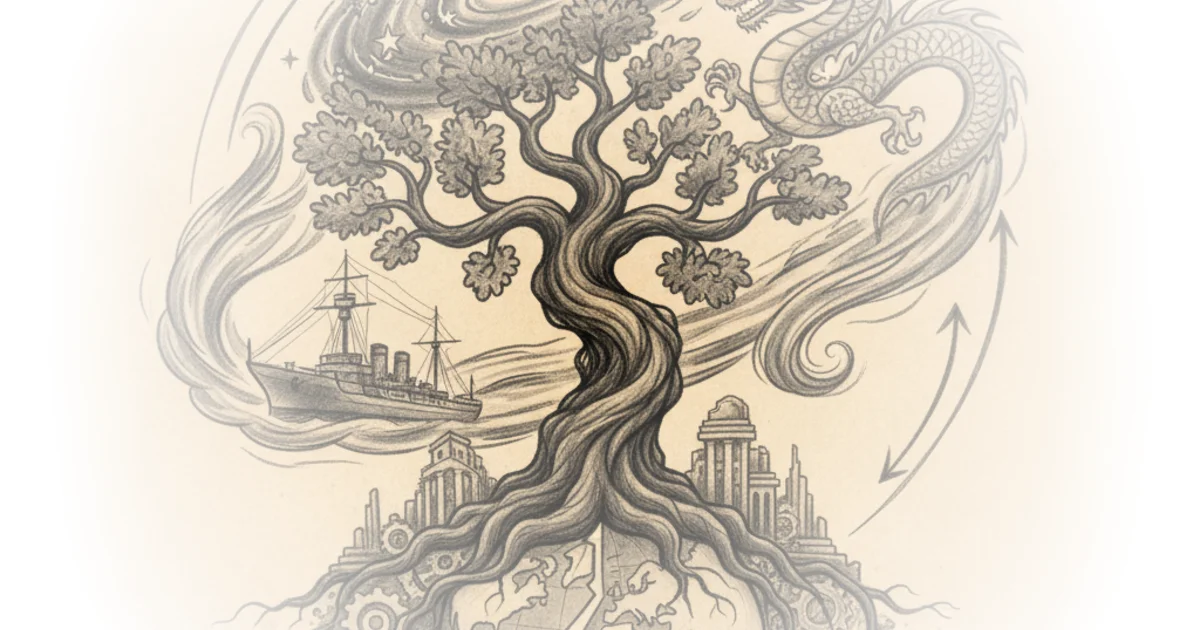
The commentary here is powerful because it refuses to accept "inevitability" as an excuse for war. Kennedy explains that in late Victorian Britain, liberal internationalists genuinely believed another nation's economic rise would expand markets and benefit everyone. This perspective held sway until a darker narrative took root. Schneider highlights how this shift wasn't just about economics but about perception: "Every one of those great chimneys pointing up into the sky are essentially great gun barrels pointing at England." This quote, attributed to newspaper magnate Lord Northcliffe after touring German factories in 1908, perfectly encapsulates how industrial capacity was reinterpreted as an existential military threat.
Every one of those great chimneys pointing up into the sky are essentially great gun barrels pointing at England.
The strength of Schneider's curation lies in showing how quickly benign trade can be recast as aggression when political leaders decide to view the world through a zero-sum lens. Critics might argue that Northcliffe's fear was not entirely unfounded given Germany's subsequent naval buildup, but Kennedy's point remains: the interpretation of that industry came before the threat materialized fully. The decision to see chimneys as gun barrels was a choice, not a law of physics.
Geography and the Great Divergence
Why did Britain embrace the rising United States while turning against Germany? Schneider guides Kennedy through this counterfactual, where two rising powers faced the same established hegemon with vastly different outcomes. The answer, Kennedy suggests, is rooted in "sheer distance" and "common language." He argues that a power 3,000 miles away is less threatening than one just "15 hours steaming across the North Sea."
Schneider effectively uses this historical lens to address modern anxieties about China. While acknowledging the echoes of the past, Kennedy points out a crucial difference: "Even today, with the rise of a much larger Chinese navy, the vastness of the Pacific still helps to temper or relativize the size and nature of that threat." This is a sophisticated nuance often lost in headlines. The argument suggests that geography acts as a buffer, allowing for a different kind of relationship than the one Britain had with Germany, which was hemmed in by proximity and ideological friction.
The discussion also touches on the role of elite culture. Schneider notes that American elites around 1900 identified strongly with Anglo-culture, whereas Germany was viewed as autocratic. This cultural alignment made it easier for British policymakers to trust the United States. "A good number of American politicians... grew up very much in this Anglo-historical tradition," Kennedy explains, contrasting this with the suspicion directed at Kaiser Wilhelm's erratic leadership.
A rising power on the other side of the Atlantic might have been a problem, but by 1903, American-Canadian relations and disputes had been resolved. So there was no hostile threat from this distant rising power across the Atlantic.
This section is particularly compelling because it challenges the idea that military capability alone drives conflict. Instead, Schneider and Kennedy show how domestic politics, cultural affinity, and even the personality of leaders (like the "erratic Kaiser") shape the trajectory of great power relations. The historical parallel to Eduard Bernstein's era reminds us that the "tribal" mindset is a political construct, reinforced by specific actors like Northcliffe who framed economic success as military danger.
The Fragility of Liberal Internationalism
The piece concludes with a sobering look at why liberal internationalist assumptions often crumble under pressure. Schneider asks if it is inevitable for these ideals to recede once a rival accumulates enough latent power. Kennedy's answer implies that the shift from "benign" to "malign" is driven by fear and the inability to escape mutual suspicion. He notes that while trade and cultural exchange existed, "if one won and prevailed, all would be well... If the other were true, then you had to keep your weapons sharp."
The narrative arc here moves from the specific case of Anglo-German antagonism to a broader warning about how systems break down. Schneider weaves in the lesson that "sweat the details" is essential; looking only at grand strategies misses the individual players and specific choices that lead to war or peace. The reference to Lord Northcliffe's tour serves as a stark reminder of how easily industrial progress can be weaponized in the public imagination.
Critics might note that this historical focus on 19th-century Europe risks underestimating the unique complexities of modern nuclear deterrence and economic interdependence, which make war less likely but also more catastrophic if it occurs. However, Kennedy's insistence on human agency—the choices made by leaders to view a rising power as a threat—remains a timeless warning.
Bottom Line
Schneider's conversation with Paul Kennedy offers a crucial corrective to deterministic views of geopolitics: great power conflict is not an automatic result of shifting economic balances but a product of specific political and cultural choices. The strongest part of this argument is the vivid illustration of how industrial chimneys were reimagined as gun barrels, proving that perception often precedes reality. The biggest vulnerability lies in assuming geography alone can prevent modern friction, yet the core lesson remains clear: understanding the "tribal" mindset is the first step to escaping it.