Doomberg opens with a claim that cuts through the noise of standard geopolitical reporting: a widely circulated story about a European leader's plane being disabled by jamming was not just exaggerated, but fundamentally fabricated. This piece matters because it exposes how easily the narrative of external aggression can be weaponized to shield internal policy failures from scrutiny. By dissecting the discrepancy between the breathless headlines and the mundane reality—a nine-minute delay rather than a navigational crisis—Doomberg forces a re-evaluation of who benefits from the chaos.
The Anatomy of a Fabrication
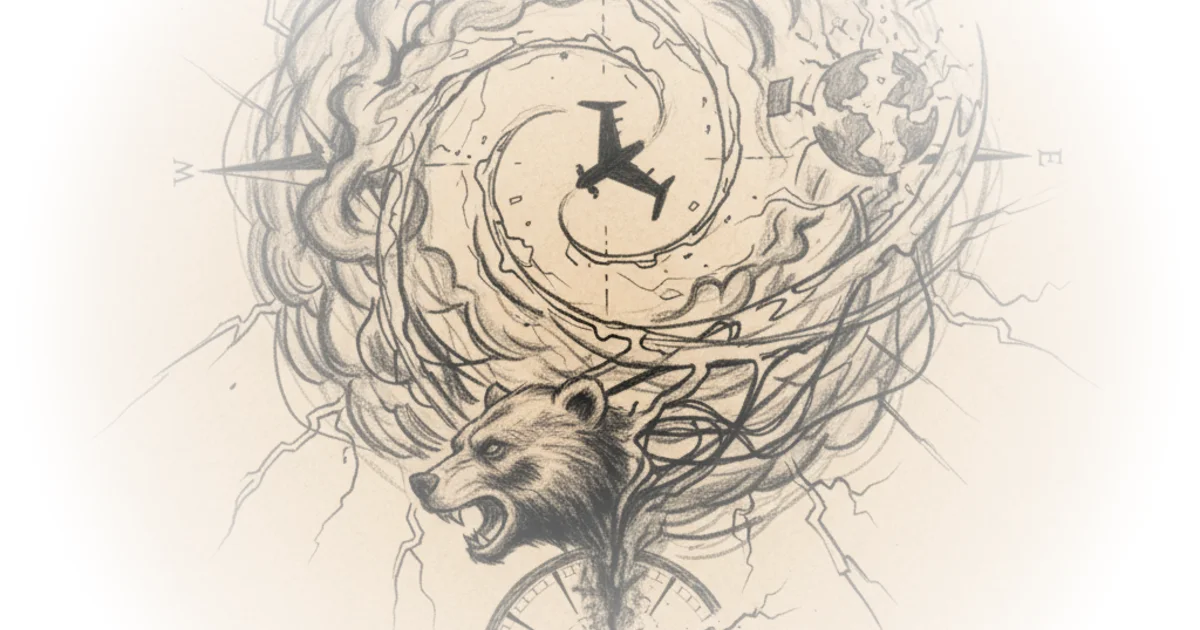
The author begins by dismantling the initial report from the Financial Times, which claimed a plane carrying European Commission President Ursula von der Leyen was forced to circle Bulgaria for an hour using paper maps. Doomberg writes, "We would link to the story, but the original has since been edited and most of the key claims—repeated countless times and breathlessly by news outlets around the world—were patently untrue." This observation is critical; it suggests a media ecosystem eager to amplify a crisis narrative without verifying the basic facts. The author notes that the plane landed only nine minutes late, a detail that renders the dramatic imagery of pilots scrambling with paper maps absurd.
Doomberg argues that the persistence of this falsehood serves a specific strategic purpose for the European leadership. "Keeping von der Leyen in her current role has to be one of Moscow's top strategic priorities," the author posits, suggesting that the Kremlin would not risk harming a leader whose policies are already so damaging to the European Union. This reframing is provocative. It shifts the focus from a potential Russian attack to the internal dynamics of the EU, implying that the current leadership is inadvertently doing the work of its geopolitical rivals.
The affair has since been largely memory-holed, yet the policies driving the continent toward economic fragility remain untouched.
Critics might argue that dismissing the jamming incident entirely ignores the reality of hybrid warfare, where disinformation is a standard tool. However, Doomberg's point stands: the specific details of this event were likely manufactured to distract from the fact that the European Commission is pursuing policies that accelerate deindustrialization.
The Green Deal as Economic Suicide
The commentary then pivots to the core economic argument: the disconnect between the European Commission's rhetoric on climate and the physical reality of energy scarcity. Doomberg highlights a passage from von der Leyen's 2025 State of the Union Speech, where she boasts of the Green Deal's success. "Already today, low-carbon sources account for over 70% of our electricity. We are global leaders in clean tech patents — better than the US, and racing with China," the author quotes. Doomberg uses this quote not to validate the claim, but to illustrate the tone-deafness of a leadership class that believes technology can replace the fundamental need for cheap, abundant energy.
The author contends that this confidence is misplaced and dangerous. "A constant refrain in these pages is that cheap and abundant energy is the bedrock of modern prosperity, and societies made poorer by fumbling elites tend to rebel," Doomberg writes. This is the piece's most urgent warning. It connects the abstract goals of carbon reduction to the tangible risk of civil unrest. The argument suggests that by prioritizing climate targets over economic stability, the EU is sowing the seeds of its own political collapse.
Doomberg further argues that the loss of cheap Russian energy has already triggered a crisis that the leadership is trying to suppress rather than solve. "To keep a lid on political unrest, the EU's leadership has suppressed political rebellion across the continent, using all manner of dirty tricks to subvert demands for change expressed at the ballot box," the author states. This is a stark accusation of democratic erosion. While the administration may view these measures as necessary for long-term stability, Doomberg frames them as a desperate attempt to delay an inevitable reckoning.
The Tipping Point
As the piece concludes, Doomberg warns that the patience of the European populace is wearing thin. The author suggests that the current economic malaise is not a temporary glitch but a structural failure. "On the path from abundance to starvation comes riot—first political, and then, if necessary, physical," Doomberg writes. This grim forecast serves as the climax of the argument, linking the specific policy choices of the executive branch to the potential for physical violence.
The author questions the sustainability of the current regime in Brussels. "With most of Europe mired in economic malaise and political turmoil, a tipping point may soon be reached," Doomberg observes. The piece implies that the "revolutionary change" is not a distant possibility but an imminent threat. The framing here is effective because it moves beyond policy critique to a discussion of regime survival. It asks the reader to consider whether the current leadership can maintain order when the economic foundation of their power has been eroded.
Critics might note that the prediction of physical riots is speculative and ignores the resilience of European institutions. Yet, the historical precedent of societies collapsing under the weight of energy poverty cannot be easily dismissed. The author's focus on the "human cost" of these policies—poverty, starvation, and unrest—grounds the abstract debate in a very real human tragedy.
Blindly staying the course on suicidal economic policies in the face of overwhelming evidence of their folly only further enrages the mob.
Bottom Line
Doomberg's strongest contribution is the unflinching link between energy policy and political stability, arguing that the EU's current trajectory is not just economically unsound but existentially dangerous. The piece's biggest vulnerability lies in its deterministic view of political collapse, which may underestimate the capacity for institutional adaptation. Readers should watch for how the administration responds to growing domestic dissent, as the gap between official rhetoric and lived reality continues to widen.