Peter Gelderloos cuts through the noise of partisan panic to deliver a startling thesis: the far Right's greatest threat isn't a sudden, violent coup, but a slow, strategic unraveling of democracy driven by entitlement and short-term greed. While many analysts fixate on the spectacle of January 6, Gelderloos argues that the real danger lies in a coalition of billionaires and fossil fuel executives who are happy to burn down long-term stability for immediate profit. This is a necessary correction for anyone trying to understand why the US is losing its global footing without a single tank rolling down Pennsylvania Avenue.
The Myth of the Imminent Coup
The piece opens by dismantling the popular narrative that the US is on the brink of a military takeover. Gelderloos points out that radicals and Democrats alike have been crying "coup" since 2016, yet failed to prepare the practical defenses an actual insurrection would require. He contrasts the chaotic events in Washington with the more organized, albeit failed, attempt by Jair Bolsonaro in Brazil. "Bolsonaro and his closest conspirators circulated detailed plans to different branches of the state and he got the support of high-ranking members of his government," Gelderloos notes, highlighting that the Brazilian attempt had the structural components a US uprising lacks.
The author's analysis of the US military's role is particularly sharp. He argues that the lack of support from command levels makes a traditional coup impossible, noting that the former president was effectively detained by his own Secret Service detail who drove him away from the Capitol against his will. "Trump had no support amongst command levels in the military, which is a sine qua non for a coup," Gelderloos writes. This reframing is crucial; it shifts the focus from a dramatic military seizure to a more insidious erosion of norms. Critics might argue that dismissing the coup narrative too quickly underestimates the potential for rogue elements or paramilitary groups to act outside formal chains of command, but the evidence regarding institutional loyalty remains compelling.
"The Right in Brazil had motivations for a coup, but these motivations weren't strong enough to get more key players involved."
The Engine of Entitlement
If there is no coup, what is driving the chaos? Gelderloos identifies a psychology of entitlement rather than strategic necessity. The argument suggests that the far Right is not trying to save the nation from collapse, but rather reacting to the loss of unearned privileges. "Cis people shouldn't have to acknowledge or allow the existence of trans people anymore. Cops shouldn't have to apologize for murdering Black people anymore," he lists, illustrating how the movement is fueled by a refusal to adapt to a changing world. This is not a strategy for governance; it is a tantrum against progress.
The author draws a stark contrast between this modern entitlement and the historical conditions that fueled 20th-century fascism. In the 1920s and 30s, nations like Germany and Italy turned to dictatorship because they faced existential threats, colonial competition, and the need to suppress internal revolution. "Germany and Italy had to amp up domestic repression to survive, and they had to go aggressive and start a war to create economic opportunities," Gelderloos explains. Today, the US faces the opposite problem: it is already the dominant power, yet it is "pissing them away." This historical comparison, reminiscent of the strategic shifts seen after the collapse of the Bretton Woods system in the early 1970s, adds significant depth to the argument that current instability is self-inflicted rather than externally forced.
Capitalism's Short-Term Suicide Pact
Perhaps the most damning section of the commentary is the analysis of why capitalists support the far Right. Gelderloos categorizes this support into three groups, arguing that for most, it is not a strategic long-term play but a surrender to monstrous short-termism. He singles out "quick return industries" like finance and fossil fuels, which prioritize immediate gains over the survival of the planet or the economy. "Their entire existence is predicated on extracting and selling as much as possible today and tomorrow, without thinking beyond that," he writes.
This is a brutal indictment of the current economic order. The author suggests that even billionaires who once posed as progressives, like Jeff Bezos, have capitulated to the far Right to maintain access to the state. "A capitalist has no ethic other than murdering life and turning it into profit," Gelderloos asserts, arguing that the moment they choose life, they lose their capital. This framing forces the reader to confront the uncomfortable reality that the destruction of democracy is not an accident, but a feature of a system that cannot function without the power of the state to enforce its will. A counterargument worth considering is that institutional investors often resist such radical shifts due to fiduciary duties, yet the data on market volatility suggests the author's point about short-termism holds weight.
"The far Right has been extremely effective at mobilizing, and their recruiting efforts are so dynamic that rightwing propaganda as well as congressional and bureaucratic tactics have raised the first serious challenge to the liberal paradigm in nearly a hundred years."
The Economic Reality
The piece concludes by grounding these theoretical arguments in hard economic data. Despite the political theater, the markets have not rewarded the chaos. "Under Trump stock market growth has been a hair over 0%, while in the previous ten years it grew an average of 11% every year," Gelderloos points out, noting the stagnation of the Dow Jones and the modest gains in the tech-heavy NASDAQ. This disconnect between political fervor and economic performance underscores the author's main point: the current trajectory is not a path to renewed greatness, but a slow decline that will increase poverty and regional conflict.
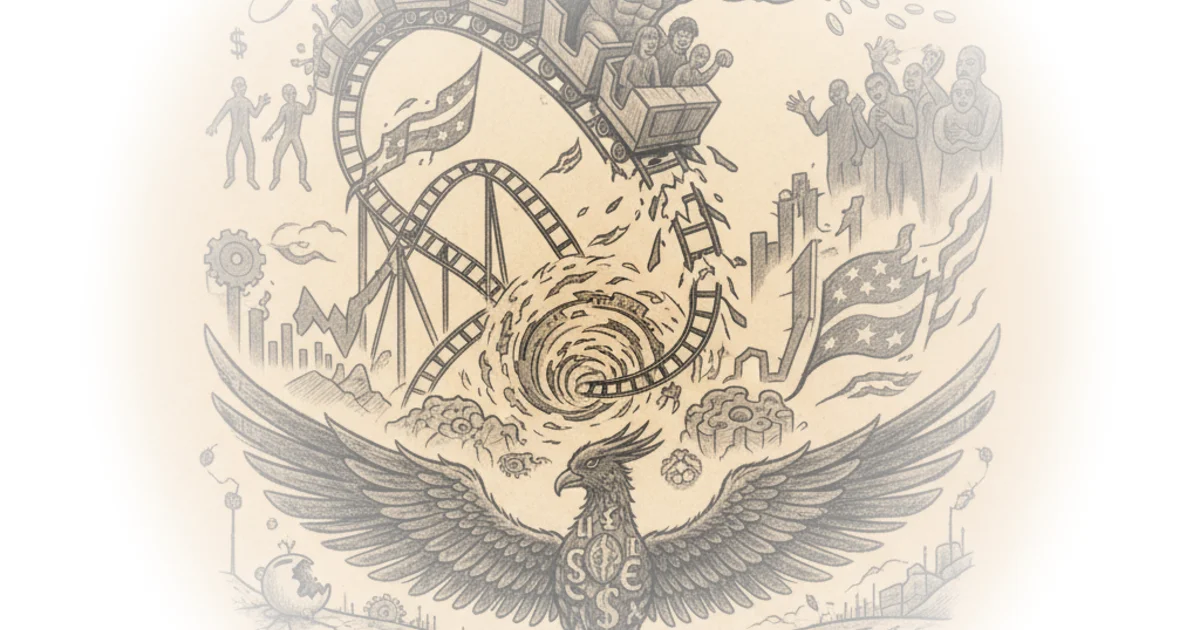
The author warns that before a new global coalition can step in to reorganize capitalism, the US will suffer greatly. "These changes will greatly increase the poverty experienced by people in the US and closely allied or dependent countries," he predicts. This is a sobering conclusion for a reader looking for a silver lining. The argument suggests that the real cost of this political rollercoaster will be paid by the most vulnerable, while the architects of the chaos retreat to their bunkers.
Bottom Line
Peter Gelderloos delivers a powerful, if bleak, diagnosis of the current political moment, successfully shifting the blame from a single leader's personality to the structural rot of entitlement and short-term capitalism. The strongest part of this argument is its refusal to be distracted by the spectacle of a potential coup, focusing instead on the quiet, steady erosion of institutions by those who profit from instability. Its biggest vulnerability lies in its deterministic view of capitalist behavior, which may underestimate the capacity for internal reform or resistance within the corporate class. Readers should watch for how the administration's policies continue to impact market stability and whether the predicted rise in poverty begins to manifest in the coming fiscal quarters.