This piece does not merely report a verdict; it exposes a chilling continuity in how American law perceives Black childhood. Kahlil Greene argues that the acquittal of Rick Chow for shooting 14-year-old Cyrus Carmack-Belton is not an anomaly, but the latest chapter in a century-long pattern where the courts treat Black children as inherent threats rather than victims needing protection. For listeners short on time but hungry for historical context, this analysis offers a critical lens: it connects a 2026 jury decision to the 1944 execution of George Stinney Jr., proving that the legal system's failure to see innocence in Black boys is a feature, not a bug.
The Anatomy of an Acquittal
Greene begins by dissecting the specific facts of the Carmack-Belton case, highlighting the absurdity of the prosecution's own narrative against the jury's conclusion. He writes that prosecutor Byron Gipson told the jury Chow "determined that Cyrus Carmack-Belton's life was worth less than four bottles of water." This stark comparison sets a moral baseline that the verdict immediately shattered. The evidence presented by witnesses like Laurie Anne Carson, who saw the boy running away looking "frightened and scared," should have been dispositive. Yet, as Greene notes, the coroner found a single gunshot wound to the lower right back—a fatal shot fired while the victim was fleeing—and no defensive injuries on the boy's body.
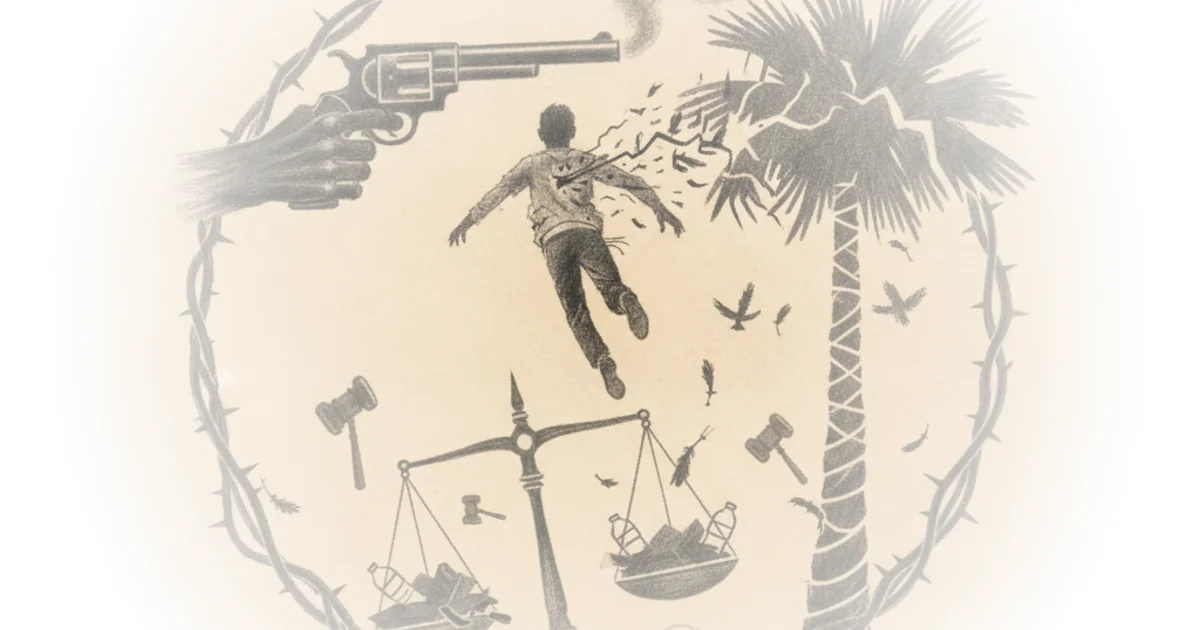
The defense relied heavily on claims that the teenager pointed a weapon at Chow's son, a narrative Greene dismantles by pointing out the lack of corroboration. In fact, the first officer on the scene testified that Chow admitted he never saw the gun pointed at anyone. Despite this, and despite a judge having previously barred the use of South Carolina's "stand your ground" law due to weak evidence, the jury acquitted Chow. Greene observes that this outcome is not surprising when viewed through the lens of the store owner's history; Chow had shot at suspected shoplifters twice in eight years and kept a wall of photos above his register. The author argues that the legal system consistently validates the fear of adults while dismissing the fear of Black children, turning a chase into a justification for lethal force.
In America, the courtroom has repeatedly functioned as a place where the killing of a Black child is made legally defensible, whether by condemning the child or by clearing the person who killed him.
Critics might argue that the jury's decision was based on the specific testimony regarding the gun, regardless of Chow's history. However, Greene effectively counters this by noting that the boy dropped his phone and backpack while running so hard he lost his shoes, behaviors inconsistent with an imminent threat to life. The disparity in how "fear" is interpreted depending on who feels it remains the crux of the injustice.
A Century of Erasure
To understand why a jury could find no crime in shooting a fleeing child, Greene reaches back 79 years to the execution of George Stinney Jr. In 1944, an all-white jury deliberated for roughly ten minutes before convicting the 14-year-old Black boy of murdering two white girls, leading to his execution by electric chair. Greene highlights the grotesque detail that officials had to sit Stinney on a Bible because he was so small his feet did not reach the floor. This historical anchor is vital; it shows that the legal mechanism for devaluing Black children's lives has existed for generations.
The author draws a direct line from Stinney to Emmett Till, another 14-year-old murdered in 1955 whose killers were acquitted after an hour of deliberation, and later to Trayvon Martin and Ahmaud Arbery. Greene writes that "very little separated" the case of Arbery's killers from Chow's: both involved men who chased someone they decided was dangerous and shot them. The difference in outcome—conviction for Arbery's killers versus acquittal for Chow—highlights a legal system where the application of self-defense laws is inconsistent and deeply racialized.
What matters is who is treated as the threat. Ask yourself, if Carmack-Belton had been white and the man chasing him Black, would the outcome have be the same?
This historical framing is powerful because it moves the conversation from a single "bad apple" shooter to a systemic institutional failure. Greene effectively uses these precedents to show that the acquittal in Columbia was not a sudden deviation but a reinforcement of an established norm.
The Mechanism of Dehumanization
The piece then shifts to the psychological underpinnings of these verdicts, citing a 2014 study by psychologist Phillip Atiba Goff. Greene explains that research proves Black boys are no longer granted the presumption of innocence starting around age 10; instead, they are perceived as adults who should know better. Participants in the study overestimated the ages of Black boys by an average of 4.5 years and judged them more responsible for alleged crimes.
This scientific context helps explain why a jury could view a 14-year-old boy running away with a gun (which he never pointed) as a legitimate target for lethal force, while viewing a 17-year-old white teenager like Kyle Rittenhouse carrying an AR-15 across state lines as someone acting in reasonable self-defense. Greene notes that "the armed white teenager received the benefit of the doubt that the fleeing Black child did not." The author argues that this dehumanization is the engine driving these disparate legal outcomes, transforming a child's flight into aggression and an adult's pursuit into protection.
For black boys, the questions come first, and the protection too often never comes at all.
A counterargument worth considering is whether the presence of a firearm on a minor changes the "child" status in the eyes of the law, regardless of race. Greene anticipates this by noting that Tamir Rice, who was holding a toy gun, was shot within seconds of police arrival and no officer was charged. The pattern suggests that the mere perception of threat attached to Black bodies overrides the physical reality of their age or the nature of the weapon.
Bottom Line
Greene's most compelling contribution is his reframing of "self-defense" not as a neutral legal standard, but as a racialized filter that determines whose life is worth protecting. The argument's greatest strength lies in its unflinching connection between historical atrocities like Stinney's execution and modern verdicts, proving that the law has consistently failed to see Black children as children. The piece's only vulnerability is its reliance on the assumption that the legal system could function differently, a hope that feels increasingly distant given the entrenched nature of these biases. Readers should watch for how this specific precedent influences future self-defense cases involving minors and whether the "threat" narrative can ever be successfully dismantled in courtrooms across the South.