A Fluffy Sphere of Surprises
Grant Sanderson's exploration reveals a mathematical principle that sounds absurd but governs everything from video game physics to atmospheric science.
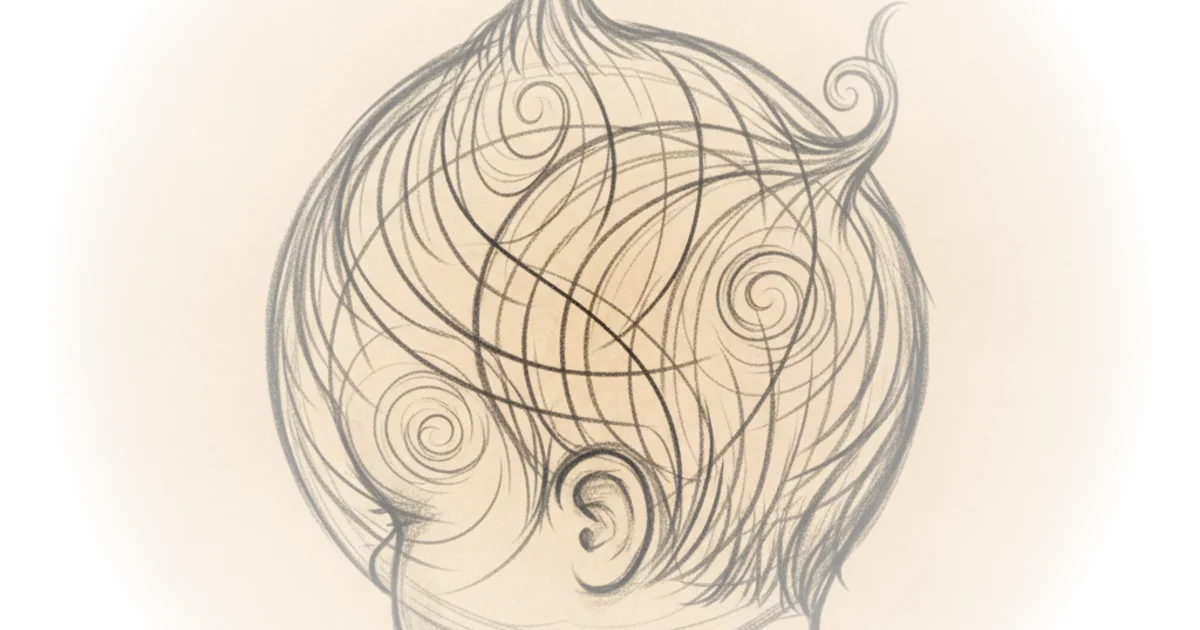
The hairy ball theorem states something seemingly ridiculous: if you cover a sphere in hair and try to comb it all flat, at least one tuft will always stick up. No matter how carefully you comb, you'll never eliminate the problem completely. The theorem sounds like a playful math joke, but it's actually a rigorous result with serious implications.
The formal statement is more precise than the informal version. Consider points on a sphere where each point gets assigned a tangent vector—a direction pointing away from that point in the plane touching the sphere at that location. This assignment of vectors to every point creates what's called a vector field. The hairy ball theorem guarantees that any continuous vector field on a sphere must have at least one point where the vector becomes zero.
This isn't just an amusing puzzle. The theorem appears in unexpected places.
Game Development's Hidden Problem
Imagine programming a 3D airplane model that follows an arbitrary path through space. The developer knows the nose should point along the tangent vector of the trajectory, but this leaves an open question: how should the plane rotate around its own axis? One might think you could simply choose any perpendicular direction for the wing and call it done.
But here's where the hairy ball theorem intervenes. Choosing a wing direction at every point is equivalent to defining a tangent vector field on a sphere. Since no continuous vector field can exist without at least one null point, the programmer will always encounter a glitch at some heading direction—where the plane's orientation jumps or breaks down.
This means game developers cannot resolve orientation from velocity alone. They must incorporate additional information from the trajectory to avoid these glitches.
Wind Patterns and Radio Signals
The same principle governs other practical scenarios. Consider wind velocity at constant altitude across Earth. Whatever continuous pattern you choose—no matter how realistic—the theorem guarantees at least one location where wind velocity is zero. Even if you dream up an entirely unrealistic pattern, you'll still find that one point of stillness.
Electromagnetic signals face the same constraint. A radio wave propagates with oscillations in electric and magnetic fields perpendicular to its direction of propagation. At a given distance from the source, these fields form tangent vector fields on a sphere. The hairy ball theorem demands at least one point where the signal becomes zero—meaning identical reception in every direction requires the signal itself to be zero.
"No matter how carefully you comb the hair flat, you'll always end up with at least one tuft sticking up."
Can You Get Just One?
The puzzle that makes this counterintuitive is whether reducing to a single problem point is even possible. Intuition suggests you'd need at least two null points—one for each direction of swirling—but that's wrong.
Using stereographic projection, you can achieve just one null point. Imagine light shining from the North Pole through every point on the sphere onto an XY plane. Each ray hits exactly one point in the plane, and vice versa. This creates a mapping where constant velocity on the plane projects to circles on the sphere that converge at the North Pole.
If you define a uniform vector field pointing right on the plane, projecting it back onto the sphere gives a field that's non-zero everywhere except at the North Pole—exactly one null point.
The Proof That Proves Impossible
How do we know this is unavoidable? The proof uses contradiction. If such a nonzero continuous vector field existed on a sphere, you could use it to turn that sphere inside out through continuous deformation. But turning a sphere inside out is mathematically impossible—a sphere cannot be continuously deformed in three dimensions without some point becoming zero.
This elegant argument was discovered by mathematician Sardare Vasser, who illustrated the core concept: for each point on the sphere, consider the vector from the field and slice along the plane defined by that vector and the radial line to the origin. Let the point move halfway around the resulting great circle in the direction of its assigned vector.
Bottom Line
The hairy ball theorem's strength lies in its universality—it emerges wherever continuous assignment of directions occurs. Its vulnerability is less obvious: the proof requires understanding deformation properties of spheres, which feels circular since we're proving impossibility by assuming transformation is possible. Yet this circularity is precisely what makes the argument beautiful and unassailable. Sanderson's piece demonstrates that seemingly playful mathematics often contains deep structural truths about how our physical world functions.