This piece cuts through the noise of routine trade disputes to reveal a chilling reality: for Beijing, the global market is not a neutral arena but a weaponized instrument of geopolitical coercion. The Walrus presents a stark warning that Canada's long-held belief—that commerce and politics can be kept in separate lanes—is not just outdated, but dangerously naive. In an era where supply chains are being repurposed as levers of control, the article argues that middle-sized economies are uniquely exposed to a new form of economic warfare that demands an immediate strategic reckoning.
The Collapse of Separation
The core of The Walrus's argument rests on the assertion that the illusion of independence between national security and international economics has been shattered. The publication draws heavily on the testimony of Michael Kovrig, the former diplomat detained in China, to illustrate the human and economic cost of this shift. "The core assumption behind Canada's China policy was simple: trade and politics could be kept in separate lanes," The Walrus writes, noting that this separation is now collapsing under the weight of retaliatory tariffs on canola.
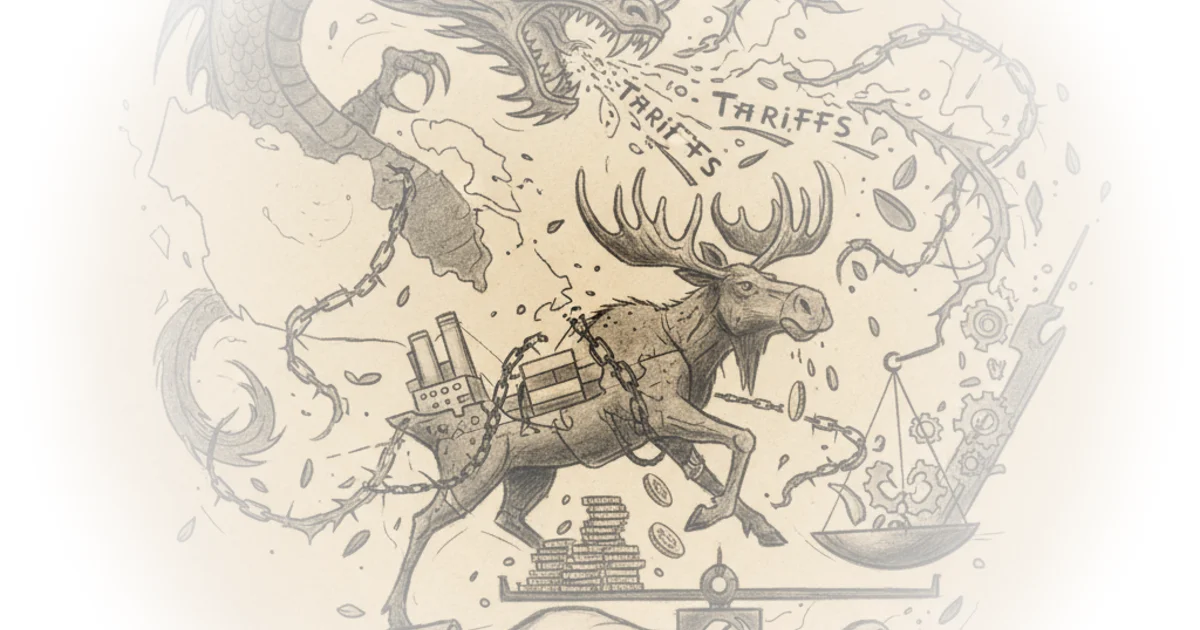
The article effectively reframes these trade barriers not as isolated economic grievances, but as deliberate acts of intimidation. It points out that Canadian agri-food giants, having ramped up exports after the 2018–2021 dispute, found themselves blindsided again. "Canadian canola businesses... apparently dreamed that the 2018–2021 dispute was a one-off," The Walrus observes, only to now lose most of a $5 billion market. This repetition is not accidental; it is a feature of a system where access to China's market is used as a disciplinary tool. The Walrus highlights that this is a global pattern, citing how Norway lost salmon exports after a Nobel Peace Prize was awarded to a dissident, and how Australia faced bans after calling for an investigation into the origins of the pandemic.
The CCP's grand strategy centres on its relentless, solipsistic pursuit of political, economic, and technological supremacy by building up what it calls 'Comprehensive National Power.'
Critics might argue that focusing solely on coercion ignores the genuine economic interdependence that still binds these nations, suggesting that total decoupling is neither feasible nor desirable. However, The Walrus counters that the logic has shifted from mutual benefit to a hierarchy where "great powers, like China, call the shots, middle powers adjust, and small states acquiesce." This framing forces readers to confront the possibility that the rules-based order is being replaced by a system where economic policy is explicitly "war by other means."
The Trap of Dependency
The commentary delves deep into the structural vulnerabilities of Canada's export profile, arguing that the country risks being relegated to a "deindustrialized, middle-income supplier of energy and commodities." The Walrus connects this economic reality to the broader strategic ambitions outlined in policies like "Made in China 2025," which prioritize self-sufficiency for China while forcing others into asymmetric dependence. "It's 'you have to buy from me, but I don't need you,'" the article paraphrases the CCP's stance, illustrating how massive subsidies create a "Second China Shock" that overwhelms global markets.
The piece draws a sobering parallel to the geopolitical context of the last decade, noting that the situation is exacerbated by the "capricious tariffs" and disruption of alliances from the United States. This creates a vacuum where states increasingly weaponize markets. The Walrus warns that if Canadian governments fail to act, the country's relationship with China will increasingly resemble that of Russia and other subordinate resource economies. The argument is bolstered by the historical context of the "reciprocity traps" mentioned in the text, where the CCP integrates foreign manufacturers into its supply chains to align their economic interests with Beijing's political goals.
Trade is war by other means. China's been working its way up the power ladder, and now even weaponizes interdependence with the European Union and US.
The Walrus suggests that the fear of retaliation is a critical, yet often unmentioned, factor in Canadian policy-making. This fear leads to self-censorship and a "prisoner's dilemma" where allies hesitate to act collectively for fear of being singled out. The article posits that this behavioral conditioning is already working, as governments and businesses scramble to avoid making the Communist Party angry rather than addressing the root causes of vulnerability.
A Path Forward or a Dead End?
Despite the grim diagnosis, The Walrus offers a potential off-ramp, rooted in the Chinese proverb: "Above there are measures, below there are countermeasures." The argument suggests that if Canada holds to a clear, consistent policy line and diversifies its economy, Beijing may eventually de-escalate to save face. The publication notes that the impact of blocking trade is often "one-shot, limited term, and self-harming," implying that persistence can force a recalibration. However, the path is fraught with difficulty, as Canada's reliance on the United States and the sheer scale of the Chinese market make diversification a painful, long-term endeavor.
The article concludes by emphasizing that the current tariff standoff is merely a symptom of a larger strategic divergence. "The current trade dispute is not the cause of rupture. It's a side effect of a much larger strategic divergence," The Walrus asserts, urging a move away from reactive crisis management toward a proactive strategy that hardens Canada against foreign interference. The piece warns that without this shift, the country risks becoming a prime target for coercion, serving as an example to others of what happens when a middle power fails to recognize the new rules of engagement.
Bottom Line
The Walrus delivers a powerful, if unsettling, analysis that successfully reframes trade disputes as existential geopolitical threats rather than mere market fluctuations. Its strongest asset is the integration of Michael Kovrig's lived experience with a rigorous breakdown of China's grand strategy, making the abstract concept of "economic coercion" viscerally real. However, the argument's biggest vulnerability lies in the sheer difficulty of execution: while the call for diversification and political hardening is sound, the article offers limited concrete steps for how a mid-sized economy can realistically escape the gravitational pull of a market eight times its size without incurring severe short-term pain.