Kenny Easwaran challenges the most common fear about artificial intelligence: that efficiency inevitably destroys jobs. Instead of focusing on specific algorithms or current headlines, Easwaran offers a historical lens that suggests the relationship between automation and employment is far more complex than a simple zero-sum game. For busy readers trying to navigate the noise of the AI revolution, this lecture provides a necessary theoretical framework that separates panic from economic reality.
The Paradox of Efficiency
The core of Easwaran's argument rests on a counterintuitive historical pattern. He introduces the Jevons Paradox, originally formulated by economist William Stanley Jevons regarding coal consumption, to explain why making things cheaper often leads to using more of them, not less. "When more efficient techniques were introduced efficiency did not mean that consumption went down but actually consumption went up," Easwaran writes. This is a crucial distinction for understanding AI; we often assume that if a machine can do the work of ten people, nine will be unemployed. Easwaran suggests that if the machine makes the output cheap enough, demand may explode, potentially absorbing the displaced labor.
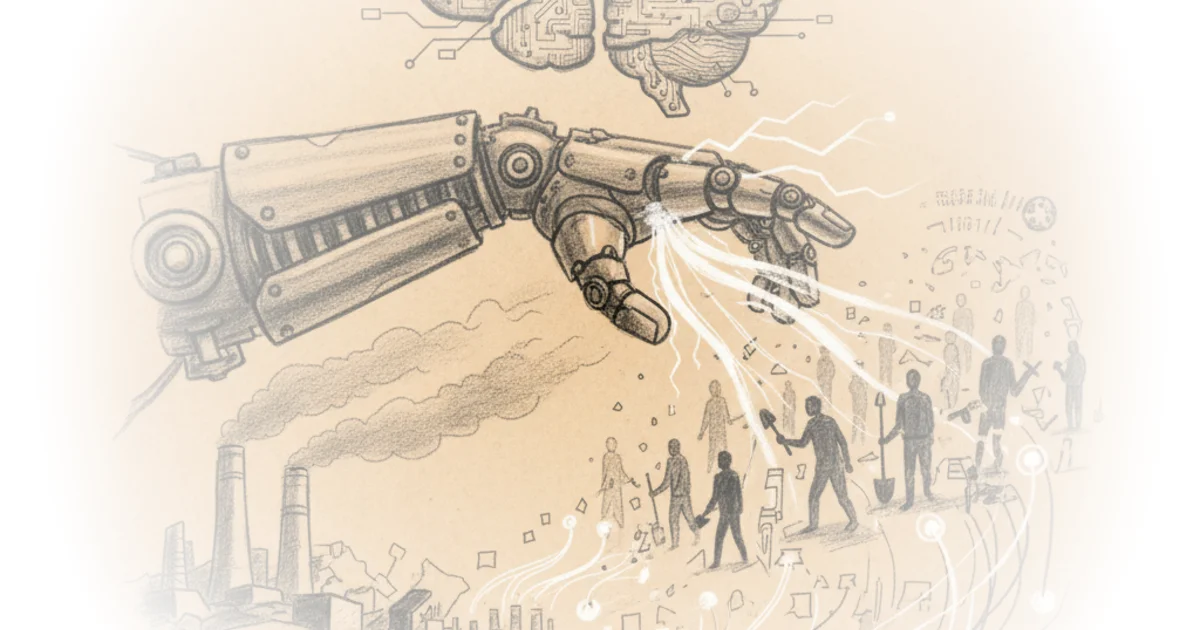
He illustrates this with the textile industry of the 19th century. Before mechanization, clothing was so labor-intensive that people owned very few items and repaired them constantly. As machines made cloth production cheaper, people didn't stop buying clothes; they bought more of them, wore different outfits for different occasions, and demanded higher quality. "By the middle of the century there were over a million workers working in textile mills in Britain and coal demand was skyrocketing," Easwaran notes. The efficiency didn't kill the industry; it expanded the market so massively that employment grew.
When consumption becomes more efficient often people start consuming more and then often the underlying good whose consumption became more efficient can sometimes go up.
Critics might argue that this historical precedent relies on tangible goods where demand is elastic, whereas the services AI targets—like legal analysis or coding—might hit a ceiling where human consumption doesn't scale indefinitely. However, Easwaran's point is that we cannot assume the ceiling exists without testing the market.
The Musician's Dilemma
Easwaran then pivots to a more nuanced case study: the music industry in the 20th century. Here, the Jevons Paradox did not fully materialize, offering a middle ground between total job destruction and total expansion. Technology allowed a single performance to reach millions, which should have decimated the need for live musicians. Yet, the number of employed musicians roughly doubled from 1900 to 2010. Why? Because new uses for music emerged that were previously impossible. "You would never have had a live band in the waiting room of a doctor's office if you had to hire all the musicians to play there but if you can just buy a recording you can uh do that," Easwaran explains.
The argument here is that while the nature of the work changed, the volume of work did not collapse. The productivity gains in recording and broadcasting created entirely new categories of employment, from jingles to background scores for video games. "Now that record music can be recorded for cheap you could an Advertiser can commission someone to write a song and they can play that song every time they play the ad," he writes. This suggests that AI might not eliminate jobs so much as it will shift them toward new, previously unimagined applications.
The Limits of Productivity
However, Easwaran is careful not to paint an overly optimistic picture. He introduces the concept of "Baumol's cost disease" to explain where productivity gains might fail to create new jobs. He points to the string quartet: no matter how advanced technology gets, a live performance of a Beethoven quartet still requires four people and the same amount of time. "The audience size that could fit into a concert hall to hear a live performance of a Beethoven string quartet remained the same no one's going there to listen to an amplified string portet," Easwaran observes. In these sectors, productivity is stagnant, meaning the cost of these services rises relative to goods that can be automated.
This creates a tension in the labor market. While some industries might see a boom in employment due to cheap, abundant output, others may face structural stagnation. "Productivity improvements are basically always benefits to the consumer who can either consume more of the re of the goods that are being produced or they can save their spending power for other goods and services but for the workers they can end up being either wins or losses," Easwaran concludes. The benefit to the consumer is guaranteed; the benefit to the worker is not.
The state of not having work has become conceptualized as a problem namely the of unemployment and I think it's important to note that the state of not being employed for wages outside the home is not by itself inherently problematic for the majority of human history.
This final point is perhaps the most profound. Easwaran reminds us that the anxiety surrounding unemployment is a relatively modern invention tied to the Industrial Revolution. "For the majority of human history the vast majority of people have not had anything like what we call a job and they haven't thought of that in particular as a problem," he argues. This reframing forces us to ask if our current economic structures are the only way to organize society, or if AI could force a necessary evolution in how we define meaning and resource distribution.
Bottom Line
Easwaran's strongest contribution is dismantling the linear assumption that efficiency equals job loss, replacing it with a dynamic view where demand can expand to meet new capabilities. His biggest vulnerability, however, is the time lag; history shows that while new jobs eventually emerge, the transition period can be devastating for specific generations of workers. The reader should watch for which sectors exhibit the "textile" response of exploding demand versus the "string quartet" response of stagnant productivity, as this distinction will determine the winners and losers of the AI era.