The paradox at the heart of poetry: every great poet learns from those who came before, yet each must develop a voice distinct from all predecessors.
This is the central challenge facing new poets—and it's the question this lecture addresses. Every poet belongs to some tradition and advances that tradition through their work. The task is identifying your tradition and finding new ways to express truths that earlier poets sang of.
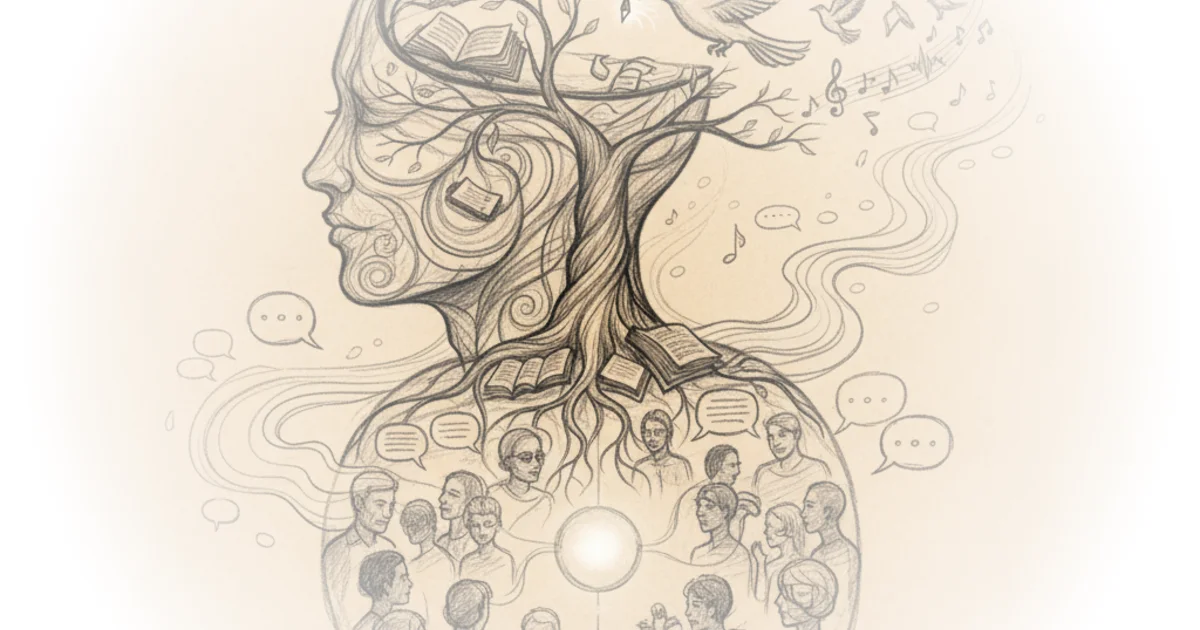
The path isn't linear, and no two poets arrive at their voice the same way. But across traditions—from classical rhetoric to modern MFA programs—a roughly four-stage process emerges: imitation, emulation, innovation, and inspiration. These stages sometimes overlap, and occasionally inspiration arrives before you've ever experimented with innovation.
The Creative Process
The poet's imagination is a house where two beings dwell: a daring, flamboyant creative force happily married to a stern, exacting judge. Becoming a poet means ensuring that marriage functions well.
Before discussing imitation and emulation, consider some advice from poet Wendel Barry—specifically his poem "How to Be a Poet." Three simple directives sit at its core: make a place to sit down, sit down, and be quiet. The essential ingredients for poetry are affection, reading, knowledge, skill, more of each than you have; inspiration, work, growing older, patience joining time to eternity.
Make a poem that does not disturb the silence from which it came.
What plowing the earth is to the farmer, what vespers is to the Cistercian monk, what filling the watering can is to the gardener—what waiting at the bus terminal with a bouquet of flowers is to the lover—is listening to the poet. You will do a lot of waiting in silence as a poet, and that's part of the process.
Parker Palmer offers useful advice: the soul speaks its truth only under quiet, inviting, and trustworthy conditions. The soul is like a wild animal—tough, resilient, savvy, self-sufficient, yet exceedingly shy. If we want to see a wild animal, the last thing we do is crash through the woods shouting for it to come out. But if we are willing to walk quietly into the woods and sit silently for an hour or two at the base of a tree, the creature may emerge.
So be silent often, and have patience with that wild animal—your soul.
Reading as Creative Work
Many people think writing means putting pen to paper or typing words. But writing is much more than that: it includes hours spent reading drafts, throwing away pages of poetry, rising early to stare at a blank page. It often includes despair, and sometimes includes victory.
Writing a dissertation meant discarding as much material as actually made it into the final product—and this is equally true for books of poetry. Those slim volumes on the shelf are like visible crests of an iceberg; vast bulk remains unseen beneath the water—all the drafts thrown out, all the revisions.
The creative process involves both hemispheres of the brain: the right and the left, the creative and the analytical.
Ian McGillchrist's influential book The Master and His Emissary argues that the right hemisphere—what he calls the master—apprehends the world in a holistic, creative, embodied, integrative way. It's living and attuned to relationship, metaphor, connections, empathy, and experience itself. It sees reality as interconnected and flowing.
The left hemisphere specializes in analysis, abstraction, categorization, breaking things into parts and handling language and logic. It's good at technical control but tends to reduce reality to what can be measured or represented. That's the emissary—useful and necessary, but it should serve the master.
McGillchrist argues that Western culture has allowed the emissary to usurp the master's authority, resulting in abstraction dominating over presence and meaning. The creative side—the right hemisphere—should be the master.
Finding Your Tradition
You begin as many poets have: by reading. But there's a certain kind of reading required for creativity, involving both hemispheres simultaneously.
When you read imaginatively, allow your imagination to take flight beneath the wings of what you're experiencing. Let it carry your intellect and analysis too. Surrender your imagination to the reading experience while remaining attuned to how those experiences are working—that's where the emissary comes in.
You want to experience what you're enjoying, but also be aware of what you're experiencing and why you're enjoying it. By bringing awareness to imaginative reading, you will understand who you are as a reader: how your own taste develops and which traditions are calling to you.
A wide, continuous range of reading reveals the company of poets you belong to. Which poets excite you? Which ones open your eyes to realities you were unaware of? Whose lines return to you throughout your daily tasks?
This is how you find your tradition—the company of poets revealed through right-hemisphere experience and left-hemisphere reflection.
Mary Oliver warns against thinking you should immerse yourself in contemporary poetry to fit in, avoiding older poets so their style doesn't affect you. She says this thinking is an error. The truly contemporary creative force is built out of the past but with a difference. To be contemporary means rising through the stack of the past like fire through a mountain—only heat so deeply and intelligently born can carry a new idea into the air.
Imitation and Emulation
Once your reading is underway—and for many it has long been underway—you've found a company of poets ready to begin that four-stage process. Let's discuss imitation first.
Imitation seems like a bad word these days, but when done correctly, it involves learning out of love. Learning from a poet or group of poets involves a rich theory of imitation dating back to the classical period.
One excellent book on this practice is Colin Burrow's Imitating Authors. In his research, Burrow found a passage from Lucretius's De Natura (book three) that metaphorically describes the relationship between a poet and predecessor—teacher, student, master, disciple—a chosen position.
Burrow has a wonderful translation of Lucretius addressing his master Epicurus as his predecessor: "You who out of the deep darkness first was able to raise a torch so clear, shedding light upon the true joys of life. It is you I follow, you glory of the Greek race, and in your deepest prince, firmly now I plant my footsteps, not in eager emulation, but rather for love, because I long to imitate you."
Lucretius distinguishes emulation as competition—this isn't how we'll use it in this lecture—but that distinction is interesting.
When you find a poet whose work feels like pure gold, you've found your teacher. Address a few lines of poetry to your favorite poets; make a connection between them. It's imaginative and creative, and actually helps.
Imitation means isolating an aspect of the poetry you love and trying to achieve the same skill. The left side of the brain—the emissary—helps find that. Perhaps it's John Keats: what excites you about his poetry? Maybe it's the rhythms. Study those rhythms and try to recreate them.
This is what painters call studies—little drawings done in preparation for a finished piece, like visual notes or practice. Mary Oliver recommends this approach too: before we can be poets, we must practice. Imitation is a very good way of investigating the real thing.
A poet develops their own style slowly over a long period of working and thinking about other styles. Among other things, imitation fades as a poet's own style emerges—that determined set of goals expressed in the technical apparatus that will best achieve those goals.
Counterarguments
Critics might note that this four-stage process, while historically accurate for certain poets, risks oversimplifying how creative voices actually emerge. Many contemporary poets don't follow these stages linearly or at all—some arrive at innovation without any period of imitation, and some find their voice by rejecting tradition entirely rather than engaging with it.
A counterargument worth considering: the framework assumes poets have access to literary traditions that may not be available to everyone. The assumption that reading widely reveals your tradition works for those with literary education but may not account for poets who come from non-canonical backgrounds or who find their voice in entirely new forms.
Bottom Line
The strongest part of this argument is its recognition that finding your poetic voice isn't a linear process—it's messy, iterative, and requires both creative imagination and analytical awareness. The lecture's greatest insight: "Make a poem that does not disturb the silence from which it came." That patience-first philosophy challenges the modern pressure to publish quickly and perform constantly.
The biggest vulnerability is its framing of tradition as something you discover rather than something you choose—a subtle but significant difference. And what readers should watch for next is how this patient, listening-based approach actually works in practice when contemporary poets are drowning in content demands and algorithmic visibility.