This isn't just another car review; it's a forensic accounting of how a beloved American icon was dismantled by a global conglomerate's obsession with shareholder returns. More Perfect Union exposes a disturbing pattern where quality was sacrificed not by accident, but by design, turning the Jeep brand from a symbol of durability into a vehicle for extracting maximum profit at the expense of the very workers and customers who built its legacy.
The Architecture of Decline
More Perfect Union begins by dismantling the narrative that the recent failures of the Jeep Wagoneer are merely isolated quality control issues. Instead, the author frames the situation as a systemic collapse rooted in the 2021 merger that created Stellantis. The piece argues that the new entity, formed from the combination of Chrysler, Fiat, and PSA, was never intended to produce the best cars, but rather the most profitable ones for investors. "The situation at Stellantis is I think the technical term a mess and a business strategy that's turned out well for shareholders at the expense of almost everyone else," the author writes, immediately establishing the stakes as a conflict between corporate efficiency and public utility.
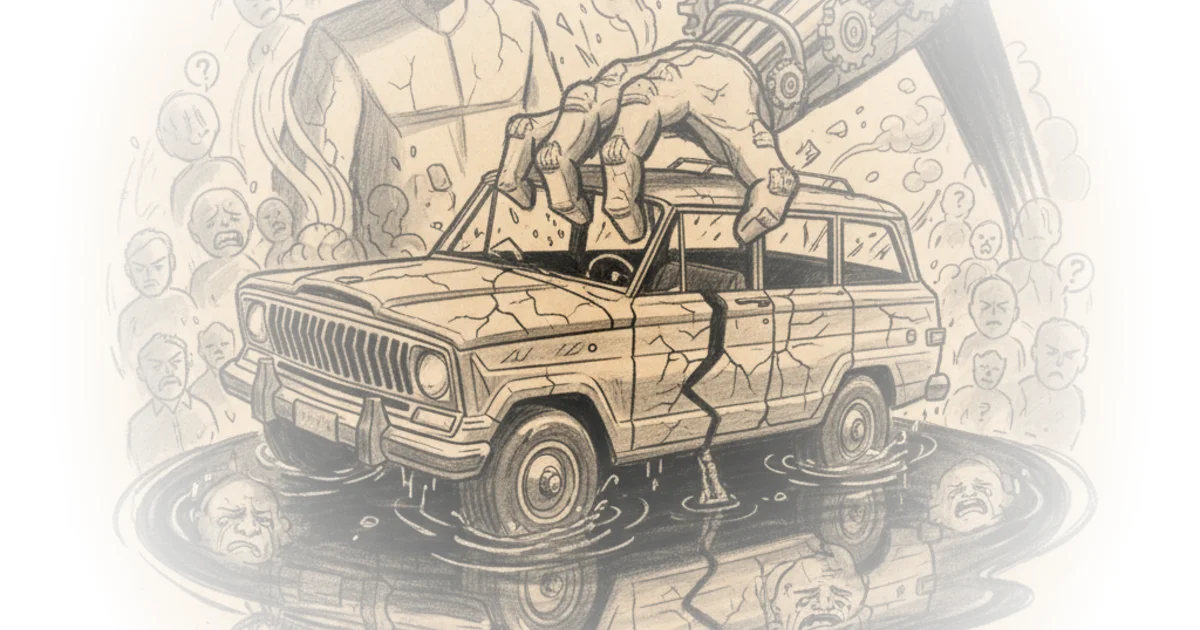
The coverage details how the new leadership, led by CEO Carlos Tavares, imported a philosophy of relentless cost-cutting that prioritized short-term margins over long-term brand health. The author notes that Tavares, a protégé of the controversial Carlos Ghosn, made it clear that "cost reduction is not becoming a taboo anymore... now everybody recognizes that the customers want affordability." This framing is crucial because it highlights the contradiction: the company claims to serve customers while systematically stripping the resources needed to do so. The evidence presented suggests that this wasn't a strategic pivot to luxury, but a degradation of the core product. As the author observes, "We're not producing what we used to and how we used to produce," a sentiment echoed by former workers who watched the factory floor transform from a place of craftsmanship to a site of rapid, cheap assembly.
"Stellantis is basically three semi nonfunctioning national automakers combined into one... and the business strategy has turned out well for shareholders at the expense of almost everyone else."
The argument gains weight when the author connects these corporate decisions to tangible community devastation. The closure of the Belvidere assembly plant is not presented as a market correction, but as a deliberate choice that hollowed out a town. The author points out that the plant was "the heart of Belvidere," and its shutdown cost the local economy millions. This humanizes the abstract concept of "efficiency." Critics might note that global automakers often struggle with overcapacity and that closing unprofitable plants is standard business practice. However, the piece effectively counters this by showing that Stellantis continued to post record profits while slashing jobs, suggesting the closures were driven by a desire to boost stock prices rather than a genuine lack of demand.
The Price of Greed
The commentary then shifts to the consumer impact, arguing that Stellantis attempted to rebrand Jeep as a luxury manufacturer without delivering luxury quality. The author highlights the jarring disparity between the price tag and the build quality of the new Wagoneer. "Jeep in the world is worth $115,000?" the author asks, channeling the confusion of customers who found plastic components replacing steel in vehicles that cost more than a mid-sized house. The piece cites specific failures: tires wearing bald in 15,000 miles, dashboard squeaks, and steering vibrations. These aren't minor annoyances; they are fundamental failures of a product that was supposed to be an upgrade.
More Perfect Union argues that this strategy was a calculated gamble. By raising prices significantly above the industry average, the company bet that brand loyalty would mask the decline in quality. "Stellantis kept prices high which meant people weren't buying their cars," the author explains, noting that inventory days stretched to 150 or even 200 days for some models. The evidence suggests the gamble failed spectacularly. While Ford and General Motors saw revenue growth, Stellantis experienced a sharp decline, proving that the market was rejecting the new value proposition. The author notes, "It is evident that something we are not doing right," a rare admission from a company that had previously blamed external market conditions for its struggles.
The piece also scrutinizes the compensation of the executive class versus the workforce. While the company laid off thousands and cut wages, CEO Carlos Tavares took home nearly $40 million, a sum described as "479 times as much as the average employee." This stark contrast serves as the moral core of the argument. The author writes, "The relentless cost cutting that let Stellantis grow its profits was starting to backfire," implying that the company's greed was its own undoing. The strategy of buying back stock while slashing jobs is presented as a final act of self-sabotage. "Despite the decline in revenue the company still managed to pull off roughly $2 billion in stock buybacks this year all while slashing jobs," the author states, underscoring the misalignment of incentives.
"Stellantis was like Wile E. Coyote running off the cliff and so long as they didn't look down they were fine."
The Path Forward
The final section of the coverage addresses the potential for course correction, particularly in light of Tavares's sudden departure. The author suggests that the new leadership might finally recognize that the old playbook is broken. The piece contrasts Stellantis's approach with Ford's strategy of investing in affordable electric vehicles, arguing that "choosing to invest rather than cut would be a radical shift in Stellantis business strategy." The author emphasizes that this shift is not just morally right but economically necessary. "If you're efficient at the sake of producing cars that people want when you're a car company that isn't going to work long term," the author warns.
The commentary also touches on the political dimension, noting the tension between the company's decision to move production to Mexico and the political promises made to keep manufacturing in the United States. The author highlights the irony that the company is moving jobs overseas while facing potential tariffs, a move that could further isolate it from the American market. The piece concludes with a plea for accountability, urging the company to honor its contractual obligations to the United Auto Workers and the communities it has abandoned. "We want to continue to do this," a worker says, capturing the frustration of a workforce that feels betrayed by the very brand they built.
Critics might argue that the global automotive market is shifting toward electrification and that high costs are an inevitable part of this transition. However, the author's evidence that competitors are managing this transition without sacrificing quality or jobs suggests that Stellantis's struggles are self-inflicted. The piece leaves the reader with a clear question: Will the new leadership choose to rebuild the brand on a foundation of quality and trust, or will they continue down the path of extraction that nearly destroyed it?
Bottom Line
More Perfect Union delivers a damning indictment of a corporate strategy that prioritized short-term shareholder gains over the long-term viability of an American institution. The strongest part of the argument is the clear link drawn between executive compensation, job cuts, and the tangible decline in product quality. The piece's biggest vulnerability is its reliance on anecdotal evidence from workers and customers, though the financial data provided supports the broader narrative of mismanagement. Readers should watch closely to see if the new CEO can pivot from a culture of cutting to one of investing, or if the damage to the Jeep brand is already irreversible.