In a landscape often dominated by abstract theology, this piece from Wayfare makes a startlingly physical claim: the soul is not a ghostly essence waiting to escape the flesh, but a union of spirit and body that must be felt to be understood. It challenges the reader to stop viewing their physical sensations as obstacles to holiness and instead treat them as the primary interface for divine communication. This is not a sermon on how to transcend the body, but a manifesto on how to inhabit it fully.
The Embodied Soul
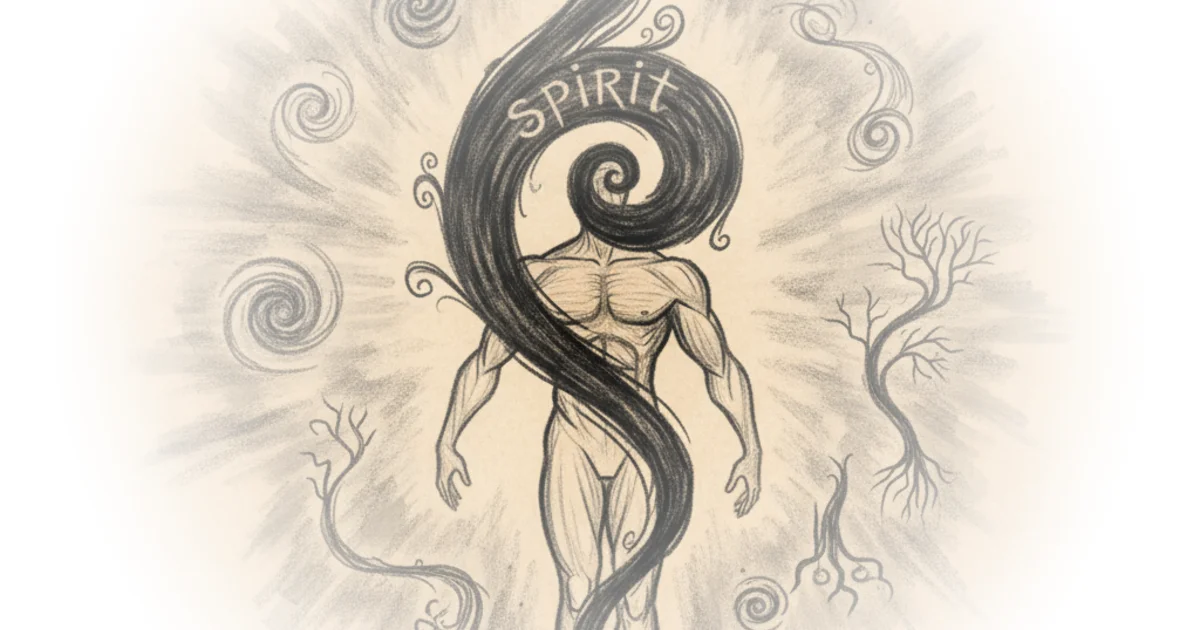
Wayfare reports that the traditional view of the soul often imagines it as "our sweet innocent spirit someday floating away on its own, untouchable, safe, harmless." The piece dismantles this dualism immediately, citing Doctrine and Covenants 88:15 to assert that "The spirit and the body are the soul of man." This reframing is crucial; it suggests that physical vulnerability is not a flaw in the design but a feature of the divine plan. The argument gains weight when it notes that even the adversary is defined by a lack of physical form, as Joseph Smith taught that "The devil has no body, [ that's ] his punishment." By grounding the soul in the material, the piece argues that physicality is the very thing that grants power over evil.
"Our bodies do tell us the truth. Not always, but we'll get to that in a minute."
The editors use visceral imagery to make this point stick, asking the reader to imagine a "12-foot-tall Kodiak grizzly bear" entering a chapel. In that moment, the body's reaction—fear—is undeniable truth. However, the commentary wisely acknowledges the fallibility of the flesh, noting that bodies can also lie, such as when we crave food we don't need or fear the dark in a safe room. This nuance prevents the argument from becoming a blind endorsement of every physical impulse. Critics might note that relying on bodily sensation can be dangerous if not paired with rigorous intellectual discernment, a risk the piece attempts to mitigate by emphasizing the need for practice.
The Mechanics of Discernment
The core of the argument shifts from theory to the messy reality of spiritual practice. Wayfare illustrates this through a personal anecdote where a missionary felt compelled to give a "Choose the Right" ring to a young woman, a move that defied standard protocol. The piece argues that such "peculiar prompting" is only recognizable to those who have "practiced by acting." This aligns with the historical precedent of Hildegard of Bingen, who, born in 1098, described her visions not as mental constructs but as physical realities she saw "wide awake, day and night," even while "fettered by sickness." Just as Hildegard's physical suffering did not negate her spiritual insights, the piece suggests our modern physical discomforts or strange urges might be the very medium through which the divine speaks.
"You must study it out in your mind; [and] then you must ask me if it be right, and if it is right I will cause that your bosom shall burn within you."
The article revisits the story of Oliver Cowdery to deconstruct the popular understanding of spiritual confirmation. While many expect a singular sensation, the piece points out that the scriptural record is far more diverse. Joseph Smith experienced a mind "enlightened," while others felt a "strongly pressing" sensation akin to stress, which led to the revelation on baptism for the dead. The editors note that the Nephites, upon hearing the voice of the resurrected Christ, experienced a cacophony of physical reactions: some were "pierced," some "quaked," and others felt their hearts "burn." This diversity of experience is the piece's most compelling theological contribution.
"Maybe it's a burning or a quaking or a piercing or a pressing or an enlightening—or maybe it is something else altogether."
By validating a spectrum of somatic responses, the piece counters the idea that there is only one "correct" way to feel the Spirit. This is particularly relevant in an era where spiritual experiences are often standardized or commodified. The argument holds up well against the counter-claim that subjective feelings are unreliable; the piece admits that feelings can be misleading but insists that the process of discerning them is the work of a lifetime.
The Human Cost of Disembodiment
The underlying tension in the piece is the danger of separating the spirit from the body. If the body is merely a temporary vessel, then its needs, pains, and desires are irrelevant. But the piece argues that this separation is a form of spiritual poverty. It draws a parallel to the abstract art of Franz Kline, whose figure studies (1910–1962) often reduced the human form to bold, structural lines, yet still conveyed a profound sense of presence. Similarly, the piece suggests that the "soul" is not found in the absence of the body, but in the intensity of its engagement with the world.
"Your body and your spirit make your soul. And they both, together, are vital, vital parts of your eternal soul."
This conclusion is not just theological; it is a call to action for how we treat ourselves and others. If the body is part of the soul, then neglecting physical health, ignoring pain, or shaming natural desires is a rejection of the divine. The piece ends by urging the reader to "Listen to your body. What is it saying?" This is a radical invitation to trust one's own physical intuition in a world that often demands we override our instincts for the sake of ideology or efficiency.
"Love them and listen to them both. Learn how to discern."
Bottom Line
Wayfare's argument is strongest in its refusal to treat the body as a secondary concern, successfully reframing physical sensation as a legitimate and necessary channel for spiritual truth. Its biggest vulnerability lies in the difficulty of distinguishing between divine prompting and biological impulse, a challenge it acknowledges but cannot fully solve with a simple formula. Readers should watch for how this embodied theology influences their own approach to decision-making, moving beyond abstract rules to a more holistic integration of mind, spirit, and flesh.