Brad DeLong channels Gary Marcus to deliver a sobering reality check to the AI investment frenzy: the era of easy profits from raw language models may never arrive. While the market buzzes with projections of Anthropic reaching $200 billion in revenue by 2028, DeLong highlights Marcus's counter-narrative that the industry is hurtling toward an "Airline Scenario"—a sector of immense utility that generates almost no economic profit for its providers. This is not just a financial critique; it is a fundamental challenge to the business models of the entire sector, suggesting that the massive capital currently being burned is a defensive scorched-earth tactic by tech giants rather than a path to sustainable value creation.
The Commoditization Trap
The core of the argument rests on the fragility of competitive advantage in large language models. DeLong writes, "The moats are shallow. Nothing stops a rival from offering a near-equivalent model—if only by distilling yours, training a cheaper system on the outputs of the expensive one you spent a fortune to build." This observation strikes at the heart of the valuation logic used by investors; if a competitor can replicate a model's performance at a fraction of the cost by training on its outputs, the premium pricing power evaporates quickly. DeLong notes that whatever frontier edge a company manages to open up "commoditizes fast: today's lead is gone in months."
This dynamic creates a cost structure that is hostile to profitability. Unlike traditional software where a product is built once and sold forever with near-zero marginal cost, AI models require perpetual reinvestment. "There is no write-once, run-forever, zero marginal-cost software dynamic here," DeLong explains, describing a "train and infer, train and infer" cycle that demands constant capital expenditure. Consequently, when companies report profits, they are often dressed in "adjusted operating income" and undisclosed math, which DeLong identifies as "the surest signal that the real profits are not there."
Durable value does exist in this business... But, in my view at least, it is highly unlikely to sit in the model. It sits in trusted data, in workflow, and in reliability.
This reframing shifts the value proposition away from the model itself and toward the "harness"—the curated datastores and deterministic pipelines that make the probabilistic output of an AI reliable for enterprise use. It is a distinction that echoes the historical shift in the airline industry, where the technology of flight became ubiquitous, but the real winners were often those who controlled the logistics and networks, not just the planes. Critics might argue that network effects could still create a monopoly on the model side if data access remains exclusive, but the rapid pace of open-weight model development suggests that exclusivity is increasingly illusory.
The Trojan War of Big Tech
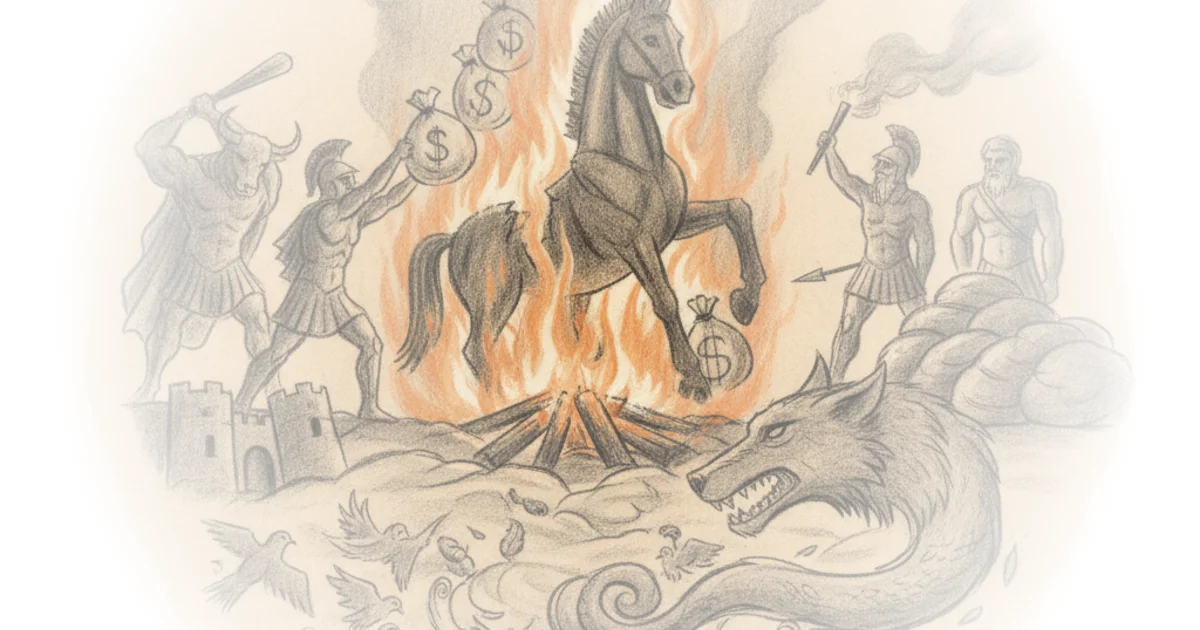
DeLong employs a vivid classical metaphor to describe the current market consolidation, casting Amazon, Facebook, Google, and Microsoft as Homeric heroes burning cash to eliminate rivals. "Amazon, Facebook, Google, and Microsoft are Agamemnon, Akhilleus, Odysseus, and Nestor," DeLong writes, illustrating how these giants are using their vast resources to ensure "no Anthropic, OpenAI, or other Hektor lives to see another sundown."
The analysis breaks down the specific strategies of these incumbents. Amazon is portrayed as Agamemnon, wielding "infrastructural and logistical" power through AWS to profit by outfitting everyone else's campaign. Facebook is cast as the volatile Akhilleus, whose "unbelievable raw force" depends on the moods of a single leadership figure, oscillating between sulking and aggressive open-source deployment. Google is the wily Odysseus, surviving through cunning and integration, while Microsoft acts as the veteran Nestor, advancing through wisdom and alliance-making. DeLong argues that their spending is "defensive" and designed to "protect the platform monopolies they already hold," leaving no room for new platform monopolies to grow.
This aggressive posture creates a high barrier to entry for any new IPO. DeLong warns that "Anthropic should study Netscape and its fate," suggesting that the current market environment is hostile to independent challengers who cannot match the capital reserves of the incumbents. The sheer scale of investment required to compete is not just about building a better model, but about surviving a price war where the giants are willing to operate at a loss to deny margin to others.
The Skeptic's Dilemma
Despite the strength of the bear case, DeLong acknowledges a troubling pattern in his own analytical history that warrants caution. He admits to having previously underestimated the resilience of Google and Facebook, believing their reliance on SEO and rage-bait would ultimately be self-defeating. "Selling your soul to SEO was not self-defeating. Neither was becoming the master necromancer of rage-bait doomscrolling," DeLong concedes. This admission adds a layer of humility to the piece, suggesting that the market's ability to monetize even flawed or commoditized technologies might exceed current pessimistic projections.
The specific financial claims surrounding Anthropic's upcoming IPO are dissected with skepticism. DeLong notes that bullish projections of "$100–150B of revenue" rely on "undisclosed math" and "hearsay on All-In," which he dismisses as insufficient evidence. He points out that the recent surge in revenue may be an anomaly driven by a "now-dead 'tokenmaxxxing' fad" and unique demand from SpaceXAI, rather than a sustainable trend. "Thus quadrupling that quarter's revenue to give Anthropic a $50 billion current run rate overstates the trend," DeLong argues, warning that investors are mistaking a temporary peak for a long-term trajectory.
The raw model, in other words, and almost surely the harness as well, is the cheap and commoditized part. The valuable part is everything wrapped around it.
This distinction is crucial for understanding where the real money will be made. If the model is a commodity, the profit margin shifts to the entities that control the data, the workflow integration, and the trust mechanisms. This aligns with the broader economic principle that in saturated markets, value migrates to the bottlenecks of reliability and distribution rather than the raw technology itself. However, the question remains whether the "harness" providers can also be commoditized, or if they possess the durability to capture the surplus value.
Bottom Line
DeLong's commentary, anchored by Marcus's skepticism, offers a necessary corrective to the hyper-optimism surrounding AI valuations, arguing that the industry is structurally predisposed to low margins due to rapid commoditization and high variable costs. The strongest part of the argument is the identification of the "Airline Scenario" as a likely outcome, where immense social utility does not translate into private profit for model providers. The biggest vulnerability, however, is the historical precedent of tech giants finding unexpected ways to monetize even commoditized services, as seen with Google and Facebook. Investors should watch not just the revenue numbers, but the ability of these companies to pivot from selling raw models to controlling the trusted data and workflows that actually drive enterprise value.