Perun cuts through the romanticized notion of military mobilization to reveal a brutal economic truth: nations consistently fail to transition from peace to war because they treat defense spending as a political afterthought rather than a strategic imperative. While most analyses focus on the generals' tactics or the technology of the day, this piece argues that the real bottleneck is often the invisible decay of industrial capacity during the quiet years between conflicts. In an era where global tensions are rising, understanding why countries repeatedly stumble over the same economic hurdles is not just academic—it is a matter of survival.
The Illusion of the Binary State
Perun begins by dismantling the common misconception that war economies are a simple switch from civilian goods to military hardware. "Historically, it might be tempting to think of war economies as essentially a binary state," Perun writes, noting that the reality is often a "crunching train wreck" rather than a seamless shift. The author correctly identifies that while technology and tactics evolve, the structural failures of mobilization remain stubbornly consistent across centuries. From shell crises to supply chain squeezes, the symptoms of poor preparation are identical whether the conflict is in the trenches of the Somme or the digital frontiers of modern warfare.
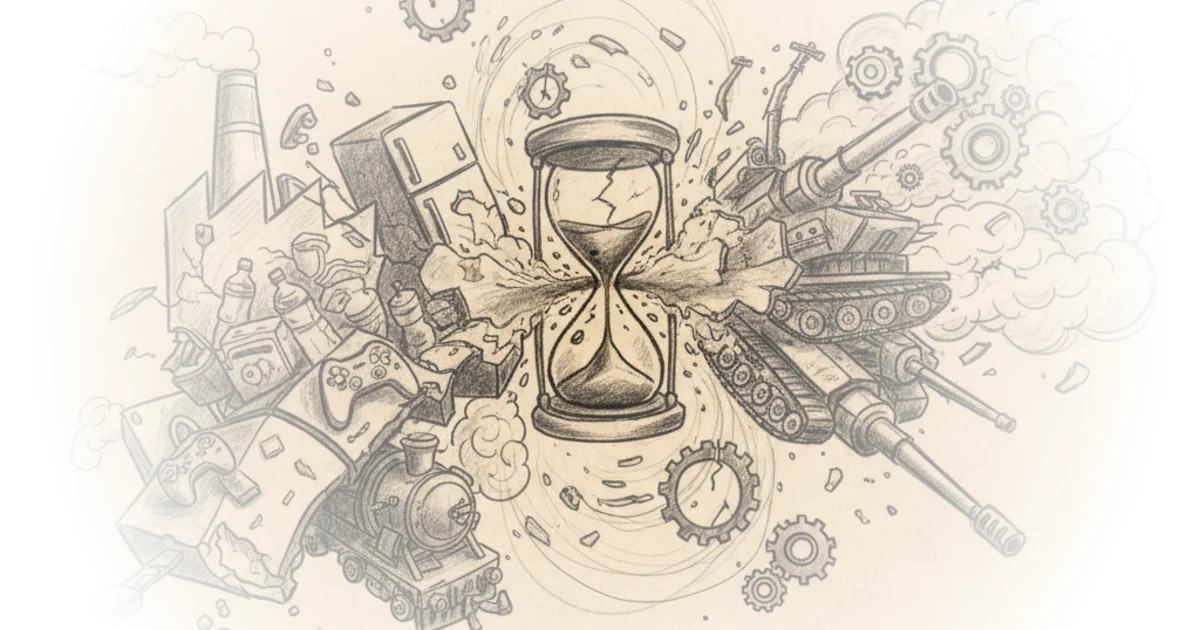
The core of the argument rests on the idea that the transition period is a distinct, critical phase that requires its own planning. Perun asserts, "If a nation is trying to be as effective and efficient as possible about its defense spending, it's got to bear mind to all three" phases: peace, transition, and war. This framing is powerful because it shifts the blame from mere bad luck to a failure of long-term strategic vision. It suggests that the inability to ramp up production quickly is a deliberate choice made during peacetime, not an unforeseen accident.
If in an emergency I can ramp up to producing enough ammunition in 6 months rather than 12 or 18, then maybe I can get away with having an 8-month stockpile rather than 19 or 20 months.
Critics might argue that modern just-in-time supply chains are too fragile to be easily reversed, making the "ramp up" argument optimistic. However, Perun's point is that the capacity to ramp up must exist before the crisis hits, a nuance often lost in debates about current logistics.
The Peace Time Paradox
The most compelling section of the commentary addresses why rational actors fail to prepare. Perun explains that while peace time offers the best opportunity to build capacity cheaply, political incentives work against it. "The first is that almost by our very nature for humans, preventive measures are seldom satisfying," Perun observes, highlighting the human tendency to ignore low-probability, high-impact risks until it is too late. This "complacency loop" is a universal human flaw, yet it has catastrophic consequences when applied to national defense.
The author further illustrates how democratic pressures exacerbate this issue. In a cabinet meeting, defense spending often loses out to health or education because "statistically speaking, most people don't vote on the basis of which party offers the best military procurement plan." This is a stark admission of the tension between long-term security and short-term political survival. The result is a "peak and trough effect" in spending, where nations overspend during a crisis and then slash budgets immediately after, dismantling the very industrial base they just paid to build.
Industry is often going to find ways to adapt to an environment of lower spending... They might optimize their supply chains and cut unnecessary costs wherever possible, noting that in peace time unnecessary costs might include things like, you know, slack capacity to produce a lot of stuff in an emergency.
This passage is particularly chilling in its description of "cost optimization" versus "ruggedization." Perun notes that after the fall of the Soviet Union, the US defense industrial base consolidated from 51 prime contractors to just five. This consolidation, while efficient for peacetime profits, creates a massive vulnerability when demand suddenly spikes. The author effectively argues that the market, left to its own devices during peace, will naturally eliminate the redundancy required for war.
The Strategic Cost of Failure
The commentary concludes by linking these economic failures directly to strategic outcomes. Perun argues that the ability to mobilize quickly is a form of deterrence in itself. "If I'm considering potentially picking a fight with a country, I shouldn't be concerned just with how powerful their military is now," the author writes. "I'm probably going to be concerned with how powerful it might be 6, 12, or 18 months in." This reframes defense spending not as a cost, but as an investment in preventing the need to fight at all.
However, history shows that nations rarely learn this lesson until they are already bleeding. Perun points out that even major powers like Britain have repeatedly "bungle[d] this part of the process," leading to unnecessary loss of life and treasure. The argument is that the "peace dividend" is often a false economy, saving money today only to pay a much higher price tomorrow.
The transition to war process has often varied from rough around the edges at best to an absolute crunching train wreck at worst.
Bottom Line
Perun's analysis is a masterclass in connecting economic theory to military reality, exposing the uncomfortable truth that our greatest defense failures are often self-inflicted during the calm before the storm. The strongest part of the argument is the identification of "slack capacity" as a necessary, yet politically unpopular, investment. The biggest vulnerability remains the political reality: until a crisis is imminent, no leader has the incentive to fund the redundancy that prevents the next crisis. Readers should watch for how current global powers are managing their industrial bases, as the gap between peacetime efficiency and wartime necessity widens every year.
The cheapest time to acquire military power is before fighting a war, yet it is the only time we are most reluctant to pay the price.